Thank you for visiting SNEWPapers!
Sign up free
Gazette Of The United States
Philadelphia, Philadelphia County, Pennsylvania
What is this article about?
On March 6 in The Hague, the National Assembly's first sitting elected Citizen Paulus as President unanimously, amid applause from assembly, ambassadors, and crowds. The assembly assumed control of the garrison, formed committees, and held sittings on March 3-4 addressing provincial regency, civic fetes, and diplomatic receptions, with debates over accusations against the President.
Clipping
OCR Quality
Full Text
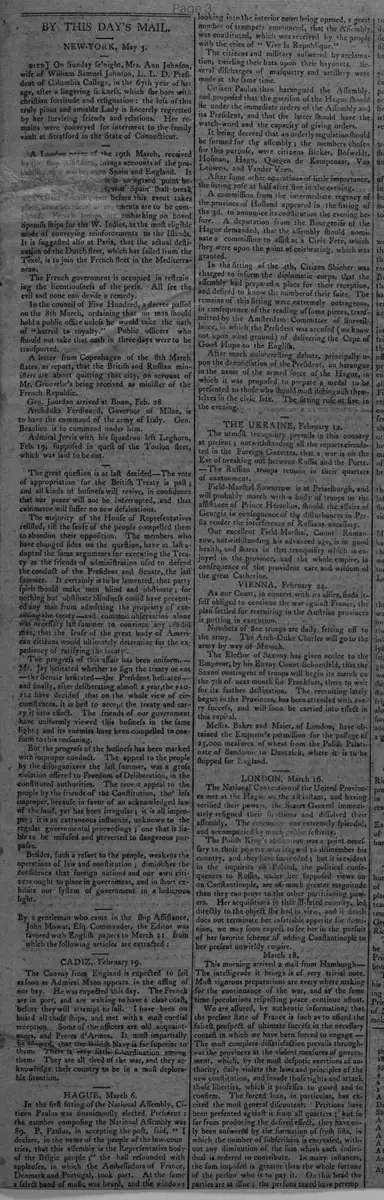
In the first sitting of the National Assembly, Citizen Paulus was unanimously elected President: the number composing the National Assembly was 89. P. Paulus, in accepting the post, said, "I declare, in the name of the people of the low-countries, that this assembly is the Representative body of the Belgic people;" the hall resounded with applauses, in which the Ambassadors of France, Denmark and Portugal, took part. At the same time a select band of music was heard, and the windows looking into the interior court being opened, a great number of trumpets announced, that the Assembly was constituted, which was received by the people with the cries of "Vive la Republique."
The citizens and military answered by acclamation, twirling their hats upon their bayonets. Several discharges of musquetry and artillery were made at the same time.
Citizen Paulus then harangued the Assembly, and proposed that the garrison of the Hague should be under the immediate orders of the Assembly and its President, and that the latter should have the watch-word and the capacity of giving orders.
It being decreed that an orderly regulation should be formed for the assembly: the members chosen for this purpose, were citizens Bicker, Boweldt, Homan, Hagan, Quagen de Kempenaar, Van Leuwen, and Vander Veen.
After some other operations of little importance, the sitting rose at half after five in the evening.
A commission from the intermediate regency of the province of Holland appeared in the sitting of the 3d. to announce its constitution the evening before. A deputation from the Bourgeoise of the Hague demanded, that the assembly should nominate a commission to sit at a Civic Fete, which they were upon the point of celebrating, which was granted.
In the sitting of the 4th, Citizen Schlicher was charged to inform the diplomatic corps, that the assembly had prepared a place for their reception, and desired to know the number of their suite. The remains of this sitting were extremely outrageous, in consequence of the reading of some pieces, transmitted by the Amsterdam Committee of Surveillance, in which the President was accused (we know not upon what ground) of delivering the Cape of Good Hope to the English.
After much uninteresting debate, principally upon the denunciation of the President, an harangue in the name of the armed force of the Hague, in which it was proposed to prepare a medal to be presented to those who should most distinguish themselves in the civic fete. The sitting rose at five in the evening.
What sub-type of article is it?
What keywords are associated?
What entities or persons were involved?
Where did it happen?
Foreign News Details
Primary Location
Hague
Event Date
March 6
Key Persons
Outcome
assembly constituted with 89 members; paulus elected president; garrison placed under assembly control; committee for regulations formed; commission for civic fete granted; diplomatic reception prepared; debates on president's alleged betrayal.
Event Details
The National Assembly held its first sitting, electing Paulus President who declared it the representative body of the Belgic people, met with applause, music, and public acclamation. Paulus proposed Assembly control over garrison. Committee selected for regulations. Sittings on 3rd and 4th addressed provincial regency announcement, civic fete commission, diplomatic invitations, and heated debates over accusations against President regarding Cape of Good Hope.