Thank you for visiting SNEWPapers!
Sign up free
The Washington Times
Washington, District Of Columbia
What is this article about?
In Frank Aldrich's trial for forging Judge Cole's endorsements on seventeen notes in Washington, the defense calls witnesses to question signature authenticity, traces note history, and Aldrich testifies denying forgery while revealing his past army convictions, pardon, and travels to Chicago, Mexico, Pittsburgh, Ohio, Cleveland, and Detroit.
Clipping
OCR Quality
Full Text
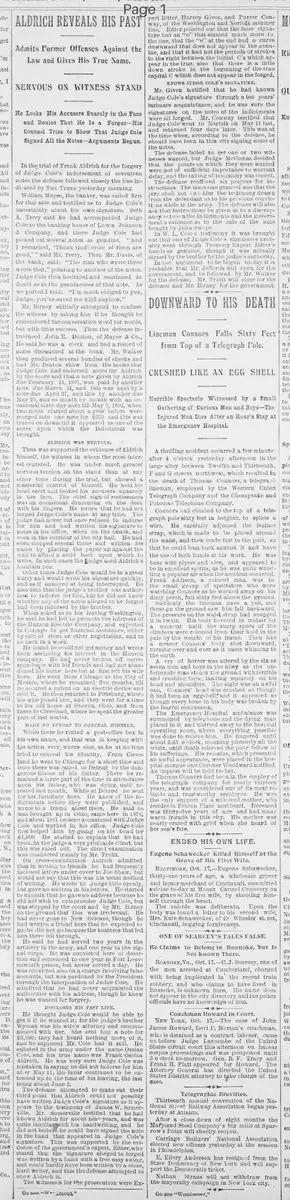
Admits Former Offenses Against the Law and Gives His True Name.
NERVOUS ON WITNESS STAND
He Looks His Accusers Squarely in the Face and Denies That He Is a Forger—His Counsel Tries to Show That Judge Cole Signed All the Notes—Arguments Begun.
In the trial of Frank Aldrich for the forgery of Judge Cole's indorsement of seventeen notes the defense followed closely the line indicated by The Times yesterday morning.
William Mayse, the banker, was called first for that side and testified as to Judge Cole's uncertainty about his own signature. Seth A. Terry said he had accompanied Judge Cole to the banking house of Lewis Johnson & Company, and there Judge Cole had picked out several notes as genuine. "And I remarked, 'Thank God! some of them are good,'" said Mr. Terry. Then Mr. Davis, of the bank, said: "The man who wrote these wrote that," pointing to another of the notes.
Judge Cole then hesitated and continued in doubt as to the genuineness of that note. As we parted I said: "I'm much obliged to you, Judge; you've saved me $225 anyhow."
Mr. Birney skilfully attempted to confuse the witness by asking him if he thought he remembered the conversation word for word, but with little success. Then the defense introduced John E. Benton, of Mayse & Co. He said he was a clerk and had a record of notes discounted at the bank. Mr. Walker then produced several bundles of checks and had Mr. Benton show from the books that Judge Cole had endorsed notes for Aldrich by the score and that a note given by Aldrich due February 21, 1891, was paid by another note due March 24, and this was paid by a note due April 27, and this by another due May 29, and so on month by month with an occasional sixty day note till May 9, 1892, when two notes started about a year before were merged into one note for $370 and this was traced on down till it appeared as one of the notes upon which the indictment was brought.
ALDRICH WAS NERVOUS.
Thus was supported the evidence of Aldrich himself, the witness in whom the most interest centered. He was under much greater nervous tension on the stand than at any other time during the trial, but showed a masterful control of himself. He held his head erect and looked his accusers squarely in the face. The chief sign of restlessness was an occasional drumming on the desk with his fingers. He swore that he had not forged Judge Cole's name at any time. The judge had never but once refused to indorse for him and had written his signature to notes in his office, when on the bench, and even in the corridor of the city hall. He had even stopped several times and written his name by placing the paper up against the wall to afford a solid back upon which to write. In such cases the judge used Aldrich's fountain pen.
Other times Judge Cole would be in a great hurry and would write his signature quickly, and as if annoyed at being interrupted. He also said that the judge's brother was authorized to indorse for him, but he did not know whether any of the notes alleged to be forged had been indorsed by the brother.
When asked as to his leaving Washington, he said he had left to promote the interests of the Hanson Electric Company, and expected in Chicago to get financial assistance, either by sale of stock or other negotiation, and to be back in a week.
He found he could not get money and wrote back assigning his interest in the Hanson company. He had never broken off correspondence with his friends and had not abandoned his home here but at first left his wife here. He went from Chicago to the City of Mexico, where he remained five months, till he secured a patent on an electric device and sold it. He then returned to Pittsburg, where his wife joined him, and they went for a time to his old home at Oberlin, Ohio, and from there to Cleveland, where he spent the greater part of last winter.
MADE NO EFFORT TO CONCEAL HIMSELF.
While there he rented a post-office box in his own name, and that was in keeping with his action everywhere else, as he at no time tried to conceal his identity. From Cleveland he went to Chicago for a short time and from there was called to Detroit by the dangerous illness of his father. There he remained a large part of the time in attendance upon his father, who was dying, until arrested last month. While at Detroit he sent for his furniture here. He knew of the indictments before they were published, and wrote to a friend about them. He said he was brought up in Ohio, came here in 1878, and about 1881 became acquainted with Judge Cole and worked in his office. Judge Cole first helped him by going on his bond for $1,000. He started to explain that he had brought the judge a very profitable client, but this was ruled out. The direct examination was conducted mainly by Mr. Truitt.
On cross-examination Aldrich admitted that in writing to friends he had frequently inclosed letters under cover to Joe Shaw, but would not say that this was his usual method of writing. He wrote to Judge Cole openly, but gave no address in his letters. He started to explain that he gave no address because he did not wish to compromise Judge Cole, but was stopped by the court and by Mr. Birney on the ground that this was irrelevant. He had never gone to New Orleans, though he had written a friend here that he expected to go; he did not go because the business that led him there fell through.
He said he had served two years in the artillery in the army, and one year in the signal corps. He was convicted here of desertion and sentenced to one year in Fort Leavenworth prison, but never served a day. He was convicted also on a charge involving false accounts, but was pardoned by the President through the interposition of Judge Cole. He admitted that he had never acquainted the authorities with his address, though he knew he was wanted for forgery.
DISCLOSES HIS PAST LIFE.
He thought Judge Cole would be able to get it if he wanted it; for the judge's brother Wyman was his wife's attorney and communicated with her. She sent him a note for $3,000; they had heard nothing more of it, and he supposed Mr. Cole had it still. He enlisted in the army under the name Ossian Cole, and his true name was Frank Ossian Aldrich. He was very sure Judge Cole was mistaken in saying he did not indorse for him after May 11; the favor continued to be extended up to the time of his leaving, the last being about June 2.
The defense attempted to make out their third point that Aldrich could not possibly have written Judge Cole's signature as it appears by the testimony of James W. Somerville. Mr. Somerville testified that he had known Aldrich for about nine years, and was quite familiar with his handwriting, and he did not believe he could have signed the note in the hand that appeared in Judge Cole's signature. This was supported by the evidence of the government's expert, Ritter, who stated that the signature alleged to be forged was written by a hand with a free easy swing, and could hardly have been written by a close, hard writer, and this the defense attempted to show Aldrich is.
The witnesses for the prosecution were Expert Ritter, Harvey Given, and Purser Conway, of the Washington and Norfolk steamer line. Ritter pointed out that the false signature had an "o" that slanted much more to the line, that the "e" at the end had a curve downward that does not appear in the genuine, and that it had not the periods or strokes to the right between the initial C's which appear in the true; also that there is a little down stroke in the beginning of the true capital C which does not appear in the forged.
KNOWS JUDGE COLE'S SIGNATURE.
Mr. Given testified that he had known Judge Cole's signature through a ten years intimate acquaintance, and he was sure the signatures on the notes of the indictments were all forged. Mr. Conway testified that Judge Cole went to Norfolk on May 11 last, and returned four days later. This was at the time when, according to the defense, he should have been in this city signing some of the notes.
The defense failed to get one or two witnesses wanted, but Judge McComas decided that the points on which they were wanted were not of sufficient importance to warrant delay, and the taking of testimony was closed.
The defense reoffered six prayers for instructions. The main one granted was that the jury shall not consider the testimony drawn from the defendant as to his previous convictions while in the army. The defense will also ask that instructions be given as to a discrepancy between the indictments and the government's evidence as to the sale of the note bought by John Swope.
In W. L. Cole's testimony it was brought out that one of Judge Cole's signatures probably went through Treasury Expert Ritter's hands as genuine, though it was actually signed by the brother by the judge's authority.
In the argument to be begun to-day it is probable that Mr. Jeffords will open for the government, and be followed by Mr. Walker for the defense. Mr. Truitt will close for the defense and Mr. Birney for the government.
What sub-type of article is it?
What themes does it cover?
What keywords are associated?
What entities or persons were involved?
Where did it happen?
Story Details
Key Persons
Location
Washington
Event Date
1892
Story Details
During Frank Aldrich's trial for forging Judge Cole's endorsements on seventeen notes, the defense presents witnesses testifying to Cole's signature habits and uncertainties, traces a chain of notes endorsed by Cole for Aldrich from 1891 to 1892, and Aldrich denies forgery, describes Cole's casual signing practices, reveals his army desertion conviction and pardon by Cole, and details his travels without concealment until arrest in Detroit.