Thank you for visiting SNEWPapers!
Sign up free
Gazette Of The United States, & Philadelphia Daily Advertiser
Philadelphia, Philadelphia County, Pennsylvania
What is this article about?
On June 20, the U.S. House passed a militia detachment bill for 80,000 men. A bill on duties for wine and spirits licenses was reported and committed. Debate ensued on raising an additional artillery corps, with speakers including Smiths, Giles, Shepard, Baldwin, and Williams arguing over necessity, costs, and fortifications.
Clipping
OCR Quality
Full Text
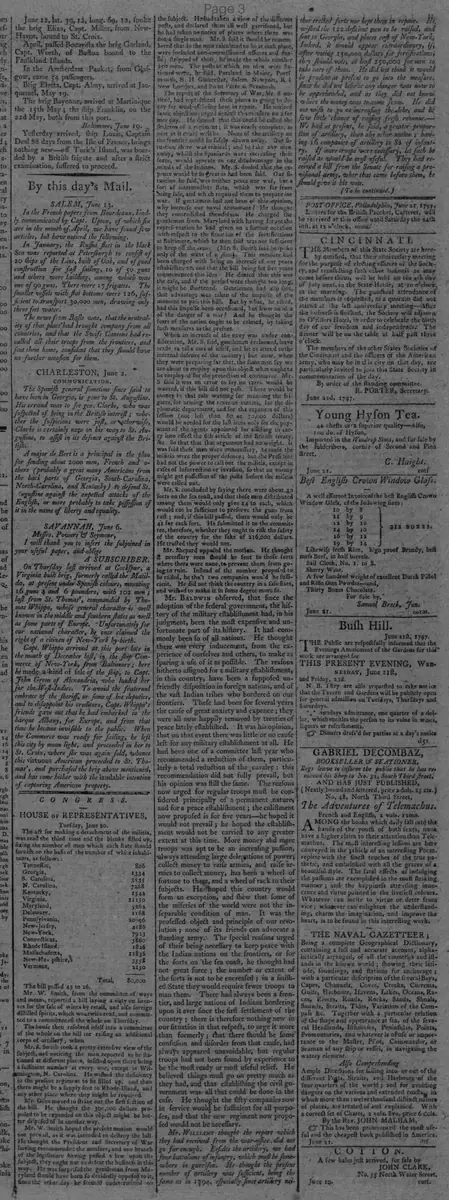
HOUSE OF REPRESENTATIVES,
Tuesday, June 20.
The act for making a detachment of the militia, was read the third time and the blanks filled up, fixing the number of men which each state should furnish on the basis of the number of white inhabitants, as follows:
Total, 80,000
The bill passed 43 to 26.
Mr. W. Smith, from the committee of ways and means, reported a bill laying a duty on licenses for the sale of wines by retail, and also foreign distilled spirits, which was twice read, and committed to a committee of the whole on Thursday.
The house then resolved itself into a committee of the whole on the bill for raising an additional corps of artillery; when
Mr. S. Smith took a pretty extensive view of the subject, and noticing the men reported to be stationed at different places, insisted upon there being a sufficient number at every one, except at Wilmington, N. Carolina. He wished the deficiency in the present regiment to be filled up, and then there might be a supply sent to Rhode-Island, and any other place where they might be required.
Mr. Giles moved to strike out the first section of the bill. He thought the 300,000 dollars proposed to be expended on this object might be better disposed of in another way.
Mr. W. Smith hoped the present motion would not prevail, as it was intended to destroy the bill. He thought the President and Secretary of War having recommended the measure, and one branch of the legislature having passed a law upon the subject, they ought not to defeat the business in this way. He was surprised the gentleman from Maryland should have been so decidedly opposed to it, since the other day he seemed undetermined on the subject. He had taken a view of the different ports, and declared them all well garrisoned, but he had taken no notice of places where there was not a single man. Mr. S. said it should be remembered that in the men calculated to be at each place, were included non-commissioned officers and music; stripped of these, he made the whole number 250 men. The ports at which no men were stationed were, he said, Portland in Maine, Portsmouth, N. H. Gloucester, Salem, Newport, R. I. New London, and Fort Petre at Savannah.
The report of the Secretary of War, Mr S noticed, had represented these places as going to decay for want of being kept in repair. He noticed some objections urged against the measure on a former day. He denied that this could be called the skeleton of a regiment; it was nearly complete, as near as it could well be. None of the artillery on the frontier could be safely drawn away. Our situation there was critical; and to take any men away, whilst the Spaniards were increasing their force, would operate to our disadvantage in the minds of the Indians. Mr. S. denied that the expense would be so great as had been said. Our situation, he said, was neither peace nor war, but a sort of intermediate state, which was far from being safe, and which required them to prepare for war. If gentlemen had not been of this opinion, why increase our naval armament? He thought they contradicted themselves. He charged the gentleman from Maryland with having forgot the representation he had given on a former occasion with respect to the situation of the fortifications at Baltimore, which he then said was not sufficient to keep off the cows. (Mr. S. Smith said he spoke only of the want of a fence.) This measure had been charged with being an increase of our peace establishment, and that the bill being for five years countenanced this idea He denied that this was the case, and if the period were thought too long, it might be shortened. Gentlemen had also said, that advantage was taken of the impulse of the moment to pass this bill. But by what, he asked, had this impulse been occasioned, but from an idea of the danger of a war? And he thought the fears of the nation ought to be calmed, by taking such measures as the present.
When an increase of the navy was under consideration, Mr. S. said, gentlemen exclaimed, leave trade to take care of itself, and let us attend to the internal defence of the country; but now, when they were preparing for that, the same men say we are about to employ upon this object what ought to be employed for the protection of commerce. Mr. S. said it was an error to say no taxes would be wanted, if this bill did not pass. There would be money in that case wanting for manning the frigates, for arming the revenue cutters, for the diplomatic department, and for the expenses of this session (not less than 60 or 70,000 dollars) would be needed for the last item only for the payment of the agents appointed or assisting to carry into effect the 6th article of the British treaty, &c. So that that argument had no weight. It was said these men were unnecessary, because the militia were the proper defence; but the President had not the power to call out the militia, except in cases of insurrection or invasion, so that an enemy might get possession of the ports before the militia were called out.
Mr. S. concluded by saying there were about 40 forts on the sea coast, and that these men distributed among them would only give 14 to each, which would not be sufficient to preserve the guns from rust; and, if this bill passed, there would only be 41 for each fort. He submitted it to the committee, therefore, whether they ought to risk the safety of the country for the sake of 216,000 dollars. He trusted they would not.
Mr. Shepard opposed the motion. He thought it necessary men should be sent to those forts where there were none, to prevent them from going to ruin. Instead of the number proposed to be raised, he tho't two companies would be sufficient. He did not think the country in a safe state, and wished to make it in some degree more so.
Mr. Baldwin observed, that since the adoption of the federal government, the history of the military establishment had, in his judgment, been the most expensive and unfortunate part of its history. It had commonly been so of all nations. He thought there was every inducement, from the experience of ourselves and others, to make as sparing a use of it as possible. The reasons hitherto assigned for a military establishment, in this country, have been a supposed unfriendly disposition in foreign nations, and of the vast Indian tribes who bordered on our frontiers. These had been for several years the cause of great anxiety and expense; they were all now happily removed by treaties of peace lately established. It was his opinion, that on that event there was little or no cause left for any military establishment at all. He had been one of a committee last year who recommended a reduction of them, particularly a total reduction of the cavalry: this recommendation did not fully prevail, but his opinion was still the same. The reasons now urged for regular troops must be considered principally of a permanent nature, and for a peace establishment; the enlistment now proposed is for five years-he hoped it would not prevail; he hoped the establishment would not be carried to any greater extent at this time. More money and more troops was apt to be an increasing passion, always attending large delegations of power; collect money to raise armies, and raise armies to collect money, has been a wheel of fortune to them, and a wheel of rack to their subjects. He hoped this country would form an exception, and show that some of the miseries of the world were not the inseparable condition of man. It was the professed object and principle of our revolution; none of its friends can advocate a standing army. The special reasons urged of their being necessary to keep peace with the Indian nations on the frontiers, or for the forts on the sea coast, he thought had not great force; the number or extent of the forts is not to be increased; in a finished state they would require fewer troops to man them. There had always been a frontier, and large nations of Indians bordering upon it ever since the first settlement of the country; there is therefore nothing new in our situation in that respect, to urge it more than formerly; that there should be some confusion and disorder from that cause, had always appeared unavoidable, but regular troops had not been found by experience to be the most ready or most useful relief. He believed things must go on pretty much as they had, and that establishing the civil government was all that could be done in the case. He thought the fifty companies now in service would be sufficient for all purposes, and that the new regiment now proposed would not be necessary.
Mr. Williams thought the report which they had received from the war-office did not go far enough. Besides the artillery, we had four battalions of infantry, which must be somewhere in garrison. He thought the present number of artillery was sufficient, being the same as in 1794, especially since artillery neither erected forts nor kept them in repair. He wished the 122 deficient men to be raised, and sent to Georgia, and places east of New-York Indeed, it would appear extraordinary, if after voting 150,000 dollars for fortifications they should vote, at least 250,000 for men to take care of them. He did not think it would be prudent at present to go into the measure; since he did not believe any danger was now to be apprehended, and as they did not know where the money was to come from. He did not wish to go on increasing the debt, and he saw little chance of raising fresh revenue.
We had at present, he said, a greater proportion of artillery, than any other nation: having 16 companies of artillery to 81 of infantry. If more troops were necessary, let such be raised as would be most useful. They had received a bill from the Senate for raising a provisional army, when that came before them, he should give it his vote.
(To be continued.)
What sub-type of article is it?
What keywords are associated?
What entities or persons were involved?
Domestic News Details
Event Date
Tuesday, June 20.
Key Persons
Outcome
militia bill passed 43 to 26, authorizing 80,000 men. duty bill on wines and spirits committed to committee. artillery bill debated; motion to strike first section opposed; outcome pending.
Event Details
House of Representatives session: Passed act detaching 80,000 militia based on white inhabitants. Reported bill imposing duties on retail wine and foreign spirits licenses, committed for Thursday. In committee of the whole on bill to raise additional artillery corps, Mr. S. Smith advocated filling deficiencies and garrisoning ports; Mr. Giles moved to strike section citing better use of funds; Mr. W. Smith defended the measure citing recommendations and strategic needs; Mr. Shepard supported limited increase; Mr. Baldwin opposed expansion of military establishment post-treaties; Mr. Williams questioned necessity and funding.