Thank you for visiting SNEWPapers!
Sign up free
Story
November 29, 1916
The Evening World
New York, New York County, New York
What is this article about?
Historical overview of Thanksgiving's origins in 1621 Plymouth Colony after surviving a severe winter, its spread in New England, Washington's 1789 national proclamation, and Lincoln's 1863 standardization as the last Thursday in November.
Clipping
OCR Quality
88%
Good
Full Text
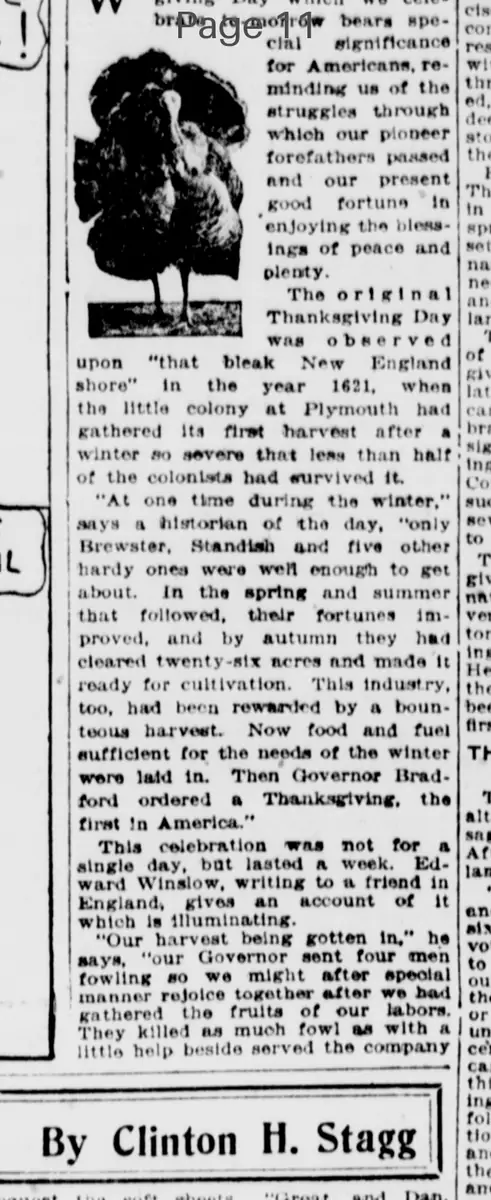
Special significance for Americans, reminding us of the struggles through which our pioneer forefathers passed and our present good fortune in enjoying the blessings of peace and plenty.
The original Thanksgiving Day was observed upon "that bleak New England shore" in the year 1621, when the little colony at Plymouth had gathered its first harvest after a winter so severe that less than half of the colonists had survived it.
"At one time during the winter," says a historian of the day, "only Brewster, Standish and five other hardy ones were well enough to get about. In the spring and summer that followed, their fortunes improved, and by autumn they had cleared twenty-six acres and made it ready for cultivation. This industry, too, had been rewarded by a bounteous harvest. Now food and fuel sufficient for the needs of the winter were laid in. Then Governor Bradford ordered a Thanksgiving, the first in America."
This celebration was not for a single day, but lasted a week. Edward Winslow, writing to a friend in England, gives an account of it which is illuminating.
"Our harvest being gotten in," he says, "our Governor sent four men fowling so we might after a special manner rejoice together after we had gathered the fruits of our labors. They killed as much fowl as with a little help beside served the company almost a week. At which time, amongst other recreations, we exercised our arms, many of the Indians coming amongst us, with some ninety men, whom for three days we entertained and feasted, and they went away and killed five deer, which they brought and bestowed on our Governor and upon the Captains and others."
From that time the observance of Thanksgiving Day became a custom in New England and gradually spread southward. The Massachusetts Bay Colony officially designated such a celebration in 1630. Connecticut followed example in 1633, and the Dutch of the New Netherlands in February, 1644.
The day of observance varied, some of the colonies holding their Thanksgiving as early as July and others as late as February; but, by degrees, it came to be the great harvest celebration, thus preserving the true significance of the first Thanksgiving Day. Between 1775 and 1782 the Continental Congress named eight such festivals, and Washington issued several thanksgiving proclamations to the army.
The first officially appointed Thanksgiving Day observed by the whole nation was the twenty-sixth of November, 1789, which George Washington proclaimed as a day for rendering the thanks of the people to Heaven for the good fortune that was theirs at that time. Washington had been in office just six months as the first President of the United States.
THE FIRST PROCLAMATION A notable document.
This document is couched in an exalted strain that should bear its message anew to every American to-day. After a brief preamble, the proclamation says:
"Now, therefore, I do recommend and assign, Thursday, the twenty-sixth of November next, to be devoted by the people of these States to the service of that great and glorious Being who is the benignant Author of all the good that was, that is, or that will be. That we may then unite in rendering unto Him our sincere and humble thanks for His kind care and protection of the people of this country previous to their becoming a nation; for the signal and manifold mercies and the favorable interpositions of His providence in the course and conclusion of the late war; for the great degree of tranquillity, union and plenty which we have since enjoyed; for the peaceable and rational manner in which we have been enabled to establish constitutions of government for our safety and happiness, and particularly the national one now lately instituted; for the civil and religious liberty with which we are blessed and the means we have of acquiring and diffusing knowledge, and, in general, for all the great favors which He hath been pleased to confer upon us.
"And also that we may then unite in most humbly offering our prayers and supplications to the great Lord and Ruler of nations and beseech Him to pardon our national and other transgressions; to enable us all, whether in public or private stations, to perform our several duties properly and punctually; to render our National Government a blessing to the people by constantly being a Government of wise, just and constitutional laws, carefully and faithfully executed and obeyed; to protect and guide all sovereigns and nations, especially such as have shown kindness to us, and to bless them with good government, peace and concord; to promote the knowledge and practice of true religion and virtue, and the increase of science among them and us, and generally to grant unto all mankind such a degree of temporal prosperity as He alone knows to be best.
"Given under my hand at the City of New York, the third day of October, in the year of our Lord, one thousand seven hundred and eighty-nine.
"GEORGE WASHINGTON."
WASHINGTON'S PRECEPTS TEACH LESSON NOW.
This eloquent address to the people of the newly united States, and one apostrophe to the Heavenly Father, has few equals in the language, and sets forth in clear and unmistakable terms the things for which the Nation gives thanks. It applies just as forcibly to the America of to-day as to the America of Washington. Our problems are but little different and our relations with the world are such that his plea for guidance has a new and more understandable character than it had for most of us before recent world events assumed such grave character.
Even after Washington had named a day of national Thanksgiving the custom was continued in various parts of the country on different days. And it was not until 1863 that Abraham Lincoln selected the last Thursday in November as a permanent day for the observance of the festival.
The original Thanksgiving Day was observed upon "that bleak New England shore" in the year 1621, when the little colony at Plymouth had gathered its first harvest after a winter so severe that less than half of the colonists had survived it.
"At one time during the winter," says a historian of the day, "only Brewster, Standish and five other hardy ones were well enough to get about. In the spring and summer that followed, their fortunes improved, and by autumn they had cleared twenty-six acres and made it ready for cultivation. This industry, too, had been rewarded by a bounteous harvest. Now food and fuel sufficient for the needs of the winter were laid in. Then Governor Bradford ordered a Thanksgiving, the first in America."
This celebration was not for a single day, but lasted a week. Edward Winslow, writing to a friend in England, gives an account of it which is illuminating.
"Our harvest being gotten in," he says, "our Governor sent four men fowling so we might after a special manner rejoice together after we had gathered the fruits of our labors. They killed as much fowl as with a little help beside served the company almost a week. At which time, amongst other recreations, we exercised our arms, many of the Indians coming amongst us, with some ninety men, whom for three days we entertained and feasted, and they went away and killed five deer, which they brought and bestowed on our Governor and upon the Captains and others."
From that time the observance of Thanksgiving Day became a custom in New England and gradually spread southward. The Massachusetts Bay Colony officially designated such a celebration in 1630. Connecticut followed example in 1633, and the Dutch of the New Netherlands in February, 1644.
The day of observance varied, some of the colonies holding their Thanksgiving as early as July and others as late as February; but, by degrees, it came to be the great harvest celebration, thus preserving the true significance of the first Thanksgiving Day. Between 1775 and 1782 the Continental Congress named eight such festivals, and Washington issued several thanksgiving proclamations to the army.
The first officially appointed Thanksgiving Day observed by the whole nation was the twenty-sixth of November, 1789, which George Washington proclaimed as a day for rendering the thanks of the people to Heaven for the good fortune that was theirs at that time. Washington had been in office just six months as the first President of the United States.
THE FIRST PROCLAMATION A notable document.
This document is couched in an exalted strain that should bear its message anew to every American to-day. After a brief preamble, the proclamation says:
"Now, therefore, I do recommend and assign, Thursday, the twenty-sixth of November next, to be devoted by the people of these States to the service of that great and glorious Being who is the benignant Author of all the good that was, that is, or that will be. That we may then unite in rendering unto Him our sincere and humble thanks for His kind care and protection of the people of this country previous to their becoming a nation; for the signal and manifold mercies and the favorable interpositions of His providence in the course and conclusion of the late war; for the great degree of tranquillity, union and plenty which we have since enjoyed; for the peaceable and rational manner in which we have been enabled to establish constitutions of government for our safety and happiness, and particularly the national one now lately instituted; for the civil and religious liberty with which we are blessed and the means we have of acquiring and diffusing knowledge, and, in general, for all the great favors which He hath been pleased to confer upon us.
"And also that we may then unite in most humbly offering our prayers and supplications to the great Lord and Ruler of nations and beseech Him to pardon our national and other transgressions; to enable us all, whether in public or private stations, to perform our several duties properly and punctually; to render our National Government a blessing to the people by constantly being a Government of wise, just and constitutional laws, carefully and faithfully executed and obeyed; to protect and guide all sovereigns and nations, especially such as have shown kindness to us, and to bless them with good government, peace and concord; to promote the knowledge and practice of true religion and virtue, and the increase of science among them and us, and generally to grant unto all mankind such a degree of temporal prosperity as He alone knows to be best.
"Given under my hand at the City of New York, the third day of October, in the year of our Lord, one thousand seven hundred and eighty-nine.
"GEORGE WASHINGTON."
WASHINGTON'S PRECEPTS TEACH LESSON NOW.
This eloquent address to the people of the newly united States, and one apostrophe to the Heavenly Father, has few equals in the language, and sets forth in clear and unmistakable terms the things for which the Nation gives thanks. It applies just as forcibly to the America of to-day as to the America of Washington. Our problems are but little different and our relations with the world are such that his plea for guidance has a new and more understandable character than it had for most of us before recent world events assumed such grave character.
Even after Washington had named a day of national Thanksgiving the custom was continued in various parts of the country on different days. And it was not until 1863 that Abraham Lincoln selected the last Thursday in November as a permanent day for the observance of the festival.
What sub-type of article is it?
Historical Event
What themes does it cover?
Providence Divine
Triumph
What keywords are associated?
Thanksgiving Origins
Plymouth Harvest
Washington Proclamation
National Holiday
What entities or persons were involved?
Brewster
Standish
Governor Bradford
Edward Winslow
George Washington
Abraham Lincoln
Where did it happen?
Plymouth Colony, New England
Story Details
Key Persons
Brewster
Standish
Governor Bradford
Edward Winslow
George Washington
Abraham Lincoln
Location
Plymouth Colony, New England
Event Date
1621
Story Details
The first Thanksgiving in 1621 at Plymouth Colony celebrated the harvest after a harsh winter, lasting a week with feasting and Indian participation. It spread through New England colonies and became a national holiday proclaimed by Washington in 1789 and standardized by Lincoln in 1863.