Thank you for visiting SNEWPapers!
Sign up free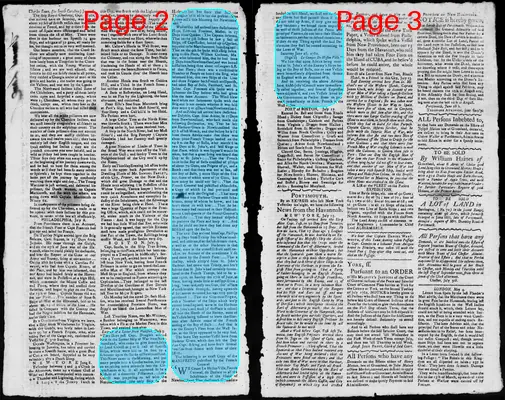
The New Hampshire Gazette
Portsmouth, Rockingham County, New Hampshire
What is this article about?
Reports from Halifax detail the French invasion of Newfoundland in June 1762, including landing of 3000 troops at Bay of Bulls, siege and surrender of St. John's with minimal resistance, capture of British ships, and a manifesto from French General Count Le Holon Ville promising protection to non-resistant inhabitants.
Merged-components note: This is a direct textual continuation of the article detailing the French landing in Newfoundland and the accompanying manifesto, split across pages due to independent page parsing.
Clippings
1 of 2
OCR Quality
Full Text
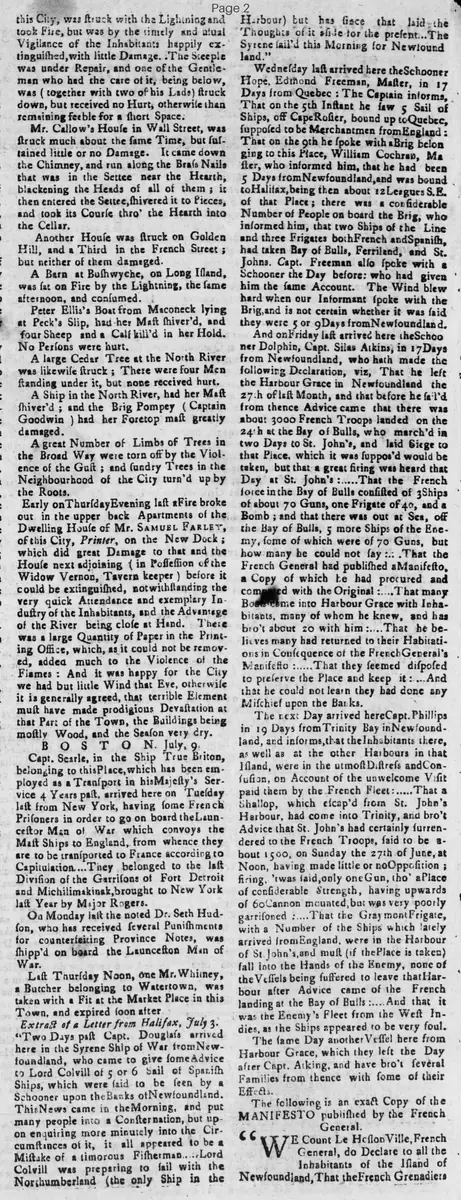
"Two Days past Capt. Douglas arrived here in the Syren Ship of War from Newfoundland, who came to give some Advice to Lord Colvill of 5 or 6 Sail of Spanish Ships, which were said to be seen by a Schooner upon the Banks of Newfoundland. This News came in the Morning, and put many people into a Consternation, but upon enquiring more minutely into the Circumstances of it, it all appeared to be a Mistake of a timorous Fisherman. Lord Colvill was preparing to sail with the Northumberland (the only Ship in the Harbour) but has since laid by for the present. The Syren sail'd this Morning for Newfoundland."
Wednesday last arrived here the Schooner Hope, Edmond Freeman, Master, in 17 Days from Quebec: The Captain informs, That on the 5th Instant he saw 5 Sail of Ships, off Cape Rosier, bound up to Quebec, supposed to be Merchantmen from England: That on the 9th he spoke with a Brig belonging to this Place, William Cochran, Master, who informed him, that he had been 5 Days from Newfoundland, and was bound to Halifax, being then about 12 Leagues S.E. of that Place; there was a considerable Number of People on board the Brig, who informed him, that two Ships of the Line and three Frigates both French and Spanish, had taken Bay of Bulls, Ferryland, and St. Johns. Capt. Freeman also spoke with Schooner the Day before: who had given him the same Account. The Wind blew hard when our Informant Spoke with the Brig, and is not certain whether it was said they were 5 or 6 Days from Newfoundland.
And on Friday last arrived here the Schooner Dolphin, Capt. Silas Aikins, in 17 Days from Newfoundland, who hath made the following Declaration, viz, That he left the Harbour Grace in Newfoundland the 27th of last Month, and that before he sail'd from thence Advice came that there was about 3000 French Troops landed on the 24th at the Bay of Bulls, who march'd in two Days to St. John's, and laid Siege to that Place, which it was suppos'd would be taken, but that a great firing was heard that Day at St. John's. That the French force in the Bay of Bulls consisted of 3 Ships of about 70 Guns, one Frigate of 40, and a Bomb; and that there was out at Sea, off the Bay of Bulls, 5 more Ships of the Enemy, some of which were of 70 Guns, but how many he could not say. That the French General had published a Manifesto, a Copy of which he had procured and compared with the Original. That many boats came into Harbour Grace with Inhabitants, many of whom he knew, and has brought about 20 with him. That he believes many had returned to their Habitations in Consequence of the French General's Manifesto. That they seemed disposed to preserve the Place and keep it. And that he could not learn they had done any Mischief upon the Banks.
The next Day arrived here Capt. Phillips in 18 Days from Trinity Bay in Newfoundland, and informs, that the Inhabitants there, as well as at the other Harbours in that Island, were in the utmost Distress and Confusion, on Account of the unwelcome Visit paid them by the French Fleet. That a Shallop, which escaped from St. John's Harbour, had come into Trinity, and brought Advice that St. John's had certainly surrendered to the French Troops, said to be about 1500, on Sunday the 27th of June, at Noon, having made little or no Opposition; firing, 'twas said, only one Gun, tho' a Place of considerable Strength, having upwards of 60 Cannon mounted, but was very poorly garrisoned. That the Graymont Frigate, with a Number of the Ships which lately arrived from England, were in the Harbour of St. John's, and must (if the Place is taken) fall into the Hands of the Enemy, none of the Vessels being suffered to leave that Harbour after Advice came of the French landing at the Bay of Bulls. And that it was the Enemy's Fleet from the West Indies, as the Ships appeared to be very foul.
The same Day another Vessel here from Harbour Grace, which they left the Day after Capt. Aikins, and have brought several Families from thence with some of their Effects.
The following is an exact Copy of the MANIFESTO published by the French General.
I, the Count Le Holon Ville, French General, do Declare to all the Inhabitants of the Island of Newfoundland. That the French Grenadiers
Landed on said Island. we shall not do them any Harm, but shall protect them if they do not take up Arms, if they give necessary Succours ; we bound them expresly, as well of those Justices of the Peace and principal Planters, do not leave their Houses or Settlements, neither to defend themselves ; if they do any Thing against the said Declaration they shall be treated according to the Laws of War.
Saturday June 26. 1762:
(Sign'd) Le Compte De Hoffon Ville.
We hear that upon Advice being received at St. John's of the Enemy's Ships being at the Bay of Bulls, one or two Vessels were immediately dispatched from thence to England with an Account of it.
And on receiving the above Advices here. his Majesty's Council were immediately called together, and several Expresses were dispatched, and two Vessels hired by the Government as Packet Boats to proceed immediately to Adm. Pocock in the West Indies.
What sub-type of article is it?
What keywords are associated?
What entities or persons were involved?
Where did it happen?
Foreign News Details
Primary Location
Newfoundland
Event Date
June 1762
Key Persons
Outcome
st. john's surrendered to about 1500 french troops on june 27, 1762, with little opposition; british ships in harbor captured; inhabitants distressed but some returned due to manifesto promising protection if non-resistant.
Event Details
French forces, including 3000 troops and fleet of ships of the line, frigates, and a bomb ketch, landed at Bay of Bulls on June 24, marched to St. John's, laid siege, and captured it on June 27. Manifesto issued by French General on June 26. Reports from various captains arriving in Halifax detail the invasion, mistaken Spanish ship sighting, and British responses including dispatches to England and Admiral Pocock.