Thank you for visiting SNEWPapers!
Sign up free
Richmond Enquirer
Richmond, Richmond County, Virginia
What is this article about?
Pittsburgh citizens celebrated January 8 with a dinner honoring General Jackson, featuring speeches by Judge Wilkins defending the administration's policies on tariff, internal improvements, and Indian removal, amid his recent Senate election.
Clipping
OCR Quality
Full Text
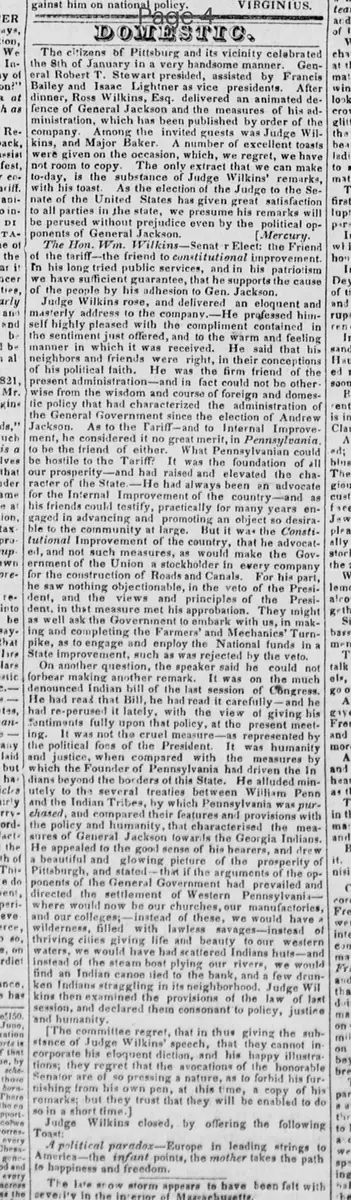
The citizens of Pittsburgh and its vicinity celebrated the 8th of January in a very handsome manner. General Robert T. Stewart presided, assisted by Francis Bailey and Isaac Lightner as vice presidents. After dinner, Ross Wilkins, Esq. delivered an animated defence of General Jackson and the measures of his administration, which has been published by order of the company. Among the invited guests was Judge Wilkins, and Major Baker. A number of excellent toasts were given on the occasion, which, we regret, we have not room to copy. The only extract that we can make to-day, is the substance of Judge Wilkins' remarks, with his toast. As the election of the Judge to the Senate of the United States has given great satisfaction to all parties in the state, we presume his remarks will be perused without prejudice even by the political opponents of General Jackson.
[Mercury.
The Hon. Wm. Wilkins—Senator Elect: the Friend of the tariff-the friend to constitutional improvement. In his long tried public services, and in his patriotism we have sufficient guarantee, that he supports the cause of the people by his adhesion to Gen. Jackson.
Judge Wilkins rose, and delivered an eloquent and masterly address to the company.-He professed himself highly pleased with the compliment contained in the sentiment just offered, and to the warm and feeling manner in which it was received. He said that his neighbors and friends were right, in their conceptions of his political faith. He was the firm friend of the present administration-and in fact could not be otherwise from the wisdom and course of foreign and domestic policy that had characterized the administration of the General Government since the election of Andrew Jackson. As to the Tariff-and to Internal Improvement, he considered it no great merit, in Pennsylvania. to be the friend of either. What Pennsylvanian could be hostile to the Tariff? It was the foundation of all our prosperity-and had raised and elevated the character of the State. He had always been an advocate for the Internal Improvement of the country-and as his friends could testify, practically for many years engaged in advancing and promoting an object so desirable to the community at large. But it was the Constitutional Improvement of the country, that he advocated, and not such measures, as would make the Government of the Union a stockholder in every company for the construction of Roads and Canals. For his part, he saw nothing objectionable, in the veto of the President, and the views and principles of the President. in that measure met his approbation. They might as well ask the Government to embark with us, in making and completing the Farmers' and Mechanics' Turnpike, as to engage and employ the National funds in a State improvement, such as was rejected by the veto.
On another question, the speaker said he could not forbear making another remark. It was on the much denounced Indian bill of the last session of Congress. He had read that Bill, he had read it carefully-and he had re-perused it lately, with the view of giving his sentiments fully upon that policy, at the present meeting. It was not the cruel measure-as represented by the political foes of the President. It was humanity and justice, when compared with the measures by which the Founder of Pennsylvania had driven the Indians beyond the borders of this State. He alluded minutely to the several treaties between William Penn and the Indian Tribes, by which Pennsylvania was purchased, and compared their features and provisions with the policy and humanity, that characterised the measures of General Jackson towards the Georgia Indians. He appealed to the good sense of his hearers, and drew a beautiful and glowing picture of the prosperity of Pittsburgh, and stated -that if the arguments of the opponents of the General Government had prevailed and directed the settlement of Western Pennsylvania- where would now be our churches, our manufactories, and our colleges;—instead of these, we would have a wilderness, filled with lawless savages-instead of thriving cities giving life and beauty to our western waters, we would have had scattered Indians huts—and instead of the steam boat plying our rivers, we would find an Indian canoe tied to the bank, and a few drunken Indians straggling in its neighborhood. Judge Wilkins then examined the provisions of the law of last session, and declared them consonant to policy, justice and humanity.
[The committee regret, that in thus giving the substance of Judge Wilkins' speech, that they cannot incorporate his eloquent diction, and his happy illustrations; they regret that the avocations of the honorable Senator are of so pressing a nature, as to forbid his furnishing from his own pen, at this time, a copy of his remarks: but they trust that they will be enabled to do so in a short time.]
Judge Wilkins closed, by offering the following Toast:
A political paradox-Europe in leading strings to America—the infant points, the mother takes the path to happiness and freedom.
What sub-type of article is it?
What keywords are associated?
What entities or persons were involved?
Where did it happen?
Domestic News Details
Primary Location
Pittsburgh
Event Date
8th Of January
Key Persons
Event Details
The citizens of Pittsburgh and its vicinity celebrated the 8th of January with a dinner presided over by General Robert T. Stewart, assisted by Francis Bailey and Isaac Lightner as vice presidents. Ross Wilkins delivered a defense of General Jackson. Judge Wilkins gave an address supporting Jackson's administration, the tariff, internal improvements, and the Indian bill, comparing it to William Penn's treaties. He offered a toast: 'A political paradox-Europe in leading strings to America—the infant points, the mother takes the path to happiness and freedom.'