Thank you for visiting SNEWPapers!
Sign up free
Gazette Of The United States, & Daily Advertiser
Philadelphia, Philadelphia County, Pennsylvania
What is this article about?
Debate in the Pennsylvania House of Representatives on a bill to appoint presidential electors, addressing constitutional concerns, joint voting, and balance between legislative branches. Speakers Buckley, Fisher, Penrose, and Boileau discuss inconsistencies, wording ambiguities, and intentions.
Merged-components note: These components form a continuous legislative debate on the election of presidential electors in Pennsylvania, with sequential reading orders and spatial progression.
Clipping
OCR Quality
Full Text
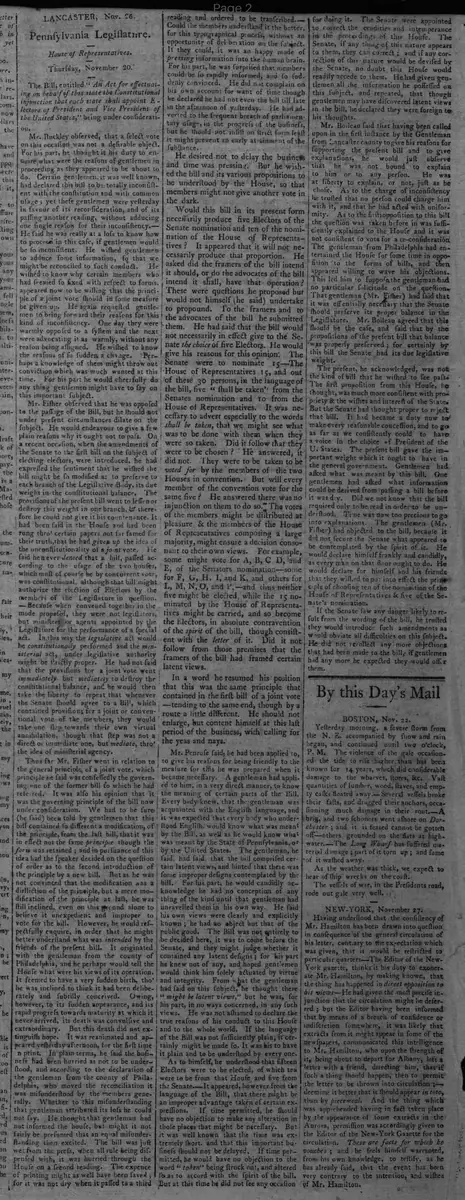
Mr. Buckley observed, that a silent vote on this occasion was not a desirable object. For his part, he thought it his duty to enquire what were the reasons of gentlemen in proceeding as they appeared to be about to do. Certain gentlemen, it was well known, had declared this bill to be totally inconsistent with the constitution and with common usage; yet these gentlemen were yesterday in favour of its reconsideration, and of its passing another reading, without adducing one single reason for their inconsistency. He said he was really at a loss to know how to proceed in this case, if gentlemen would be so inconsistent. He wished gentlemen to adduce some information, so that we might be reconciled to such conduct. He wished to know why certain members who had seemed so fixed with respect to forms, appeared now to be willing that the principle of a joint vote should in some measure be given up. He again requested gentlemen to bring forward their reasons for this kind of inconsistency. One day they were warmly opposed to a system and the next were advocating it as warmly, without any reason being assigned. He wished to know the reasons of so sudden a change. Perhaps a knowledge of them might throw out conviction which was much wanted at this time. For his part he would cheerfully do any thing gentlemen might have to say on this important subject.
Mr. Fisher observed that he was opposed to the passage of the Bill, but he should not under present circumstances dilate on the subject. He would endeavour to give a few plain reasons why it ought not to pass. On a recent occasion, when the amendments of the Senate to the first bill on the subject of electing electors, were introduced, he had expressed the sentiment that he wished the bill might be so modified as to preserve to each branch of the Legislative Body, its due weight in the constitutional balance. The provisions of the present bill went to lessen or destroy this weight in one branch, & therefore he could not give it his countenance. It had been said in the House and had been rung thro' certain papers not far famed for their truth, that he had given up the idea of the unconstitutionality of a joint vote. He said he never denied that a bill, passed according to the usage of the two houses, which must of course be by concurrent vote, was constitutional, although that bill might authorize the election of Electors by the members of the Legislature in question. -Because when convened together in the mode proposed, they were not legislators, but ministers or agents appointed by the Legislature for the performance of a special act. In this way the legislative act would be constitutionally performed and the ministerial act, under legislative authority might be strictly proper. He had not said that the provisions for a joint vote went immediately but mediately to destroy the constitutional balance, and he would then take the liberty to repeat that whenever the Senate should agree to a Bill, which contained provisions for a joint or conventional vote of the members, they would take one step towards their own virtual annihilation, though that step was not a direct or immediate one, but mediate, thro' the idea of ministerial agency.
Thus far Mr. Fisher went in relation to the general principle of a joint vote, which principle he said was confessedly the governing one of the former bill to which he had referred. It was also his opinion that it was the governing principle of the bill now under consideration. We had to be sure (he said) been told by gentlemen that this bill contained so different a modification, of the principle, from the last bill, that it was in effect not the same principle though the form was retained; and in pursuance of this idea had the speaker decided on the question of order as to the second introduction of the principle by a new bill. But as he was not convinced that the modification was a distinction of the principle, but a mere modification of the principle at last, he was still inclined, even on this ground alone to believe it unexpedient and improper to vote for the bill. However, he would respectfully enquire, in order that he might better understand what was intended by the friends of the present bill. It originated with the gentleman from the county of Philadelphia, and he perhaps would tell the House what were his views of its operation. It seemed to have a very sudden birth, tho' he was inclined to think it had been deliberately and subtly conceived. Owing, however, to its sudden appearance, and its rapid progress towards maturity at which it never arrived, its death was convulsive and extraordinary. But this death did not extinguish hope. It was reanimated and appeared yesterday afternoon, for the first time in print. In plain terms, he said the business had been hurried so as not to be understood, and according to the declaration of the gentleman from the county of Philadelphia, who moved the reconsideration it was misunderstood by the members generally. Whether to this misunderstanding that gentleman attributed its loss he could not say. He thought that gentleman had not informed the house, but might it not fairly be presumed that an equal misunderstanding then excited. The bill was just wet from the press, when all rule being dispensed with, it was hurried-through the House on a second reading. The expense of printing might as well have been saved; for it was not dry when it passed to a third reading and ordered to be transcribed. Could the members understand it the better, for this typographical process, without an opportunity of deliberation on the subject. If they could, it was an happy mode of pressing information into the human brain. For his part, he was surprised that members could be so rapidly informed, and so suddenly convinced. He did not complain on his own account for want of time though he declared he had not even the bill till late in the afternoon of yesterday. He had adverted to the frequent breach of parliamentary usage, in the progress of the business, but he should not insist on strict form least it might prevent an early attainment of the substance.
He desired not to delay the business and time was pressing. But he wished the bill and its various propositions to be understood by the House, so that members might not give another vote in the dark.
Would this bill in its present form necessarily produce five Electors of the Senate nomination and ten of the nomination of the House of Representatives? It appeared that it will not necessarily produce that proportion. He asked did the framers of the bill intend it should, or do the advocates of the bill intend it shall, have that operation?
These were questions he proposed but would not himself (he said) undertake to propound. To the framers and to the advocates of the bill he submitted them. He had said that the bill would not necessarily in effect give to the Senate the choice of five Electors. He would give his reasons for this opinion. The Senate were to nominate 15 The House of Representatives 15, and out of these 30 persons, in the language of the bill, five "shall be taken" from the Senates nomination and 10 from the House of Representatives. It was necessary to advert especially to the words shall be taken, that we might see what was to be done with them when they were so taken. Did it follow that they were to be chosen? He answered, it did not. They were to be taken to be voted for by the members of the two Houses in convention. But will every member of the convention vote for the same five? He answered there was no injunction on them to do so. The votes of the members might be distributed at pleasure & the members of the House of Representatives composing a large majority, might ensure a decision consonant to their own views. For example, some might vote for A, B, C D, and E, of the Senators nominationsome for F. G, H, I, and K, and others for L, M, N, O, and P. and thus neither five might be elected, while the 15 nominated by the House of Representatives might be carried, and so become the Electors, in absolute contravention of the spirit of the bill, though consistent with the letter of it. Did it not follow from those premises that the framers of the bill had framed certain latent views.
In a word he resumed his position that this was the same principle that contained in the first bill of a joint vote —tending to the same end, though by a route a little different. He should not enlarge, but content himself at this last period of the business, with calling for the yeas and nays.
Mr. Penrose said, he had been applied to, to give his reasons for being friendly to the measure for this he was prepared when it became necessary. A gentleman had applied to him, in a very direct manner, to know the meaning of certain parts of the Bill. Every body knew, that the gentleman was acquainted with the English language, and it was expected that every body who understood English, would know what was meant by the Bill, as well as he would know what was meant by the State of Pennsylvania, or by the United States. The gentleman, he said, had said, that the bill comprised certain latent views, and hinted that there was some improper designs contemplated by the bill. For his part, he would candidly acknowledge he had no conception of any thing of the kind until that gentleman had unravelled them in his own way. He said his own views were clearly and explicitly known; he had no object but that of the public good. The Bill was not entirely to be decided here, it was to come before the Senate, and they might judge whether it contained any latent designs; for his part he knew not of any, and hoped gentlemen would think him solely actuated by virtue and integrity. From what the gentleman had said on this subject, he thought there "might be latent views," but he was, for his part, in no ways concerned, in any such views. He was not ashamed to declare the true reasons of his conduct to this House and to the whole world. If the language of the Bill was not sufficiently plain, it certainly might be made so. It was his to have it plain and to be understood by every one. As to himself, he understood that fifteen Electors were to be elected, of which ten were to be from that House and five from the Senate.--It appeared, however from the language of the Bill, that there might be an improper advantage taken of certain expressions. If time permitted, he should have no objection to make any alteration in those places that might be necessary. But it was well known that the time was extremely short. and that this important business should not be delayed, If time permitted, he would have no objection to the word "taken" being struck out, and altered so as to accord with the spirit of the bill. But at this time he did not see any occasion. for doing it. The Senate were appointed to correct the crudities and intemperance in the proceedings of this House. The Senate, if any thing of this nature appears to them, they can correct: and if any correction of this nature would be desired by the Senate, no doubt this House would readily accede to them. He had given gentlemen all the information he possessed on this subject, and repeated, that though gentlemen may have discovered latent views in the bill, he declared they were foreign to his thoughts.
Mr. Boileau said that having been called upon in the first instance by the Gentleman from Lancaster county to give his reasons for supporting the present bill and to give explanations, he would just observe that he was not bound to explain to him or to any person. He was at liberty to explain, or not, just as he chose. As to the charge of inconsistency he trusted that no person could charge him with it, and that he had acted with uniformity. As to the first opposition to this bill the question was taken before it was sufficiently explained to the House and it was not consistent to vote for a re-consideration The gentleman from Philadelphia had entertained the House for some time in opposition to the forms of bills, and then appeared willing to waive his objections. This led him to suppose the gentleman had no particular solicitude on the question- That gentleman (Mr. Fisher) had said that it was essentially necessary that the Senate Should preserve its proper balance in the Legislature. Mr. Boileau agreed that this should be the case, and said that by the propositions of the present bill that balance was properly preserved; for certainly by this bill the Senate had its due legislative weight.
The present, he acknowledged, was not the kind of bill that he wished to see pass The first proposition from this House, he thought, was much more consistent with propriety & the wishes and interest of the State. But the Senate had thought proper to reject that bill. It had became a duty now to make every reasonable concession, and to go as far as we consistently could to have a voice in the choice of President of the U. States. The present bill gave the important weight which it ought to have in the general government. Gentlemen had asked what was meant by this bill. One gentlemen had asked what information could be derived from passing a bill before it was dry. Did we not know that the bill required only to be read in order to be understood. Time was now too precious to go into explanations. The gentlemen (Mr. Fisher) had objected to the bill, because it did not secure the Senate what appeared to be contemplated by the spirit of it. He would declare himself frankly and candidly, as every man on that floor ought to do. He would declare for himself and his friends that they wished to put into effect the principle of choosing ten of the nomination of the House of Representatives & five of the Senate's nomination.
If the Senate saw any danger likely to result from the wording of the bill, he trusted they would introduce such amendments as would obviate all difficulties on this subject. He did not recollect any more objections that had been made to the bill, if gentlemen had any more he expected they would offer them.
What sub-type of article is it?
What keywords are associated?
What entities or persons were involved?
Where did it happen?
Domestic News Details
Primary Location
Pennsylvania
Key Persons
Event Details
Debate in the House of Representatives on a bill for appointing electors, with speakers addressing constitutional consistency, joint voting principles, legislative balance, bill wording ambiguities, and calls for explanations and yeas and nays.