Thank you for visiting SNEWPapers!
Sign up free
Wheeling Daily Intelligencer
Wheeling, Ohio County, West Virginia
What is this article about?
At the Southern Convention in Vicksburg, Mississippi, a motion to publish Mr. Spratt's speech favoring reopening the African slave trade caused uproar. Hon. Henry S. Foote vehemently opposed it, calling the speech treasonous and refusing to endorse its official publication.
Clipping
OCR Quality
Full Text
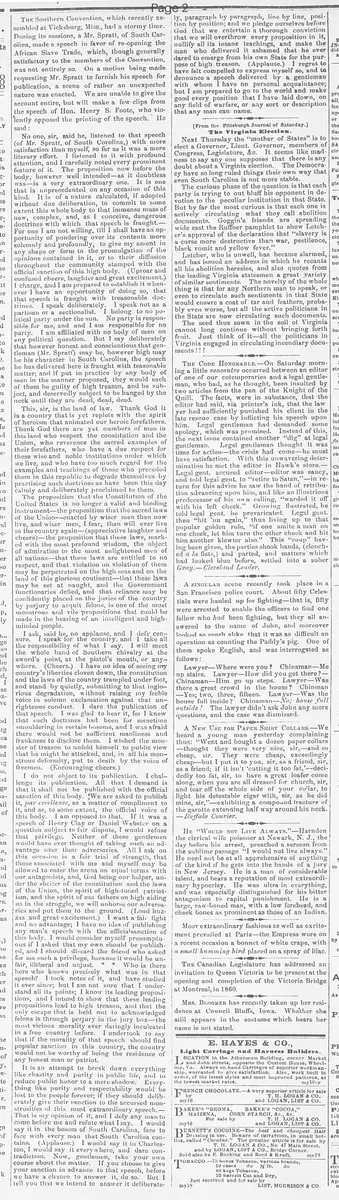
"No one, sir, said he, listened to that speech (of Mr. Spratt, of South Carolina,) with more satisfaction than myself, so far as it was a mere literary effort. I listened to it with profound attention, and I carefully noted every prominent feature of it. The proposition now before the body, however well intended—as it doubtless was—is a very extraordinary one. It is one that is unprecedented on any occasion of this kind. It is of a nature calculated, if adopted without due deliberation, to commit to some extent this whole body to that immense mass of new, complex, and, as I conceive, dangerous doctrines with which that speech is fraught.—For one I am not willing, till I shall have an opportunity of pondering over its contents more solemnly and profoundly, to give my assent in any shape or form to the promulgation of the opinions contained in it, or to their diffusion throughout the community stamped with the official sanction of this high body. (Uproar and confused cheers, laughter and great excitement.) I charge, and I am prepared to establish it whenever I have an opportunity of doing so, that that speech is fraught with treasonable doctrines. I speak deliberately. I speak not as a partisan or a sectionalist. I belong to no political party under the sun. No party is responsible for me, and I am responsible for no party. I am affiliated with no body of men on any political question. But I say deliberately that however honest and conscientious that gentleman (Mr. Spratt) may be, however high may be his character in South Carolina, the speech he has delivered here is fraught with treasonable matter; and if put in practice by any body of men in the manner proposed, they would each of them be guilty of high treason, and be subject, and deservedly subject to be hanged by the neck until they are dead, dead, dead. This, sir, is the land of law. Thank God it is a country that is yet replete with the spirit of heroism that animated our heroic forefathers. Thank God there are yet numbers of men in this land who respect the constitution and the Union, who reverence the sacred examples of their forefathers, who have a due respect for these wise and noble institutions under which we live, and who have too much regard for the examples and teachings of those who preceded them in this republic to degrade themselves by practising such doctrines as have been this day calmly and deliberately proclaimed to them. The proposition that the Constitution of the United States is no longer a valid and binding instrument—the proposition that the sacred laws of the Union—enacted by wiser men than now live, and wiser men, I fear, than will ever live in the country again—(appreciative laughter and cheers)—the proposition that these laws, marked with the most profound wisdom, the object of admiration to the most enlightened men of all nations—that these laws are entitled to no respect, and that violation on violation of them may be perpetrated on the high seas and on the land of this glorious continent—that these laws may be set at naught, and the Government functionaries defied, and that reliance may be confidently placed on the juries of the country by perjury to acquit felons, is one of the most monstrous and vile propositions that could be made in the hearing of an intelligent and high minded people. I ask, said he, no applause, and I defy censure. I speak for the country, and I take all the responsibility of what I say. I will meet the whole band of Southern chivalry at the sword's point, at the pistol's mouth, or anywhere. (Cheers.) I have no idea of seeing my country's liberties cloven down, the constitution and the laws of the country trampled under foot, and stand by quietly, submitting to that inglorious degradation, without raising my feeble voice in solemn exclamation against that unrighteous conduct. I dare the publication of that speech. I was glad to hear it, for I knew that such doctrines had been for some time smouldering in certain bosoms, and I was afraid there would not be sufficient manliness and frankness to disclose them. I wished the monster of treason to unfold himself to public view that he might be attacked, and, in all his monstrous deformity, put to death by the voice of freemen. (Encouraging cheers.) I do not object to its publication. I challenge its publication. All that I demand is that it shall not be published with the official sanction of this body. We are asked to publish it, par excellence, as a matter of compliment to it, and as, to some extent, the official voice of this body. I am opposed to that. If it was a speech of Henry Clay or Daniel Webster on a question subject to fair dispute, I would refuse that privilege. Neither of these gentlemen would have ever thought of taking such an advantage over their adversaries. All I ask on this occasion is a fair trial of strength, that those associated with me and myself may be allowed to enter the arena on equal terms with our antagonists, and, God being our helper, under the shelter of the constitution and the laws of the Union, the spirit of high-toned patriotism, and the spirit of our fathers on high aiding us in the struggle, we will unhorse our adversaries and put them to the ground. (Loud huzzas and great excitement.) I want a fair fight and no advantage; I have no idea of publishing any man's speech with the official sanction of this body. I would consider myself presumptuous if I asked that my own should be published, and I should discard the friend who asked for me such a privilege, because it would be unfair, illiberal and unjust. * * Who is there here who knows precisely what was in that speech? I took notes of it, and have studied it ever since; but I am not sure that I understand all its points; I know its leading propositions, and I intend to show that these leading propositions lead to high treason, and that the only escape that is held out to acknowledged felons is through perjury in the jury box—the most vicious morality ever daringly inculcated in a free country before. I undertook to say that if the morality of that speech should find popular sanction in this country, the country would not be worthy of being the residence of any honest man or patriot. It is an attempt to break down everything like chastity and purity in public life, and to reduce public honor to a mere shadow. Everything like purity and respectability would be lost to the people forever; if they should deliberately give their sanction to the accursed monstrosities of this most extraordinary speech. That is my opinion of it, and I defy any man to come before me and refute what I say. I would say it in the bosom of South Carolina, face to face with every man that South Carolina contains. (Applause.) I would say it in Charleston, I would say it everywhere, and dare contradiction. Now, gentlemen, take your own course about the matter. If you choose to give your sanction in advance to that speech, before we have a chance to answer it, do so. But I tell you that we intend to answer it deliberately, paragraph by paragraph, line by line, position by position; and we pledge ourselves before God that we entertain a thorough conviction that we will overthrow every proposition in it, nullify all its insane teachings, and make the man who delivered it ashamed that he ever dared to emerge from his own State for the purpose of high treason. (Applause.) I regret to have felt compelled to express myself so, and to denounce a speech delivered by a gentleman with whom I have no personal acquaintance; but I am prepared to go to the world and make good every position that I have laid down, on any field of warfare, or any sort or description that any man can name."
What sub-type of article is it?
What keywords are associated?
What entities or persons were involved?
Where did it happen?
Domestic News Details
Primary Location
Vicksburg, Miss.
Key Persons
Outcome
debate over publishing the speech; foote opposes official sanction, challenges its publication without endorsement, vows to refute its contents.
Event Details
During the Southern Convention in Vicksburg, Mr. Spratt of South Carolina delivered a speech advocating reopening the African Slave Trade. A motion to publish it led to opposition from Hon. Henry S. Foote, who denounced it as containing treasonable doctrines against the U.S. Constitution and laws, arguing against official publication by the convention.