Thank you for visiting SNEWPapers!
Sign up free
Literary
May 29, 1826
The Virginian
Lynchburg, Virginia
What is this article about?
This essay satirizes the term 'respectable,' arguing it is misapplied to denote wealth, status, and appearances rather than true character, virtue, or achievements. It critiques societal hypocrisy where material success trumps moral qualities, especially among the middle and upper classes.
Clipping
OCR Quality
95%
Excellent
Full Text
MISCELLANEOUS.
From Constable's Edinburgh Magazine.
ON RESPECTABLE PEOPLE.
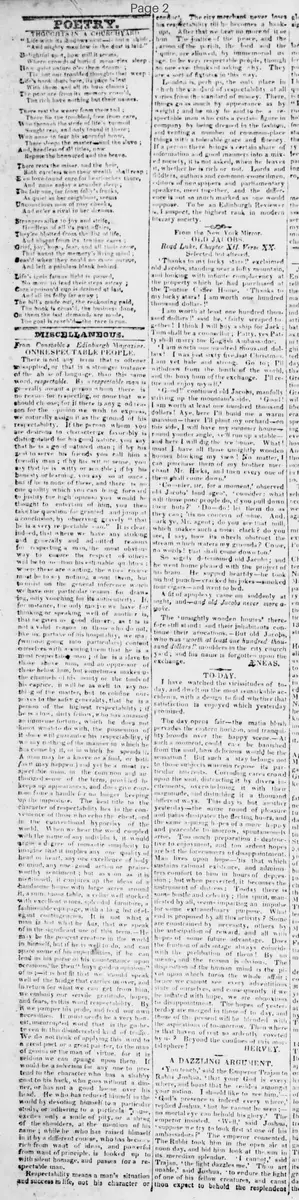
There is not any term that is oftener misapplied, or that is a stronger instance of the abuse of language, than this same word, respectable. By a respectable man is generally meant a person whom there is no reason for respecting, or none that we should choose; for if there is any good reason for the opinion we wish to express, we naturally assign it as the ground of his respectability. If the person whom you are desirous to characterize favourably is distinguished for his good nature, you say that he is a good natured man; if by his zeal to serve his friends you call him a friendly man; if by his wit or sense, you say that he is witty or sensible; if by his honesty or learning, you say so at once. But if he is none of these, and there is no one quality which you can bring forward to justify the high opinion you would be thought to entertain of him, you then take the question for granted and jump at a conclusion, by observing generally "that he is a very respectable man." It is clear, indeed, that where we have any striking and generally acknowledged reasons for respecting a man, the most obvious way to ensure the respect of others will be to mention his estimable qualities: where these are wanting, the wise course must be to say nothing about them, but to insist on the general inference which we have our particular reason for drawing, only vouching for its authenticity. It, for instance, the only motive we have for thinking or speaking well of another is, that he gives us good dinner, as this is not a valid reason to those who do not, like us, partake of his hospitality, we may (without going into particulars) content ourselves with assuring them that he is a most respectable man; if he is a slave to those above him, and an oppressor of those below him, but sometimes makes us the channels of his bounty or the tools of his caprice, it will be as well to say nothing of the matter, but to confine ourselves to the safer generality, that he is a person of the highest respectability; if he is a low, dirty fellow, who has amassed an immense fortune, which he does not know what to do with, the possession of it alone will guarantee his respectability, if we say nothing of the manner in which he has come by it, or in which he spends it. A man may be a knave or a tool, or both (as it may happen) and yet be a most respectable man, in the common and authorized sense of the term, provided he keeps up appearances, and does not give any one a handle for no longer keeping up the imposture. The best title to the character of respectability lies in the concurrence of those who echo the cheat, and in the conventional hypocrisy of the world. When we hear the word coupled with the name of any individual, it would argue a degree of romantic simplicity to imagine that it implies any one quality of head or heart, any one excellence of body or mind, any one good action or praiseworthy sentiment; but as soon as it is announced, it conjures up the ideas of a handsome house with large acres around it, a snug dining room, a cellar well stocked with excellent wines, splendid furniture, a fashionable equipage, with a long list of eligibilities contingent. It is not what a man is but what he has, that we speak of in the significant use of this term.--He may be the poorest creature in the world in himself, but if he is well to do, and can spare some of his superfluities, if he can lend us his purse or his countenance upon occasions, he then "buys golden opinions" of us;--it is but fit that we should speak well of the bridge that carries us over, and in return for what we can get from him, we embody our servile gratitude, hopes, and fears, in this word respectability. By it we pamper his pride, and trade on our own necessities. It must needs be a very honest, uncorrupt word that is the go-between in this disinterested kind of traffic. We do not think of applying this word to a great poet or a great painter, to the man of genius or the man of virtue, for it is seldom we can sponge upon them. It would be a solecism for any one to pretend to the character who has a shabby coat to his back, who goes without a dinner, or has not a good house over his head. He who has reduced himself in the world by devoting himself to a particular study, or adhering to a particular cause, excites only a smile of pity, or a shrug of the shoulders, at the mention of his name; while he who has raised himself in it by a different course, who has become rich from want of ideas, and powerful from want of principle, is looked up to with silent homage, and passes for a respectable man. Respectability means a man's situation and success in life, not his character or conduct. The city merchant never imagines his respectability till he becomes a bank-director. After that we hear no more of it or him. The justice of the peace, and the parson of the parish, the lord and the squire, are allowed, by immemorial usage, to be very respectable people, though no one really thinks of asking why. They are a sort of fixtures in this way. London is, perhaps, the only place in which the standard of respectability at all varies from the standard of money. There, things go as much by appearance as by weight; and he may be said to be a respectable man who cuts a certain figure in company by being dressed in the fashion, and venting a number of common-place things with a tolerable grace and fluency. If a person there brings a certain share of information and good manners into a mixed society, it is not asked, when he leaves it, whether he is rich or not. Lords and fiddlers, authors and common-councilmen, editors of newspapers and parliamentary speakers, meet together, and the difference is not so much marked as one would suppose. To be an Edinburgh Reviewer, I suspect, the highest rank in modern literary society.
From Constable's Edinburgh Magazine.
ON RESPECTABLE PEOPLE.
There is not any term that is oftener misapplied, or that is a stronger instance of the abuse of language, than this same word, respectable. By a respectable man is generally meant a person whom there is no reason for respecting, or none that we should choose; for if there is any good reason for the opinion we wish to express, we naturally assign it as the ground of his respectability. If the person whom you are desirous to characterize favourably is distinguished for his good nature, you say that he is a good natured man; if by his zeal to serve his friends you call him a friendly man; if by his wit or sense, you say that he is witty or sensible; if by his honesty or learning, you say so at once. But if he is none of these, and there is no one quality which you can bring forward to justify the high opinion you would be thought to entertain of him, you then take the question for granted and jump at a conclusion, by observing generally "that he is a very respectable man." It is clear, indeed, that where we have any striking and generally acknowledged reasons for respecting a man, the most obvious way to ensure the respect of others will be to mention his estimable qualities: where these are wanting, the wise course must be to say nothing about them, but to insist on the general inference which we have our particular reason for drawing, only vouching for its authenticity. It, for instance, the only motive we have for thinking or speaking well of another is, that he gives us good dinner, as this is not a valid reason to those who do not, like us, partake of his hospitality, we may (without going into particulars) content ourselves with assuring them that he is a most respectable man; if he is a slave to those above him, and an oppressor of those below him, but sometimes makes us the channels of his bounty or the tools of his caprice, it will be as well to say nothing of the matter, but to confine ourselves to the safer generality, that he is a person of the highest respectability; if he is a low, dirty fellow, who has amassed an immense fortune, which he does not know what to do with, the possession of it alone will guarantee his respectability, if we say nothing of the manner in which he has come by it, or in which he spends it. A man may be a knave or a tool, or both (as it may happen) and yet be a most respectable man, in the common and authorized sense of the term, provided he keeps up appearances, and does not give any one a handle for no longer keeping up the imposture. The best title to the character of respectability lies in the concurrence of those who echo the cheat, and in the conventional hypocrisy of the world. When we hear the word coupled with the name of any individual, it would argue a degree of romantic simplicity to imagine that it implies any one quality of head or heart, any one excellence of body or mind, any one good action or praiseworthy sentiment; but as soon as it is announced, it conjures up the ideas of a handsome house with large acres around it, a snug dining room, a cellar well stocked with excellent wines, splendid furniture, a fashionable equipage, with a long list of eligibilities contingent. It is not what a man is but what he has, that we speak of in the significant use of this term.--He may be the poorest creature in the world in himself, but if he is well to do, and can spare some of his superfluities, if he can lend us his purse or his countenance upon occasions, he then "buys golden opinions" of us;--it is but fit that we should speak well of the bridge that carries us over, and in return for what we can get from him, we embody our servile gratitude, hopes, and fears, in this word respectability. By it we pamper his pride, and trade on our own necessities. It must needs be a very honest, uncorrupt word that is the go-between in this disinterested kind of traffic. We do not think of applying this word to a great poet or a great painter, to the man of genius or the man of virtue, for it is seldom we can sponge upon them. It would be a solecism for any one to pretend to the character who has a shabby coat to his back, who goes without a dinner, or has not a good house over his head. He who has reduced himself in the world by devoting himself to a particular study, or adhering to a particular cause, excites only a smile of pity, or a shrug of the shoulders, at the mention of his name; while he who has raised himself in it by a different course, who has become rich from want of ideas, and powerful from want of principle, is looked up to with silent homage, and passes for a respectable man. Respectability means a man's situation and success in life, not his character or conduct. The city merchant never imagines his respectability till he becomes a bank-director. After that we hear no more of it or him. The justice of the peace, and the parson of the parish, the lord and the squire, are allowed, by immemorial usage, to be very respectable people, though no one really thinks of asking why. They are a sort of fixtures in this way. London is, perhaps, the only place in which the standard of respectability at all varies from the standard of money. There, things go as much by appearance as by weight; and he may be said to be a respectable man who cuts a certain figure in company by being dressed in the fashion, and venting a number of common-place things with a tolerable grace and fluency. If a person there brings a certain share of information and good manners into a mixed society, it is not asked, when he leaves it, whether he is rich or not. Lords and fiddlers, authors and common-councilmen, editors of newspapers and parliamentary speakers, meet together, and the difference is not so much marked as one would suppose. To be an Edinburgh Reviewer, I suspect, the highest rank in modern literary society.
What sub-type of article is it?
Essay
Satire
What themes does it cover?
Social Manners
Moral Virtue
What keywords are associated?
Respectability
Social Hypocrisy
Wealth Status
Moral Critique
Appearance Vs Substance
Conventional Honor
Literary Details
Title
On Respectable People
Key Lines
By A Respectable Man Is Generally Meant A Person Whom There Is No Reason For Respecting, Or None That We Should Choose;
It Is Not What A Man Is But What He Has, That We Speak Of In The Significant Use Of This Term.
Respectability Means A Man's Situation And Success In Life, Not His Character Or Conduct.
We Do Not Think Of Applying This Word To A Great Poet Or A Great Painter, To The Man Of Genius Or The Man Of Virtue, For It Is Seldom We Can Sponge Upon Them.
To Be An Edinburgh Reviewer, I Suspect, The Highest Rank In Modern Literary Society.