Thank you for visiting SNEWPapers!
Sign up free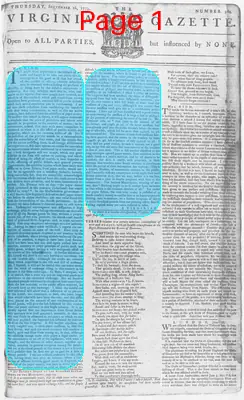
Letter to Editor
September 16, 1773
The Virginia Gazette
Williamsburg, Virginia
What is this article about?
A Virginian critiques paper money's harms in Virginia, citing economic losses, moral corruption, trade imbalances, and historical examples from Louisiana, Massachusetts, and Britain. Urges abandonment for stable currency, referencing Montesquieu.
Clipping
OCR Quality
98%
Excellent
Full Text
Mrs. Rind,
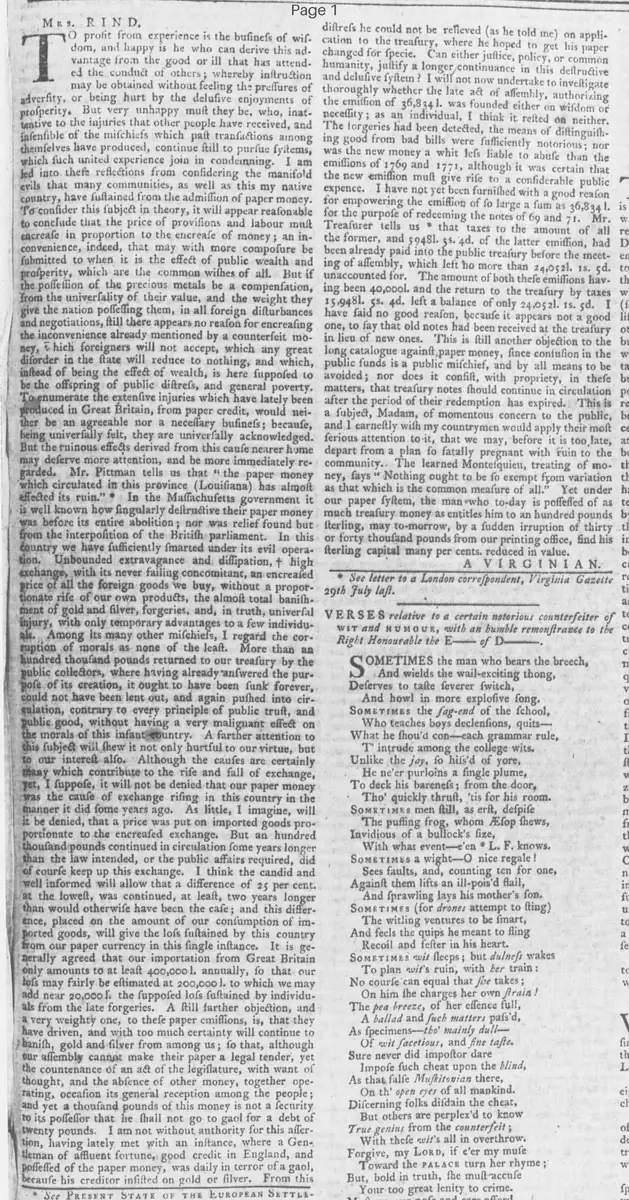
No profit from experience is the business of life. From the good or ill that has attended the conduct of others; whereby instruction may be obtained without feeling the pressures of adversity, or being hurt by the delusive enjoyments of prosperity. But very unhappy must they be, who, inattentive to the injuries that other people have received, and insensible of the mischiefs which past transactions among themselves have produced, continue still to pursue systems, which such united experience join in condemning. I am led into these reflections from considering the manifold evils that many communities, as well as this my native country, have sustained from the admission of paper money. To consider this subject in theory, it will appear reasonable to conclude that the price of provisions and labour must increase in proportion to the increase of money; an inconvenience, indeed, that may with more composure be submitted to when it is the effect of public wealth and prosperity, which are the common wishes of all. But if the possession of the precious metals be a compensation, from the universality of their value, and the weight they give the nation possessing them, in all foreign disturbances and negotiations, still there appears no reason for increasing the inconvenience already mentioned by a counterfeit money, which foreigners will not accept, which any great disorder in the state will reduce to nothing, and which, instead of being the effect of wealth, is here supposed to be the offspring of public distress, and general poverty. To enumerate the extensive injuries which have lately been produced in Great Britain, from paper credit, would neither be an agreeable nor a necessary business; because, being universally felt, they are universally acknowledged. But the ruinous effects derived from this cause nearer home may deserve more attention, and be more immediately regarded. Mr. Pittman tells us that "the paper money which circulated in this province (Louisiana) has almost effected its ruin." In the Massachusetts government it is well known how singularly destructive their paper money was before its entire abolition; nor was relief found but from the interposition of the British parliament. In this country we have sufficiently smarted under its evil operation. Unbounded extravagance and dissipation, high exchange, with its never failing concomitant, an increased price of all the foreign goods we buy, without a proportionate rise of our own products, the almost total banishment of gold and silver, forgeries, and, in truth, universal injury, with only temporary advantages to a few individuals. Among its many other mischiefs, I regard the corruption of morals as none of the least. More than an hundred thousand pounds returned to our treasury by the public collectors, where having already answered the purpose of its creation, it ought to have been sunk forever, could not have been lent out, and again pushed into circulation, contrary to every principle of public trust, and public good, without having a very malignant effect on the morals of this infant country. A farther attention to this subject will show it not only hurtful to our virtue, but to our interest also. Although the causes are certainly many which contribute to the rise and fall of exchange, yet, I suppose, it will not be denied that our paper money was the cause of exchange rising in this country in the manner it did some years ago. As little, I imagine, will it be denied, that a price was put on imported goods proportionate to the increased exchange. But an hundred thousand pounds continued in circulation some years longer than the law intended, or the public affairs required, did of course keep up this exchange. I think the candid and well informed will allow that a difference of 25 per cent. at the lowest, was continued, at least, two years longer than would otherwise have been the case; and this difference, placed on the amount of our consumption of imported goods, will give the loss sustained by this country from our paper currency in this single instance. It is generally agreed that our importation from Great Britain only amounts to at least 400,000 l. annually, so that our loss may fairly be estimated at 200,000 l. to which we may add near 20,000 l. the supposed loss sustained by individuals from the late forgeries. A still farther objection, and a very weighty one, to these paper emissions, is, that they have driven, and with too much certainty will continue to banish, gold and silver from among us; so that, although our assembly cannot make their paper a legal tender, yet the countenance of an act of the legislature, with want of thought, and the absence of other money, together operating, occasion its general reception among the people; and yet a thousand pounds of this money is not a security to its possessor that he shall not go to gaol for a debt of twenty pounds. I am not without authority for this assertion, having lately met with an instance, where a Gentleman of affluent fortune, good credit in England, and possessed of the paper money, was daily in terror of a gaol, because his creditor insisted on gold or silver. From this
distress he could not be relieved (as he told me) on application to the treasury, where he hoped to get his paper changed for specie. Can either justice, policy, or common humanity, justify a longer continuance in this destructive and delusive system? I will not now undertake to investigate thoroughly whether the late act of assembly, authorizing the emission of 36,834 l. was founded either on wisdom or necessity; as an individual, I think it rested on neither. The forgeries had been detected, the means of distinguishing good from bad bills were sufficiently notorious; nor was the new money a whit less liable to abuse than the emissions of 1769 and 1771, although it was certain that the new emission must give rise to a considerable public expense. I have not yet been furnished with a good reason for empowering the emission of so large a sum as 36,834 l. for the purpose of redeeming the notes of 69 and 71. Mr. Treasurer tells us that taxes to the amount of all the former, and 5948 l. 5 s. 4 d. of the latter emission, had been already paid into the public treasury before the meeting of assembly, which left no more than 24,052 l. 1 s. 5 d. unaccounted for. The amount of both these emissions having been 40,000 l. and the return to the treasury by taxes 15,948 l. 5 s. 4 d. left a balance of only 24,052 l. 1 s. 5 d. I have said no good reason, because it appears not a good one, to say that old notes had been received at the treasury in lieu of new ones. This is still another objection to the long catalogue against paper money, since confusion in the public funds is a public mischief, and by all means to be avoided; nor does it consist, with propriety, in these matters, that treasury notes should continue in circulation after the period of their redemption has expired. This is a subject, Madam, of momentous concern to the public, and I earnestly wish my countrymen would apply their most serious attention to it, that we may, before it is too late, depart from a plan so fatally pregnant with ruin to the community. The learned Montesquieu, treating of money, says "Nothing ought to be so exempt from variation as that which is the common measure of all." Yet under our paper system, the man who to-day is possessed of as much treasury money as entitles him to an hundred pounds sterling, may to-morrow, by a sudden irruption of thirty or forty thousand pounds from our printing office, find his sterling capital many per cents. reduced in value.
A VIRGINIAN.
* See letter to a London correspondent, Virginia Gazette 29th July last.
No profit from experience is the business of life. From the good or ill that has attended the conduct of others; whereby instruction may be obtained without feeling the pressures of adversity, or being hurt by the delusive enjoyments of prosperity. But very unhappy must they be, who, inattentive to the injuries that other people have received, and insensible of the mischiefs which past transactions among themselves have produced, continue still to pursue systems, which such united experience join in condemning. I am led into these reflections from considering the manifold evils that many communities, as well as this my native country, have sustained from the admission of paper money. To consider this subject in theory, it will appear reasonable to conclude that the price of provisions and labour must increase in proportion to the increase of money; an inconvenience, indeed, that may with more composure be submitted to when it is the effect of public wealth and prosperity, which are the common wishes of all. But if the possession of the precious metals be a compensation, from the universality of their value, and the weight they give the nation possessing them, in all foreign disturbances and negotiations, still there appears no reason for increasing the inconvenience already mentioned by a counterfeit money, which foreigners will not accept, which any great disorder in the state will reduce to nothing, and which, instead of being the effect of wealth, is here supposed to be the offspring of public distress, and general poverty. To enumerate the extensive injuries which have lately been produced in Great Britain, from paper credit, would neither be an agreeable nor a necessary business; because, being universally felt, they are universally acknowledged. But the ruinous effects derived from this cause nearer home may deserve more attention, and be more immediately regarded. Mr. Pittman tells us that "the paper money which circulated in this province (Louisiana) has almost effected its ruin." In the Massachusetts government it is well known how singularly destructive their paper money was before its entire abolition; nor was relief found but from the interposition of the British parliament. In this country we have sufficiently smarted under its evil operation. Unbounded extravagance and dissipation, high exchange, with its never failing concomitant, an increased price of all the foreign goods we buy, without a proportionate rise of our own products, the almost total banishment of gold and silver, forgeries, and, in truth, universal injury, with only temporary advantages to a few individuals. Among its many other mischiefs, I regard the corruption of morals as none of the least. More than an hundred thousand pounds returned to our treasury by the public collectors, where having already answered the purpose of its creation, it ought to have been sunk forever, could not have been lent out, and again pushed into circulation, contrary to every principle of public trust, and public good, without having a very malignant effect on the morals of this infant country. A farther attention to this subject will show it not only hurtful to our virtue, but to our interest also. Although the causes are certainly many which contribute to the rise and fall of exchange, yet, I suppose, it will not be denied that our paper money was the cause of exchange rising in this country in the manner it did some years ago. As little, I imagine, will it be denied, that a price was put on imported goods proportionate to the increased exchange. But an hundred thousand pounds continued in circulation some years longer than the law intended, or the public affairs required, did of course keep up this exchange. I think the candid and well informed will allow that a difference of 25 per cent. at the lowest, was continued, at least, two years longer than would otherwise have been the case; and this difference, placed on the amount of our consumption of imported goods, will give the loss sustained by this country from our paper currency in this single instance. It is generally agreed that our importation from Great Britain only amounts to at least 400,000 l. annually, so that our loss may fairly be estimated at 200,000 l. to which we may add near 20,000 l. the supposed loss sustained by individuals from the late forgeries. A still farther objection, and a very weighty one, to these paper emissions, is, that they have driven, and with too much certainty will continue to banish, gold and silver from among us; so that, although our assembly cannot make their paper a legal tender, yet the countenance of an act of the legislature, with want of thought, and the absence of other money, together operating, occasion its general reception among the people; and yet a thousand pounds of this money is not a security to its possessor that he shall not go to gaol for a debt of twenty pounds. I am not without authority for this assertion, having lately met with an instance, where a Gentleman of affluent fortune, good credit in England, and possessed of the paper money, was daily in terror of a gaol, because his creditor insisted on gold or silver. From this
distress he could not be relieved (as he told me) on application to the treasury, where he hoped to get his paper changed for specie. Can either justice, policy, or common humanity, justify a longer continuance in this destructive and delusive system? I will not now undertake to investigate thoroughly whether the late act of assembly, authorizing the emission of 36,834 l. was founded either on wisdom or necessity; as an individual, I think it rested on neither. The forgeries had been detected, the means of distinguishing good from bad bills were sufficiently notorious; nor was the new money a whit less liable to abuse than the emissions of 1769 and 1771, although it was certain that the new emission must give rise to a considerable public expense. I have not yet been furnished with a good reason for empowering the emission of so large a sum as 36,834 l. for the purpose of redeeming the notes of 69 and 71. Mr. Treasurer tells us that taxes to the amount of all the former, and 5948 l. 5 s. 4 d. of the latter emission, had been already paid into the public treasury before the meeting of assembly, which left no more than 24,052 l. 1 s. 5 d. unaccounted for. The amount of both these emissions having been 40,000 l. and the return to the treasury by taxes 15,948 l. 5 s. 4 d. left a balance of only 24,052 l. 1 s. 5 d. I have said no good reason, because it appears not a good one, to say that old notes had been received at the treasury in lieu of new ones. This is still another objection to the long catalogue against paper money, since confusion in the public funds is a public mischief, and by all means to be avoided; nor does it consist, with propriety, in these matters, that treasury notes should continue in circulation after the period of their redemption has expired. This is a subject, Madam, of momentous concern to the public, and I earnestly wish my countrymen would apply their most serious attention to it, that we may, before it is too late, depart from a plan so fatally pregnant with ruin to the community. The learned Montesquieu, treating of money, says "Nothing ought to be so exempt from variation as that which is the common measure of all." Yet under our paper system, the man who to-day is possessed of as much treasury money as entitles him to an hundred pounds sterling, may to-morrow, by a sudden irruption of thirty or forty thousand pounds from our printing office, find his sterling capital many per cents. reduced in value.
A VIRGINIAN.
* See letter to a London correspondent, Virginia Gazette 29th July last.
What sub-type of article is it?
Persuasive
Informative
Ethical Moral
What themes does it cover?
Economic Policy
Morality
Commerce Trade
What keywords are associated?
Paper Money
Currency Evils
Economic Loss
Moral Corruption
Exchange Rates
Forgeries
Gold Silver
Virginia Assembly
What entities or persons were involved?
A Virginian.
Mrs. Rind
Letter to Editor Details
Author
A Virginian.
Recipient
Mrs. Rind
Main Argument
paper money causes economic harm, moral corruption, and trade disadvantages in virginia and elsewhere; it should be abandoned in favor of gold and silver to prevent further ruin.
Notable Details
References Mr. Pittman On Louisiana
Massachusetts Paper Money Abolished By British Parliament
Corruption From Re Circulating 100,000 Pounds
Estimated Loss Of 200,000 L. From Exchange Rates
Forgeries Causing 20,000 L. Loss
Instance Of Gentleman Unable To Pay Debt With Paper
Critique Of 1773 Emission Of 36,834 L.
Quotes Montesquieu On Money's Stability