Thank you for visiting SNEWPapers!
Sign up free
Story
March 19, 1848
The Daily Union
Washington, District Of Columbia
What is this article about?
Historical account from 1848 medical abstract on using galvanism to dissolve human calculi, referencing J. B. Sutherland's 1812 thesis and experiments by Orioli, Hall, Bourges de Mortiere, Prevost, and Dumas showing successful decomposition.
Clipping
OCR Quality
95%
Excellent
Full Text
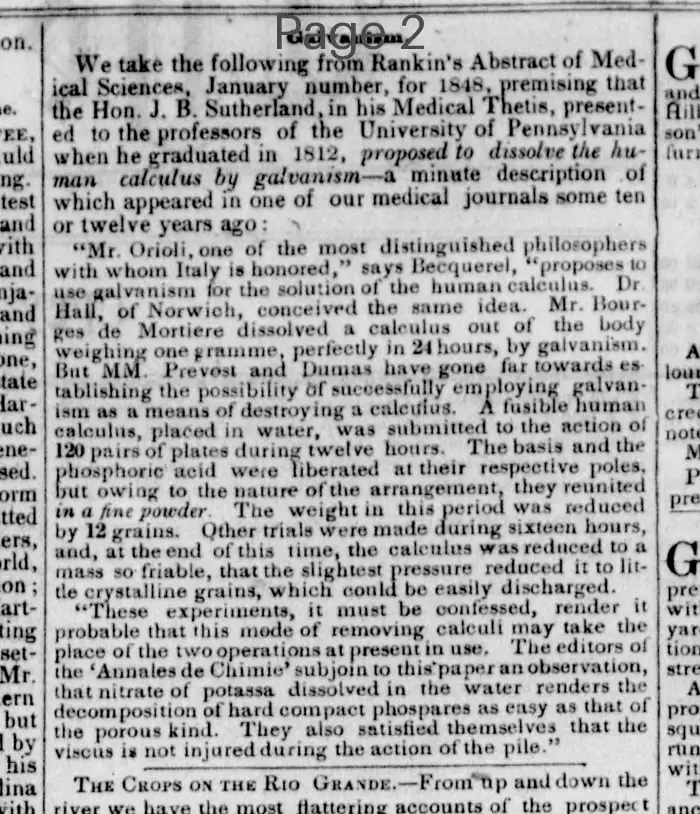
We take the following from Rankin's Abstract of Medical Sciences, January number, for 1848, premising that the Hon. J. B. Sutherland, in his Medical Thesis, presented to the professors of the University of Pennsylvania when he graduated in 1812, proposed to dissolve the human calculus by galvanism--a minute description of which appeared in one of our medical journals some ten or twelve years ago:
"Mr. Orioli, one of the most distinguished philosophers with whom Italy is honored," says Becquerel, "proposes to use galvanism for the solution of the human calculus. Dr. Hall, of Norwich, conceived the same idea. Mr. Bourges de Mortiere dissolved a calculus out of the body weighing one gramme, perfectly in 24 hours, by galvanism. But MM. Prevost and Dumas have gone far towards establishing the possibility of successfully employing galvanism as a means of destroying a calculus. A fusible human calculus, placed in water, was submitted to the action of 120 pairs of plates during twelve hours. The basis and the phosphoric acid were liberated at their respective poles. but owing to the nature of the arrangement, they reunited in a fine powder. The weight in this period was reduced by 12 grains. Other trials were made during sixteen hours, and, at the end of this time, the calculus was reduced to a mass so friable, that the slightest pressure reduced it to little crystalline grains, which could be easily discharged. "
These experiments, it must be confessed, render it probable that this mode of removing calculi may take the place of the two operations at present in use. The editors of the 'Annales de Chimie' subjoin to this paper an observation, that nitrate of potassa dissolved in the water renders the decomposition of hard compact phosphates as easy as that of the porous kind. They also satisfied themselves that the viscus is not injured during the action of the pile."
"Mr. Orioli, one of the most distinguished philosophers with whom Italy is honored," says Becquerel, "proposes to use galvanism for the solution of the human calculus. Dr. Hall, of Norwich, conceived the same idea. Mr. Bourges de Mortiere dissolved a calculus out of the body weighing one gramme, perfectly in 24 hours, by galvanism. But MM. Prevost and Dumas have gone far towards establishing the possibility of successfully employing galvanism as a means of destroying a calculus. A fusible human calculus, placed in water, was submitted to the action of 120 pairs of plates during twelve hours. The basis and the phosphoric acid were liberated at their respective poles. but owing to the nature of the arrangement, they reunited in a fine powder. The weight in this period was reduced by 12 grains. Other trials were made during sixteen hours, and, at the end of this time, the calculus was reduced to a mass so friable, that the slightest pressure reduced it to little crystalline grains, which could be easily discharged. "
These experiments, it must be confessed, render it probable that this mode of removing calculi may take the place of the two operations at present in use. The editors of the 'Annales de Chimie' subjoin to this paper an observation, that nitrate of potassa dissolved in the water renders the decomposition of hard compact phosphates as easy as that of the porous kind. They also satisfied themselves that the viscus is not injured during the action of the pile."
What sub-type of article is it?
Medical Curiosity
Curiosity
What themes does it cover?
Recovery
Triumph
What keywords are associated?
Galvanism
Calculus Dissolution
Medical Experiments
Human Stones
Scientific Trials
What entities or persons were involved?
J. B. Sutherland
Mr. Orioli
Becquerel
Dr. Hall
Mr. Bourges De Mortiere
Prevost
Dumas
Story Details
Key Persons
J. B. Sutherland
Mr. Orioli
Becquerel
Dr. Hall
Mr. Bourges De Mortiere
Prevost
Dumas
Event Date
1848
Story Details
Proposals and experiments using galvanism to dissolve human calculi, including Sutherland's 1812 thesis, Orioli and Hall's ideas, Bourges de Mortiere's 24-hour dissolution, and Prevost and Dumas's trials reducing calculi to friable powder over 12-16 hours, suggesting it could replace surgery.