Thank you for visiting SNEWPapers!
Sign up free
Literary
October 29, 1904
The Gazette
Cleveland, Cuyahoga County, Ohio
What is this article about?
Ellen Osmond's essay on the 1904 winter fashion revival of Louis XVI and Josephine period styles for evening wear, highlighting corsages, skirts, colors, materials, and modern adaptations while warning against excesses like crinolines.
Clipping
OCR Quality
98%
Excellent
Full Text
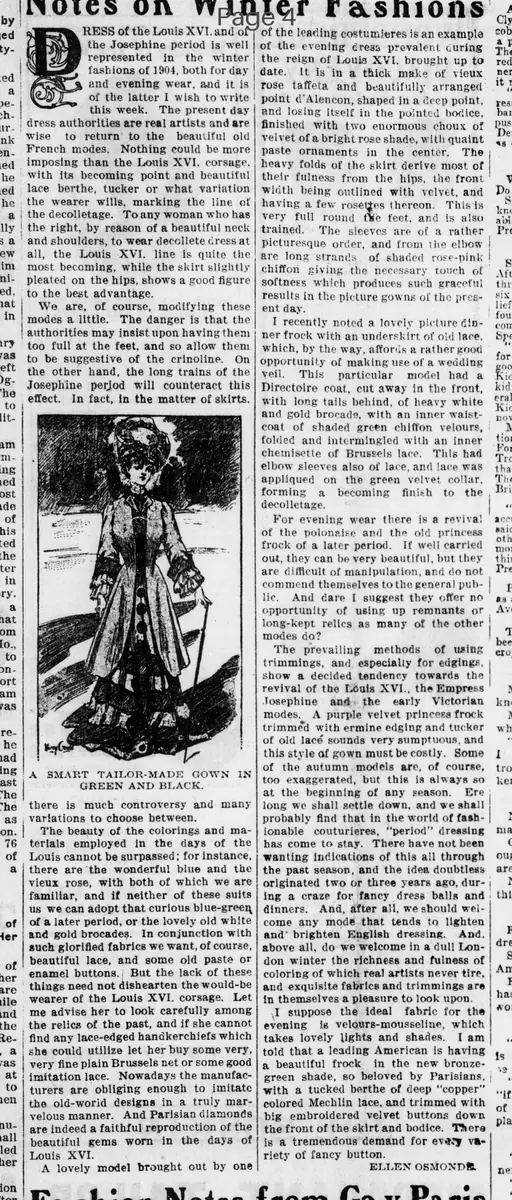
Dress of the Louis XVI. and of the Josephine period is well represented in the winter fashions of 1904, both for day and evening wear, and it is of the latter I wish to write this week. The present day dress authorities are real artists and are wise to return to the beautiful old French modes. Nothing could be more imposing than the Louis XVI. corsage, with its becoming point and beautiful lace berthe, tucker or what variation the wearer wills, marking the line of the decolletage. To any woman who has the right, by reason of a beautiful neck and shoulders, to wear decollete dress at all, the Louis XVI. line is quite the most becoming, while the skirt slightly pleated on the hips, shows a good figure to the best advantage.
We are, of course, modifying these modes a little. The danger is that the authorities may insist upon having them too full at the feet, and so allow them to be suggestive of the crinoline. On the other hand, the long trains of the Josephine period will counteract this effect. In fact, in the matter of skirts, there is much controversy and many variations to choose between.
The beauty of the colorings and materials employed in the days of the Louis cannot be surpassed; for instance, there are the wonderful blue and the vieux rose, with both of which we are familiar, and if neither of these suits us we can adopt that curious blue-green of a later period, or the lovely old white and gold brocades. In conjunction with such glorified fabrics we want, of course, beautiful lace, and some old paste or enamel buttons. But the lack of these things need not dishearten the would-be wearer of the Louis XVI. corsage. Let me advise her to look carefully among the relics of the past, and if she cannot find any lace-edged handkerchiefs which she could utilize let her buy some very, very fine plain Brussels net or some good imitation lace. Nowadays the manufacturers are obliging enough to imitate the old-world designs in a truly marvelous manner. And Parisian diamonds are indeed a faithful reproduction of the beautiful gems worn in the days of Louis XVI.
One of the leading costumieres is an example of the evening dress prevalent during the reign of Louis XVI. brought up to date. It is in a thick make of vieux rose taffeta and beautifully arranged point d'Alencon, shaped in a deep point, and losing itself in the pointed bodice, finished with two enormous choux of velvet of a bright rose shade, with quaint paste ornaments in the center. The heavy folds of the skirt derive most of their fulness from the hips, the front width being outlined with velvet, and having a few rosettes thereon. This is very full round the feet, and is also trained. The sleeves are of a rather picturesque order, and from the elbow are long strands of shaded rose-pink chiffon giving the necessary touch of softness which produces such graceful results in the picture gowns of the present day.
I recently noted a lovely picture dinner frock with an underskirt of old lace, which, by the way, affords a rather good opportunity of making use of a wedding veil. This particular model had a Directoire coat, cut away in the front, with long tails behind, of heavy white and gold brocade, with an inner waistcoat of shaded green chiffon velours, folded and intermingled with an inner chemisette of Brussels lace. This had elbow sleeves also of lace, and lace was appliqued on the green velvet collar, forming a becoming finish to the decolletage.
For evening wear there is a revival of the polonaise and the old princess frock of a later period. If well carried out, they can be very beautiful, but they are difficult of manipulation, and do not commend themselves to the general public. And dare I suggest they offer no opportunity of using up remnants or long-kept relics as many of the other modes do?
The prevailing methods of using trimmings, and especially for edgings, show a decided tendency towards the revival of the Louis XVI., the Empress Josephine and the early Victorian modes. A purple velvet princess frock trimmed with ermine edging and tucker of old lace sounds very sumptuous, and this style of gown must be costly. Some of the autumn models are, of course, too exaggerated, but this is always so at the beginning of any season. Ere long we shall settle down, and we shall probably find that in the world of fashionable couturieres, "period" dressing has come to stay. There have not been wanting indications of this all through the past season, and the idea doubtless originated two or three years ago, during a craze for fancy dress balls and dinners. And, after all, we should welcome any mode that tends to lighten and brighten English dressing. And, above all, do we welcome in a dull London winter the richness and fulness of coloring of which real artists never tire, and exquisite fabrics and trimmings are in themselves a pleasure to look upon.
I suppose the ideal fabric for the evening is velours-mousseline, which takes lovely lights and shades. I am told that a leading American is having a beautiful frock in the new bronze-green shade, so beloved by Parisians, with a tucked berthe of deep "copper" colored Mechlin lace, and trimmed with big embroidered velvet buttons down the front of the skirt and bodice. There is a tremendous demand for every variety of fancy button.
A lovely model brought out by one of the leading costumieres is an example of the evening dress prevalent during the reign of Louis XVI. brought up to date. It is in a thick make of vieux rose taffeta and beautifully arranged point d'Alencon, shaped in a deep point, and losing itself in the pointed bodice, finished with two enormous choux of velvet of a bright rose shade, with quaint paste ornaments in the center. The heavy folds of the skirt derive most of their fulness from the hips, the front width being outlined with velvet, and having a few rosettes thereon. This is very full round the feet, and is also trained. The sleeves are of a rather picturesque order, and from the elbow are long strands of shaded rose-pink chiffon giving the necessary touch of softness which produces such graceful results in the picture gowns of the present day.
ELLEN OSMOND.
We are, of course, modifying these modes a little. The danger is that the authorities may insist upon having them too full at the feet, and so allow them to be suggestive of the crinoline. On the other hand, the long trains of the Josephine period will counteract this effect. In fact, in the matter of skirts, there is much controversy and many variations to choose between.
The beauty of the colorings and materials employed in the days of the Louis cannot be surpassed; for instance, there are the wonderful blue and the vieux rose, with both of which we are familiar, and if neither of these suits us we can adopt that curious blue-green of a later period, or the lovely old white and gold brocades. In conjunction with such glorified fabrics we want, of course, beautiful lace, and some old paste or enamel buttons. But the lack of these things need not dishearten the would-be wearer of the Louis XVI. corsage. Let me advise her to look carefully among the relics of the past, and if she cannot find any lace-edged handkerchiefs which she could utilize let her buy some very, very fine plain Brussels net or some good imitation lace. Nowadays the manufacturers are obliging enough to imitate the old-world designs in a truly marvelous manner. And Parisian diamonds are indeed a faithful reproduction of the beautiful gems worn in the days of Louis XVI.
One of the leading costumieres is an example of the evening dress prevalent during the reign of Louis XVI. brought up to date. It is in a thick make of vieux rose taffeta and beautifully arranged point d'Alencon, shaped in a deep point, and losing itself in the pointed bodice, finished with two enormous choux of velvet of a bright rose shade, with quaint paste ornaments in the center. The heavy folds of the skirt derive most of their fulness from the hips, the front width being outlined with velvet, and having a few rosettes thereon. This is very full round the feet, and is also trained. The sleeves are of a rather picturesque order, and from the elbow are long strands of shaded rose-pink chiffon giving the necessary touch of softness which produces such graceful results in the picture gowns of the present day.
I recently noted a lovely picture dinner frock with an underskirt of old lace, which, by the way, affords a rather good opportunity of making use of a wedding veil. This particular model had a Directoire coat, cut away in the front, with long tails behind, of heavy white and gold brocade, with an inner waistcoat of shaded green chiffon velours, folded and intermingled with an inner chemisette of Brussels lace. This had elbow sleeves also of lace, and lace was appliqued on the green velvet collar, forming a becoming finish to the decolletage.
For evening wear there is a revival of the polonaise and the old princess frock of a later period. If well carried out, they can be very beautiful, but they are difficult of manipulation, and do not commend themselves to the general public. And dare I suggest they offer no opportunity of using up remnants or long-kept relics as many of the other modes do?
The prevailing methods of using trimmings, and especially for edgings, show a decided tendency towards the revival of the Louis XVI., the Empress Josephine and the early Victorian modes. A purple velvet princess frock trimmed with ermine edging and tucker of old lace sounds very sumptuous, and this style of gown must be costly. Some of the autumn models are, of course, too exaggerated, but this is always so at the beginning of any season. Ere long we shall settle down, and we shall probably find that in the world of fashionable couturieres, "period" dressing has come to stay. There have not been wanting indications of this all through the past season, and the idea doubtless originated two or three years ago, during a craze for fancy dress balls and dinners. And, after all, we should welcome any mode that tends to lighten and brighten English dressing. And, above all, do we welcome in a dull London winter the richness and fulness of coloring of which real artists never tire, and exquisite fabrics and trimmings are in themselves a pleasure to look upon.
I suppose the ideal fabric for the evening is velours-mousseline, which takes lovely lights and shades. I am told that a leading American is having a beautiful frock in the new bronze-green shade, so beloved by Parisians, with a tucked berthe of deep "copper" colored Mechlin lace, and trimmed with big embroidered velvet buttons down the front of the skirt and bodice. There is a tremendous demand for every variety of fancy button.
A lovely model brought out by one of the leading costumieres is an example of the evening dress prevalent during the reign of Louis XVI. brought up to date. It is in a thick make of vieux rose taffeta and beautifully arranged point d'Alencon, shaped in a deep point, and losing itself in the pointed bodice, finished with two enormous choux of velvet of a bright rose shade, with quaint paste ornaments in the center. The heavy folds of the skirt derive most of their fulness from the hips, the front width being outlined with velvet, and having a few rosettes thereon. This is very full round the feet, and is also trained. The sleeves are of a rather picturesque order, and from the elbow are long strands of shaded rose-pink chiffon giving the necessary touch of softness which produces such graceful results in the picture gowns of the present day.
ELLEN OSMOND.
What sub-type of article is it?
Essay
What themes does it cover?
Social Manners
Commerce Trade
What keywords are associated?
Louis Xvi Fashion
Josephine Period
Evening Dress
1904 Winter Fashions
Vieux Rose
Brussels Lace
Period Dressing
What entities or persons were involved?
Ellen Osmond
Literary Details
Author
Ellen Osmond
Subject
Revival Of Louis Xvi And Josephine Period Fashions In 1904 Evening Wear
Key Lines
Nothing Could Be More Imposing Than The Louis Xvi. Corsage, With Its Becoming Point And Beautiful Lace Berthe, Tucker Or What Variation The Wearer Wills, Marking The Line Of The Decolletage.
The Beauty Of The Colorings And Materials Employed In The Days Of The Louis Cannot Be Surpassed; For Instance, There Are The Wonderful Blue And The Vieux Rose, With Both Of Which We Are Familiar.
Ere Long We Shall Settle Down, And We Shall Probably Find That In The World Of Fashionable Couturieres, "Period" Dressing Has Come To Stay.