Thank you for visiting SNEWPapers!
Sign up free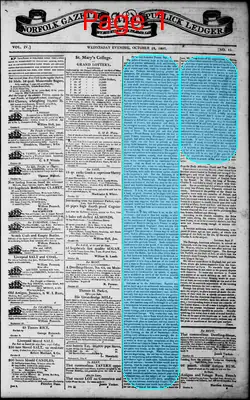
Norfolk Gazette And Publick Ledger
Norfolk, Virginia
What is this article about?
Editorial in the London Times discusses tense relations with Russia over the seizure of the Danish navy and potential violation of neutrality, urging impartiality, and with America over dispatches demanding quick response to a June incident, hoping for amicable settlement amid European conflicts.
Clipping
OCR Quality
Full Text
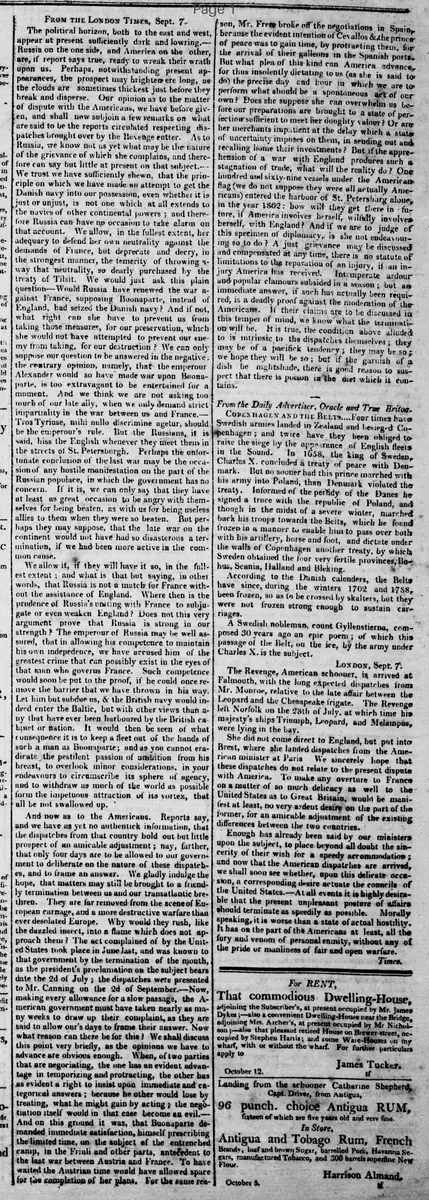
The political horizon, both to the east and west, appear at present sufficiently dark and lowering. Russia on the one side, and America on the other, are, if report says true, ready to wreak their wrath upon us. Perhaps, notwithstanding present appearances, the prospect may brighten ere long, as the clouds are sometimes thickest just before they break and disperse. Our opinion as to the matter of dispute with the Americans, we have before given, and shall now subjoin a few remarks on what are said to be the reports circulated respecting dispatches brought over by the Revenge cutter. As to Russia, we know not as yet what may be the nature of the grievance of which she complains, and therefore can say but little at present on that subject. We trust we have sufficiently shewn, that the principle on which we have made an attempt to get the Danish navy into our possession, even whether it is just or unjust, is not one which at all extends to the navies of other continental powers; and therefore Russia can have no occasion to take alarm on that account. We allow, in the fullest extent, her adequacy to defend her own neutrality against the demands of France, but deprecate and decry, in the strongest manner, the temerity of throwing away that neutrality, so dearly purchased by the treaty of Tilsit. We would just ask this plain question--Would Russia have renewed the war against France, supposing Buonaparte, instead of England, had seized the Danish navy? And if not, what right can she have to prevent us from taking those measures, for our preservation, which she would not have attempted to prevent our enemy from taking, for our destruction? We can only suppose our question to be answered in the negative: the contrary opinion, namely, that the emperor Alexander would so have made war upon Buonaparte, is too extravagant to be entertained for a moment. And we think we are not asking too much of our late ally, when we only demand strict impartiality in the war between us and France. --Tros Tyriusque mihi nullo discrimine agetur, should be the emperor's rule. But the Russians, it is said, hiss the English whenever they meet them in the streets of St. Petersburgh. Perhaps the unfortunate conclusion of the last war may be the occasion of any hostile manifestation on the part of the Russian populace, in which the government has no concern. If it is, we can only say that they have at least as great occasion to be angry with themselves for being beaten, as with us for being useless allies to them when they were so beaten. But perhaps they may suppose, that the late war on the continent would not have had so disastrous a termination, if we had been more active in the common cause.
We allow it, if they will have it so, in the fullest extent; and what is that but saying, in other words, that Russia is not a match for France without the assistance of England. Where then is the prudence of Russia's uniting with France to subjugate or even weaken England? Does not this very argument prove that Russia is strong in our strength? The emperor of Russia may be well assured, that in allowing his competence to maintain his own independence, we have accused him of the greatest crime that can possibly exist in the eyes of that man who governs France. Such competence would soon be put to the proof, if he could once remove the barrier that we have thrown in his way. Let him but subdue us, & the British navy would indeed enter the Baltic, but with other views than any that have ever been harboured by the British cabinet or nation. It would then be seen of what consequence it is to keep a fleet out of the hands of such a man as Buonaparte; and as you cannot eradicate the pestilent passion of ambition from his breast, to overlook minor considerations, in your endeavours to circumscribe its sphere of agency, and to withdraw as much of the world as possible from the impetuous attraction of its vortex, that all be not swallowed up.
And now as to the Americans. Reports say, and we have as yet no authentick information, that the dispatches from that country hold out but little prospect of an amicable adjustment; nay, farther, that only four days are to be allowed to our government to deliberate on the nature of these dispatches, and to frame an answer. We gladly indulge the hope, that matters may still be brought to a friendly termination between us and our transatlantic brethren. They are far removed from the scene of European carnage, and a more destructive warfare than ever desolated Europe. Why would they rush, like the dazzled insect, into a flame which does not approach them? The act complained of by the United States took place in June last, and was known to that government by the termination of the month, as the president's proclamation on the subject bears date the 2d of July; the dispatches were presented to Mr. Canning on the 2d of September. -Now, making every allowance for a slow passage, the American government must have taken nearly as many weeks to draw up their complaint, as they are said to allow our's days to frame their answer. Now what reason can there be for this? We shall discuss this point very briefly, as the opinions we have to advance are obvious enough. When, of two parties that are negociating, the one has an evident advantage in temporizing and protracting, the other has as evident a right to insist upon immediate and categorical answers; because the other would lose by treating, what he might gain by acting; the negociation itself would in that case become an evil. --And on this ground it was, that Buonaparte demanded immediate satisfaction, himself prescribing the limited time, on the subject of the entrenched camp, in the Friuli and other parts, antecedent to the last war between Austria and France. To have waited the Austrian time would have allowed space for the completion of her plans. For the same rea-
What sub-type of article is it?
What keywords are associated?
What entities or persons were involved?
Where did it happen?
Foreign News Details
Primary Location
Russia And United States
Event Date
As Of September 7
Key Persons
Outcome
little prospect of amicable adjustment with america; tensions with russia over danish navy seizure and neutrality
Event Details
The article opines on darkening political prospects with Russia, defending Britain's seizure of the Danish navy as not threatening Russian neutrality under the Tilsit treaty, urging impartiality from Emperor Alexander, and noting anti-English sentiment in St. Petersburg. It argues Russia needs British alliance against France. Regarding America, dispatches via the Revenge cutter indicate poor prospects for settlement of a June incident, with only four days allowed for British response, contrasting with American preparation time; hopes for peaceful resolution to avoid involvement in European war.