Thank you for visiting SNEWPapers!
Sign up free
Story
June 13, 1860
The Evansville Daily Journal
Evansville, Vanderburgh County, Indiana
What is this article about?
Judge Law maintains silence on political stances ahead of the 1860 Baltimore Democratic Convention, reflecting on his past failures as a Whig and Democrat candidate for Congress and Senate, and his shifting positions to secure a national role.
Clipping
OCR Quality
98%
Excellent
Full Text
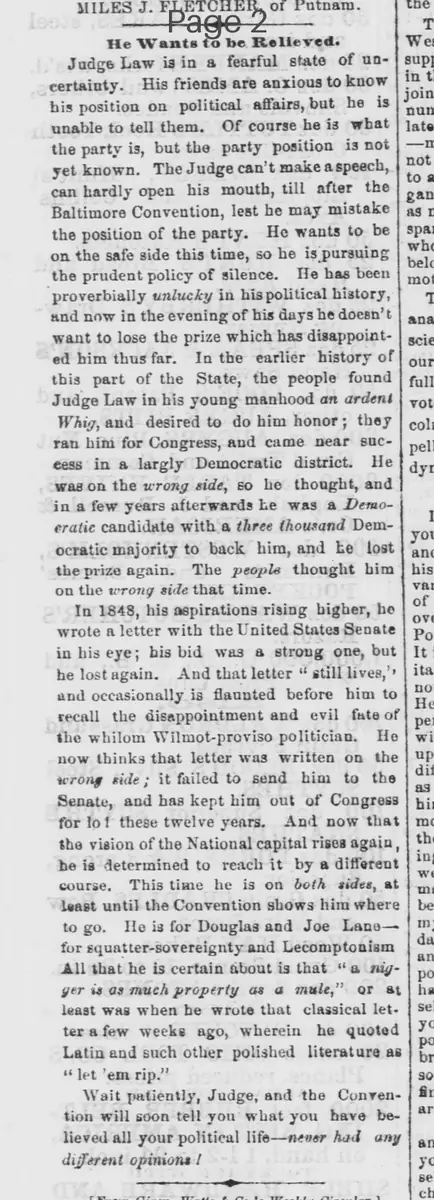
He Wants to be Relieved.
Judge Law is in a fearful state of uncertainty. His friends are anxious to know his position on political affairs, but he is unable to tell them. Of course he is what the party is, but the party position is not yet known. The Judge can't make a speech, can hardly open his mouth, till after the Baltimore Convention, lest he may mistake the position of the party. He wants to be on the safe side this time, so he is pursuing the prudent policy of silence. He has been proverbially unlucky in his political history, and now in the evening of his days he doesn't want to lose the prize which has disappointed him thus far. In the earlier history of this part of the State, the people found Judge Law in his young manhood an ardent Whig, and desired to do him honor; they ran him for Congress, and came near success in a largely Democratic district. He was on the wrong side, so he thought, and in a few years afterwards he was a Democratic candidate with a three thousand Democratic majority to back him, and he lost the prize again. The people thought him on the wrong side that time. In 1848, his aspirations rising higher, he wrote a letter with the United States Senate in his eye; his bid was a strong one, but he lost again. And that letter still lives, and occasionally is flaunted before him to recall the disappointment and evil fate of the whilom Wilmot-proviso politician. He now thinks that letter was written on the wrong side; it failed to send him to the Senate, and has kept him out of Congress for lo! these twelve years. And now that the vision of the National capital rises again, he is determined to reach it by a different course. This time he is on both sides, at least until the Convention shows him where to go. He is for Douglas and Joe Lane—for squatter-sovereignty and Lecomptonism. All that he is certain about is that "a nigger is as much property as a mule," or at least was when he wrote that classical letter a few weeks ago, wherein he quoted Latin and such other polished literature as "let 'em rip." Wait patiently, Judge, and the Convention will soon tell you what you have believed all your political life—never had any different opinions.
Judge Law is in a fearful state of uncertainty. His friends are anxious to know his position on political affairs, but he is unable to tell them. Of course he is what the party is, but the party position is not yet known. The Judge can't make a speech, can hardly open his mouth, till after the Baltimore Convention, lest he may mistake the position of the party. He wants to be on the safe side this time, so he is pursuing the prudent policy of silence. He has been proverbially unlucky in his political history, and now in the evening of his days he doesn't want to lose the prize which has disappointed him thus far. In the earlier history of this part of the State, the people found Judge Law in his young manhood an ardent Whig, and desired to do him honor; they ran him for Congress, and came near success in a largely Democratic district. He was on the wrong side, so he thought, and in a few years afterwards he was a Democratic candidate with a three thousand Democratic majority to back him, and he lost the prize again. The people thought him on the wrong side that time. In 1848, his aspirations rising higher, he wrote a letter with the United States Senate in his eye; his bid was a strong one, but he lost again. And that letter still lives, and occasionally is flaunted before him to recall the disappointment and evil fate of the whilom Wilmot-proviso politician. He now thinks that letter was written on the wrong side; it failed to send him to the Senate, and has kept him out of Congress for lo! these twelve years. And now that the vision of the National capital rises again, he is determined to reach it by a different course. This time he is on both sides, at least until the Convention shows him where to go. He is for Douglas and Joe Lane—for squatter-sovereignty and Lecomptonism. All that he is certain about is that "a nigger is as much property as a mule," or at least was when he wrote that classical letter a few weeks ago, wherein he quoted Latin and such other polished literature as "let 'em rip." Wait patiently, Judge, and the Convention will soon tell you what you have believed all your political life—never had any different opinions.
What sub-type of article is it?
Biography
What themes does it cover?
Misfortune
Fortune Reversal
What keywords are associated?
Judge Law
Political Uncertainty
Baltimore Convention
Whig Democrat Shift
Electoral Failures
Wilmot Proviso
Squatter Sovereignty
What entities or persons were involved?
Judge Law
Douglas
Joe Lane
Where did it happen?
This Part Of The State
Story Details
Key Persons
Judge Law
Douglas
Joe Lane
Location
This Part Of The State
Event Date
1860
Story Details
Judge Law stays silent until the Baltimore Convention to align with the Democratic Party's position, recalling his past losses as a Whig congressional candidate, Democratic candidate, and failed Senate bid in 1848 via a Wilmot-proviso letter, now supporting both sides including Douglas and Lane while viewing slaves as property like mules.