Thank you for visiting SNEWPapers!
Sign up free
Story
April 29, 1813
Virginia Argus
Richmond, Virginia
What is this article about?
Defense of Virginia against ambition charges: it ceded territories reducing power; presidents Washington, Jefferson, Madison elected by national merit, not state machinations, as shown in election vote analyses from 1789-1816.
Clipping
OCR Quality
98%
Excellent
Full Text
From the Military Monitor.
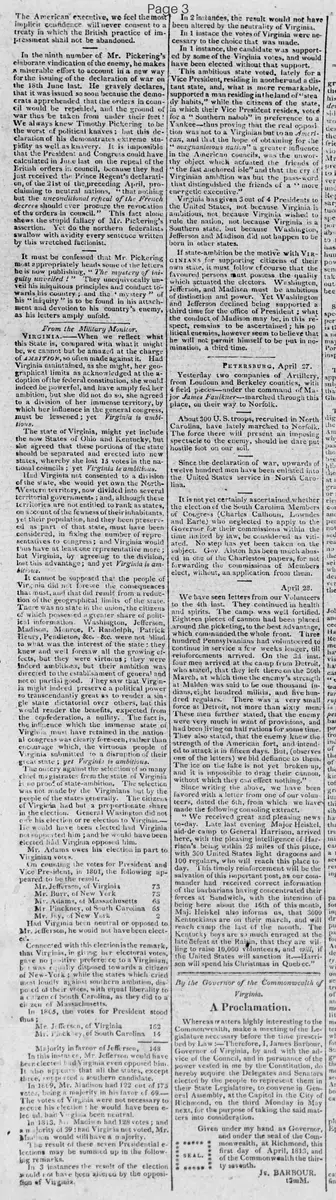
VIRGINIA.—When we reflect what this State is, compared with what it might be, we cannot but be amazed at the charge of AMBITION, so often made against it. Had Virginia maintained, as she might, her geographical limits as acknowledged at the adoption of the federal constitution, she would indeed be powerful, and have amply fed her ambition, but she did not do so, she agreed to a division of her immense territory, by which her influence in the general congress, must be lessened; yet Virginia is ambitious.
The state of Virginia, might yet include the now States of Ohio and Kentucky, but she agreed that these portions of the state should be separated and erected into new states, whereby she lost 15 votes in the national councils; yet Virginia is ambitious.
Had Virginia not consented to a division of the state, she would yet own the North-Western territory, now divided into several territorial governments; and, although these territories are not entitled to rank as states, on account of the fewness of their inhabitants, yet their population, had they been preserved as part of that state, must have been considered, in fixing the number of representatives to congress; and Virginia would thus have at least one representative more; but Virginia, by agreeing to the division, lost this advantage; and yet Virginia is ambitious.
It cannot be supposed that the people of Virginia did not foresee the consequences that must, and that did result from a reduction of the geographical limits of the state. There was no state in the union, the citizens of which possessed a greater share of political information. Washington, Jefferson, Madison, Monroe, P. Randolph, Patrick Henry, Pendleton, &c. &c. were not blind to what was the interest of the state: they knew and well foresaw all the growing effects, but they were virtuous; they were indeed ambitious, but their ambition was directed to the establishment of general and not of partial good. They saw that Virginia might indeed preserve a political power so transcendently great as to render a single state dictatorial over others, but this would render the benefits, expected from the confederation, a nullity. The fact is, the influence which the immense state of Virginia must have retained in the national congress was clearly foreseen, rather than encourage which, the virtuous people of Virginia submitted to a disruption of their great state; yet Virginia is ambitious.
The outcry against the selection of so many chief magistrates from the state of Virginia is no proof of state-ambition. The selection was not made by the Virginians but by the people of the states generally. The citizens of Virginia had but a proportionate share in the election. General Washington did not owe his election or re-election to Virginia.—He would have been elected had Virginia not supported him; and he would have been elected had Virginia opposed him.
Mr. Adams owes his election in part to Virginian votes.
(on counting the votes for President and Vice-President, in 1801, the following appeared to be the result.
Mr. Jefferson, of Virginia 73
Mr. Burr, of New York 73
Mr. Adams, of Massachusetts 65
Mr. Pinckney, of South Carolina 65
Mr. Jay, of New York 0
Had Virginia been neutral or opposed to Mr. Jefferson, he would not have been elected.
Connected with this election is the remark, that Virginia, in giving her electoral votes, gave no positive preference to a Virginian, but was equally disposed towards a citizen of New-York; while the states which cried most loudly against southern ambition, disposed of their votes, with equal liberality to a citizen of South Carolina, as they did to a citizen of Massachusetts.
In 1805, the votes for President stood thus;
Mr. Jefferson, of Virginia 162
Mr. Pinckney, of South Carolina 14
Majority in favour of Jefferson, 148
In this instance, Mr. Jefferson would have been elected had Virginia even opposed him. It also appears that all the states, except three, supported a southern candidate.
In 1809, Mr. Madison had 122 out of 175 votes, being a majority in his favor of 69.—The votes of Virginia were not necessary to secure his election: he would have been elected had Virginia been neutral.
In 1813, J. Madison had 128 votes; and a majority of 39: had Virginia not voted, Mr. Madison would still have a majority.
The result of these seven Presidential elections may be summed up in the following remarks.
In 3 instances the result of the election would not have been altered by the opposition of Virginia,
In 2 instances, the result would not have been altered by the neutrality of Virginia.
In 1 instance the votes of Virginia were necessary to the choice that was made.
In 1 instance, the candidate was supported by some of the Virginia votes, and would have been elected without that support.
This ambitious state voted, lately for a Vice President, residing in another and a distant state, and, what is more remarkable, supported a man residing in the land of "steady habits," while the citizens of the state, in which their Vice President resides, voted for a "Southern nabob" in preference to a Yankee—thus proving that the real opposition was not to a Virginian but to an American, and that the hope of obtaining for the "magnanimous nation" a greater influence in the American councils, was the unworthy object which actuated the friends of "the fast anchored isle" and that the cry of Virginian ambition was but the pass-word that distinguished the friends of a "more energetic executive."
Virginia has given 3 out of 4 Presidents to the United States, not because Virginia is ambitious, not because Virginia wished to rule the nation, not because Virginia is a Southern state, but because Washington, Jefferson and Madison did not happen to be born in other states.
If state-ambition be the motive with VIRGINIANS for supporting citizens of their own state, it must follow of course that the favoured persons must possess the quality which actuated the electors. Washington, Jefferson, and Madison must be ambitious of distinction and power. Yet Washington and Jefferson declined being supported a third time for the office of President; what the conduct of Madison may be, in this respect, remains to be ascertained; his political enemies, however seem to believe that he will not permit himself to be put in nomination, a third time.
VIRGINIA.—When we reflect what this State is, compared with what it might be, we cannot but be amazed at the charge of AMBITION, so often made against it. Had Virginia maintained, as she might, her geographical limits as acknowledged at the adoption of the federal constitution, she would indeed be powerful, and have amply fed her ambition, but she did not do so, she agreed to a division of her immense territory, by which her influence in the general congress, must be lessened; yet Virginia is ambitious.
The state of Virginia, might yet include the now States of Ohio and Kentucky, but she agreed that these portions of the state should be separated and erected into new states, whereby she lost 15 votes in the national councils; yet Virginia is ambitious.
Had Virginia not consented to a division of the state, she would yet own the North-Western territory, now divided into several territorial governments; and, although these territories are not entitled to rank as states, on account of the fewness of their inhabitants, yet their population, had they been preserved as part of that state, must have been considered, in fixing the number of representatives to congress; and Virginia would thus have at least one representative more; but Virginia, by agreeing to the division, lost this advantage; and yet Virginia is ambitious.
It cannot be supposed that the people of Virginia did not foresee the consequences that must, and that did result from a reduction of the geographical limits of the state. There was no state in the union, the citizens of which possessed a greater share of political information. Washington, Jefferson, Madison, Monroe, P. Randolph, Patrick Henry, Pendleton, &c. &c. were not blind to what was the interest of the state: they knew and well foresaw all the growing effects, but they were virtuous; they were indeed ambitious, but their ambition was directed to the establishment of general and not of partial good. They saw that Virginia might indeed preserve a political power so transcendently great as to render a single state dictatorial over others, but this would render the benefits, expected from the confederation, a nullity. The fact is, the influence which the immense state of Virginia must have retained in the national congress was clearly foreseen, rather than encourage which, the virtuous people of Virginia submitted to a disruption of their great state; yet Virginia is ambitious.
The outcry against the selection of so many chief magistrates from the state of Virginia is no proof of state-ambition. The selection was not made by the Virginians but by the people of the states generally. The citizens of Virginia had but a proportionate share in the election. General Washington did not owe his election or re-election to Virginia.—He would have been elected had Virginia not supported him; and he would have been elected had Virginia opposed him.
Mr. Adams owes his election in part to Virginian votes.
(on counting the votes for President and Vice-President, in 1801, the following appeared to be the result.
Mr. Jefferson, of Virginia 73
Mr. Burr, of New York 73
Mr. Adams, of Massachusetts 65
Mr. Pinckney, of South Carolina 65
Mr. Jay, of New York 0
Had Virginia been neutral or opposed to Mr. Jefferson, he would not have been elected.
Connected with this election is the remark, that Virginia, in giving her electoral votes, gave no positive preference to a Virginian, but was equally disposed towards a citizen of New-York; while the states which cried most loudly against southern ambition, disposed of their votes, with equal liberality to a citizen of South Carolina, as they did to a citizen of Massachusetts.
In 1805, the votes for President stood thus;
Mr. Jefferson, of Virginia 162
Mr. Pinckney, of South Carolina 14
Majority in favour of Jefferson, 148
In this instance, Mr. Jefferson would have been elected had Virginia even opposed him. It also appears that all the states, except three, supported a southern candidate.
In 1809, Mr. Madison had 122 out of 175 votes, being a majority in his favor of 69.—The votes of Virginia were not necessary to secure his election: he would have been elected had Virginia been neutral.
In 1813, J. Madison had 128 votes; and a majority of 39: had Virginia not voted, Mr. Madison would still have a majority.
The result of these seven Presidential elections may be summed up in the following remarks.
In 3 instances the result of the election would not have been altered by the opposition of Virginia,
In 2 instances, the result would not have been altered by the neutrality of Virginia.
In 1 instance the votes of Virginia were necessary to the choice that was made.
In 1 instance, the candidate was supported by some of the Virginia votes, and would have been elected without that support.
This ambitious state voted, lately for a Vice President, residing in another and a distant state, and, what is more remarkable, supported a man residing in the land of "steady habits," while the citizens of the state, in which their Vice President resides, voted for a "Southern nabob" in preference to a Yankee—thus proving that the real opposition was not to a Virginian but to an American, and that the hope of obtaining for the "magnanimous nation" a greater influence in the American councils, was the unworthy object which actuated the friends of "the fast anchored isle" and that the cry of Virginian ambition was but the pass-word that distinguished the friends of a "more energetic executive."
Virginia has given 3 out of 4 Presidents to the United States, not because Virginia is ambitious, not because Virginia wished to rule the nation, not because Virginia is a Southern state, but because Washington, Jefferson and Madison did not happen to be born in other states.
If state-ambition be the motive with VIRGINIANS for supporting citizens of their own state, it must follow of course that the favoured persons must possess the quality which actuated the electors. Washington, Jefferson, and Madison must be ambitious of distinction and power. Yet Washington and Jefferson declined being supported a third time for the office of President; what the conduct of Madison may be, in this respect, remains to be ascertained; his political enemies, however seem to believe that he will not permit himself to be put in nomination, a third time.
What sub-type of article is it?
Historical Event
What themes does it cover?
Justice
Moral Virtue
What keywords are associated?
Virginia Ambition
Presidential Elections
Territorial Division
Political Influence
Southern Presidents
What entities or persons were involved?
Washington
Jefferson
Madison
Monroe
P. Randolph
Patrick Henry
Pendleton
Adams
Burr
Pinckney
Jay
Where did it happen?
Virginia
Story Details
Key Persons
Washington
Jefferson
Madison
Monroe
P. Randolph
Patrick Henry
Pendleton
Adams
Burr
Pinckney
Jay
Location
Virginia
Event Date
1801 1813
Story Details
The article refutes charges of Virginia's ambition by noting its voluntary territorial divisions reducing its influence, and analyzes presidential elections showing Virginia's votes were not decisive in most cases, attributing selections to the merits of Virginians like Washington, Jefferson, and Madison rather than state ambition.