Thank you for visiting SNEWPapers!
Sign up free
The Columbia Evening Missourian
Columbia, Boone County, Missouri
What is this article about?
In Jefferson City on July 11, the Missouri Senate is set to pass the Ralph road bill after a joint committee, led by Sen. Ralph, toured eastern states to study hard-surface road construction. The bill emphasizes durable highways over dirt or gravel, informed by experts from Indiana, Massachusetts, and others.
Clipping
OCR Quality
Full Text
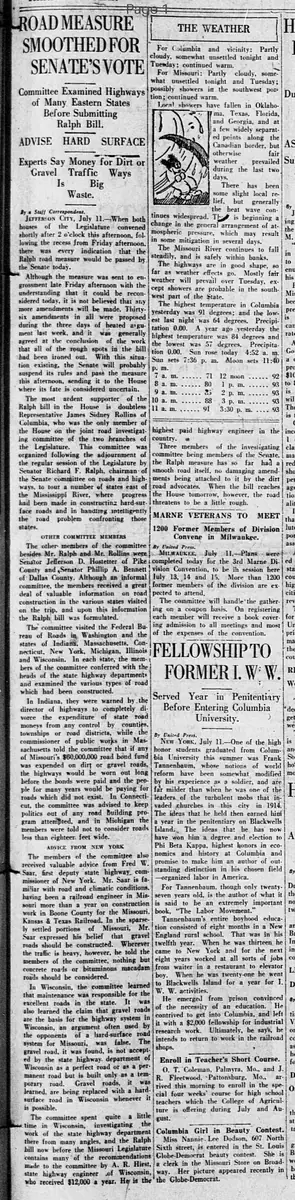
SMOOTHED FOR
SENATE'S VOTE
Committee Examined Highways of Many Eastern States Before Submitting Ralph Bill.
ADVISE HARD SURFACE
Experts Say Money for Dirt or Gravel Traffic Ways Is Big Waste.
By Staff Correspondent.
JEFFERSON CITY, July 11.—When both houses of the Legislature convened shortly after 2 o'clock this afternoon, following the recess from Friday afternoon, there was every indication that the Ralph road measure would be passed by the Senate today.
Although the measure was sent to engrossment late Friday afternoon with the understanding that it could be reconsidered today, it is not believed that any more amendments will be made. Thirty-six amendments in all were proposed during the three days of heated argument last week, and it was generally agreed at the conclusion of the work that all of the rough spots in the bill had been ironed out. With this situation existing, the Senate will probably suspend its rules and pass the measure this afternoon, sending it to the House where its fate is considered uncertain.
The most ardent supporter of the Ralph bill in the House is doubtless Representative James Sidney Rollins of Columbia, who was the only member of the House on the joint road investigating committee of the two branches of the Legislature. This committee was organized following the adjournment of the regular session of the Legislature by Senator Richard F. Ralph, chairman of the Senate committee on roads and highways, to tour a number of states east of the Mississippi River, where progress had been made in constructing hard-surface roads and in handling intelligently the road problem confronting those states.
OTHER COMMITTEE MEMBERS
The other members of the committee besides Mr. Ralph and Mr. Rollins were Senator Jefferson D. Hostetter of Pike County and Senator Phillip A. Bennett of Dallas County. Although an informal committee, the members received a great deal of valuable information on road construction in the various states visited on the trip, and upon this information the Ralph bill was formulated.
The committee visited the Federal Bureau of Roads in Washington and the states of Indiana, Massachusetts, Connecticut, New York, Michigan, Illinois and Wisconsin. In each state, the members of the committee conferred with the heads of the state highway departments and examined the various types of road which had been constructed.
In Indiana, they were warned by the director of highways to completely divorce the expenditure of state road moneys from any control by counties, townships or road districts, while the commissioner of public works in Massachusetts told the committee that if any of Missouri's $60,000,000 road bond fund was expended on dirt or gravel roads, the highways would be worn out long before the bonds were paid and the people for many years would be paying for roads which did not exist. In Connecticut, the committee was advised to keep politics out of any road building program attempted, and in Michigan the members were told not to consider roads less than eighteen feet wide.
ADVICE FROM NEW YORK
The members of the committee also received valuable advice from Fred W. Saar, first deputy state highway commissioner of New York. Mr. Saar is familiar with road and climatic conditions, having been a railroad engineer in Missouri more than a year on construction work in Boone County for the Missouri, Kansas & Texas Railroad. In the sparsely settled portions of Missouri, Mr. Saar expressed his belief that gravel roads should be constructed. Wherever the traffic is heavy, however, he told the members of the committee, nothing but concrete roads or bituminous macadam roads should be considered.
In Wisconsin, the committee learned that maintenance was responsible for the excellent roads in the state. It was also learned the claim that gravel roads are the basis for the highway system in Wisconsin, an argument often used by the opponents of a hard-surface road system for Missouri, was false. The gravel road, it was found, is not accepted by the state highway department of Wisconsin as a perfect road or as a permanent road but is built only as a temporary road. Gravel roads, it was learned, are being replaced with a hard surface road in Wisconsin whenever it is possible.
The committee spent quite a little time in Wisconsin, investigating the work of the state highway department there from many angles, and the Ralph bill now before the Missouri Legislature contains many of the recommendations made to the committee by A. R. Hirst, state highway engineer of Wisconsin, who received $12,000 a year. He is the highest paid highway engineer in the country.
Three members of the investigating committee being members of the Senate, the Ralph measure has so far had a smooth road itself, no damaging amendments being attached to it by the dirt road advocates. When the bill reaches the House tomorrow, however, the road threatens to be a little rough.
What sub-type of article is it?
What themes does it cover?
What keywords are associated?
What entities or persons were involved?
Where did it happen?
Story Details
Key Persons
Location
Jefferson City, Missouri; Indiana; Massachusetts; Connecticut; New York; Michigan; Illinois; Wisconsin; Washington
Event Date
July 11
Story Details
A joint legislative committee toured eastern states to study road construction, informing the Ralph bill for hard-surface roads in Missouri. The Senate is poised to pass it, but the House outcome is uncertain, with advice against dirt or gravel roads and emphasis on maintenance and politics-free programs.