Thank you for visiting SNEWPapers!
Sign up free
Story
June 14, 1820
Alexandria Gazette & Daily Advertiser
Alexandria, Virginia
What is this article about?
A mummified human head discovered in Egypt during canal digging in 1819 is speculated to be Pompey the Great's, embalmed and presented to Caesar, now owned by Dr. Mitchell in New York alongside an Egyptian dog mummy.
Clipping
OCR Quality
98%
Excellent
Full Text
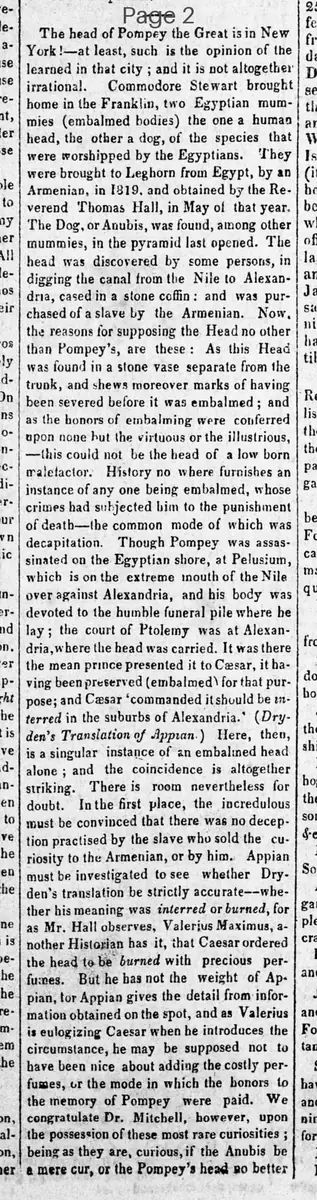
The head of Pompey the Great is in New York!—at least, such is the opinion of the learned in that city; and it is not altogether irrational. Commodore Stewart brought home in the Franklin, two Egyptian mummies (embalmed bodies) the one a human head, the other a dog, of the species that were worshipped by the Egyptians. They were brought to Leghorn from Egypt, by an Armenian, in 1819, and obtained by the Reverend Thomas Hall, in May of that year. The Dog, or Anubis, was found, among other mummies, in the pyramid last opened. The head was discovered by some persons, in digging the canal from the Nile to Alexandria, cased in a stone coffin: and was purchased of a slave by the Armenian. Now, the reasons for supposing the Head no other than Pompey's, are these: As this Head was found in a stone vase separate from the trunk, and shews moreover marks of having been severed before it was embalmed; and as the honors of embalming were conferred upon none but the virtuous or the illustrious.—this could not be the head of a low born malefactor. History no where furnishes an instance of any one being embalmed, whose crimes had subjected him to the punishment of death—the common mode of which was decapitation. Though Pompey was assassinated on the Egyptian shore, at Pelusium, which is on the extreme mouth of the Nile over against Alexandria, and his body was devoted to the humble funeral pile where he lay; the court of Ptolemy was at Alexandria, where the head was carried. It was there the mean prince presented it to Cæsar, it having been preserved (embalmed) for that purpose; and Cæsar 'commanded it should be interred in the suburbs of Alexandria.' (Dryden's Translation of Appian.) Here, then, is a singular instance of an embalmed head alone; and the coincidence is altogether striking. There is room nevertheless for doubt. In the first place, the incredulous must be convinced that there was no deception practised by the slave who sold the curiosity to the Armenian, or by him. Appian must be investigated to see whether Dryden's translation be strictly accurate—whether his meaning was interred or burned, for as Mr. Hall observes, Valerius Maximus, another Historian has it, that Caesar ordered the head to be burned with precious perfumes. But he has not the weight of Appian, for Appian gives the detail from information obtained on the spot, and as Valerius is eulogizing Caesar when he introduces the circumstance, he may be supposed not to have been nice about adding the costly perfumes, or the mode in which the honors to the memory of Pompey were paid. We congratulate Dr. Mitchell, however, upon the possession of these most rare curiosities; being as they are, curious, if the Anubis be a mere cur, or the Pompey's head no better than that of the treacherous centurion who murdered his unsuspecting General,
What sub-type of article is it?
Curiosity
Extraordinary Event
Historical Event
What keywords are associated?
Pompey Head
Egyptian Mummy
Historical Curiosity
Archaeological Find
Pompey Assassination
Caesar Presentation
What entities or persons were involved?
Pompey The Great
Commodore Stewart
Reverend Thomas Hall
Dr. Mitchell
Armenian
Ptolemy
Cæsar
Where did it happen?
Egypt (Nile To Alexandria Canal, Pelusium, Alexandria); New York; Leghorn
Story Details
Key Persons
Pompey The Great
Commodore Stewart
Reverend Thomas Hall
Dr. Mitchell
Armenian
Ptolemy
Cæsar
Location
Egypt (Nile To Alexandria Canal, Pelusium, Alexandria); New York; Leghorn
Event Date
1819
Story Details
An embalmed human head found in a stone coffin during Nile-Alexandria canal digging in 1819 is believed to be Pompey's, severed and embalmed after his assassination at Pelusium, presented to Caesar in Alexandria; acquired by an Armenian, then Thomas Hall, now in New York with a dog mummy, sparking historical debate.