Thank you for visiting SNEWPapers!
Sign up free
The National Intelligencer And Washington Advertiser
Washington, District Of Columbia
What is this article about?
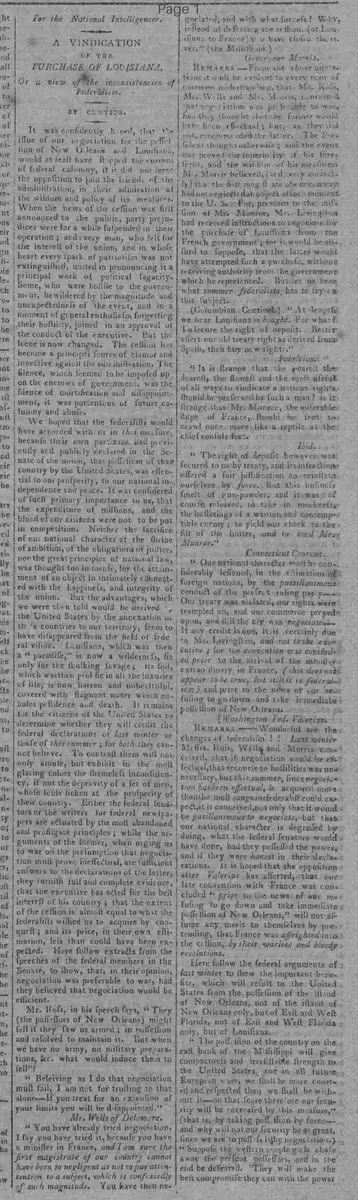
Editorial by Curtius vindicating the U.S. purchase of Louisiana from France, contrasting Federalist senators' prior advocacy for acquiring the territory (even by war) with their current opposition, portraying it as partisan inconsistency while praising the administration's wise negotiation.
Merged-components note: These three components form a single continued editorial: 'A VINDICATION OF THE PURCHASE OF LOUISIANA. Or a view of the inconsistencies of Federalism. BY CURTIUS.' The label is changed from 'story' for the latter two to 'editorial' as it is an opinion piece defending administration policy.
Clippings
1 of 2
OCR Quality
Full Text
A VINDICATION
OF THE
PURCHASE OF LOUISIANA.
Or a view of the inconsistencies of Federalism.
BY
CURTIUS.
It was confidently hoped, that the issue of our negociation for the possession of New Orleans and Louisiana. would at least have stopped the current of federal calumny, if it did not force the opposition to join the friends of the administration, in their admiration of the wisdom and policy of its measures. When the news of the cession was first announced to the public, party prejudices were for a while suspended in their operation ; and every man, who felt for the interest of the union, and in whose heart every spark of patriotism was not extinguished, united in pronouncing it a principal work of political sagacity. Some, who were hostile to the government, bewildered by the magnitude and unexpectedness of the event, and in a moment of general enthusiasm forgetting their hostility, joined in an approval of the conduct of the executive. But the scene is now changed. The cession has become a principal source of clamor and invective against the administration. The silence, which seemed to be imposed up on the enemies of government, was the silence of mortification and disappointment, it was portentous of future calumny and abuse.
We hoped that the federalists would have accorded with us in this measure, because their own partisans had previously and publicly declared in the Senate of the union, that possession of that country by the United States, was essential to our prosperity, to our national independence and peace. It was considered of such primary importance to us, that the expenditure of millions, and the blood of our citizens were not to be put in competition. Neither the sacrifice of our national character at the shrine of ambition, of the obligations of justice. nor the great principles of national law, was thought too immense, for the attainment of an object so intimately connected with the happiness, and integrity of the union. But the advantages, which we were then told would be derived the United States by the annexation o the countries to our territory, seem to have disappeared from the field of federal vision. Louisiana, which was then a "paradise," is now a wilderness, fit only for the skulking savage; its soil, which was then prolific in all the luxuries of life, is now barren and unhealthful, Covered with stagnant water which exhales pestilence and death. It remains for the citizens of the United States to determine whether they will credit the federal declarations of last winter or those of this summer; for both they cannot believe. To contrast them will not only amuse, but exhibit in the most glaring colors the harmless inconsistency, if not the depravity of a set of men, whose souls sicken at the prosperity of their country. Either the federal senators or the writers for federal newspapers are actuated by the most abandoned and profligate principles ; while the arguments of the former, when urging us to war on the presumption that negociation must prove ineffectual, are sufficient answers to the declarations of the latter, they furnish full and complete evidence, that the executive has acted for the best interest of his country ; that the extent of the cession is almost equal to what the federalists wished us to acquire by conquest; and its price, in their own estimation, less than could have been expected. Here follow extracts from the speeches of the federal members in the Senate, to show, that, in their opinion, negociation was preferable to war, had they believed that negociation would be efficient.
Mr. Ross, in his speech says, "They (the powers of New Orleans) might sell if they saw us armed ; in possession and resolved to maintain it. But when we have no army, no military preparations, &c. what would induce them to sell"?
"Believing as I do that negociation must fail, I am not for trusting to that alone. If you treat for an extension of your limits you will be disappointed."
Mr. Wells of Delaware.
"You have already tried negociation. I say you have tried it, because you have a minister in France, and I am sure the first magistrate of our country cannot have been so negligent as not to pay attention to a subject, which is confessedly of such magnitude. You have then ne- gociated, and with what success? Why. instead of defeating the cession, (of Louisiana to France) you have closed the ri- ver." (the Mississippi.)
Gouverneur Morris.
Remarks From the above quotations it must be evident to every man of common understanding. that Mr. Ross, Mr. Wells and Mr. Morris, conceived that negociation was preferable to war, had they thought that the former would have been effectual: but. as they did not, recommended the latter. The President thought otherwise ; and the event has proved the superiority of his fore- sight, and the wisdom of his measures. Mr.. Morris believed, (and very correctly) that the first magistrate our country had not neglected an object of such moment to the U. S. m For. previous to the mission of Mr: Monroe, Mr. Livingston had received instructions to negotiate for the purchase of Louisiana from the French government ; for it would be ab- surd to suppose, that the latter would have attempted such a purchase, without re- ceiving authority from the government which he represented. But let us hear what summer federalists, has to say on this subject.
(Columbian Centinel.) "At length we hear Louisiana is bought. For what? To secure the right of deposit. Better assert our old treaty right as derived from Spain, then buy new rights."
Fabricius
"Is it strange that the nearest the dearest, the slowest and the most useful of all ways to vindicate a nations rights should be preserved by such a man ? is it strange that/ Mr. Monroe, the miserable dupe of France, should be sent to crawl once more like a reptile at the chief consuls feet."
Ibid.
"The right of deposit however was secured to us by treaty, and its infraction offered a fair justification to reinstate ourselves by force. But this business smelt of gun-powder. and it was of course resolved, to take in meekness, the buffettings of a wanton and contempt- ible enemy ; to yield our cheek to the smite of the writer, and to send Mr. Monroe."
to
Connecticut Courant.
"Our national character must be considerably lessened, in the estimation of foreign nations, by the pusillanimous conduct of the present ruling party. Our treaty was violated, our rights were trampled on, and our commerce preyed upon, and still the cry was negotiate-- If any credit is due, it is certainly due" to Mr. Livingston, and not to the executive : or the convention was concluded prior to the arrival of the minister extraordinary in France, (this does not appear to be true, but still it is federal- ism) and prior to the news of our refusing to go down and take immediate possession of New Orleans.
Washington Fed. Valerius.
REMARKS.--Wonderful are the changes of federalism ! ! Last winter Messrs. Ross, Wells and Morris con- ceived, that if negociation would be ef- fectual, that recourse to hostilities was un- necessary, but this summer, since negociation has been effectual, & acquired more than the most sanguine federalists could ex- pect, it is conceived, not only that it would be pusillanimous to negotiate, but that our national character is degraded by doing, what the federal senators would have done, had they possessed the power, and if they were honest in their declarations. it is hoped that the opposition after Valerius has asserted, that our late convention with France was con- cluded "prior to the news of our refusing to go down and take immediate possession of New Orleans, " will not as- sume any merit to themselves by pre- tending, that France was affrighted into the cession, by their warlike and bloody resolutions.
Here follow the federal arguments of last winter to shew the important benefits, which will result to the United States from the possession of the island of New Orleans, not of the island of New Orleans only, but of East and West Florida, not of East and West Florida only, but of Louisiana.
"The possession of the country on the east bank of the Mississippi will give compactness and irresistible strength to the United States, and in all future European wars, we shall be more courted and respected than we shall be with- out it--on that score therefore our secu- rity will be increased by this measure," (that is, by taking possession by force-- and why will not our security be as great, since we are to possess it by negociation.)
"Suppose the western people go & chase away the present possessors, and in the end be defeated. They will make the best compromise they can with the power
commanding the mouth of the river.
Is it not evident that any power having the command of the mouth of the river must possess the land on both sides of it?) Bonaparte will then say to you, my French West India colonies and those of my allies, can be supplied from my colony of Louisiana, with flour, pork, beef, lumber and any other necessary.--If you on the Atlantic coast, with to trade with my colonies in those articles, you must pay 15 or 20 per cent. import: we want no further supplies from you, and revenue to France must be the condition of all future intercourse."
(Ross's first speech)
"We are not deliberating about the right of deposit in New Orleans only, nor about the island of New Orleans, we are told that we are to look for new and powerful neighbors in Louisiana.--What right has Spain to give us these neighbors without consulting us. To change our present security into hazard and uncertainty? I do not believe that Spain has any right to do so. What are the limits of Louisiana! It extends 3,000 miles upon your frontier, New Orleans is ceded with The Floridas and they belong to the matters of Louisiana and New Orleans. Then the owners possess the lock and key of the whole western Country. They have not only 3,000 miles on your frontier in the interior country, but they have the command of your outlet to the ocean, and 700 miles of sea coast, embracing the finest harbours in North America. This makes them in fact masters of the western world." (If France possesses this country) "we must go to market through a line of batteries manned by veterans, and return home with our money through a fortified camp. This privilege will be held at their will, and may be withheld whenever their interest forbids its further continuance.--Our object is not war, but the attainment of security or a right without which our political existence cannot continue."
Ross's second speech.
"He (Bonaparte) knows full well the value of the position, the mouth of the Mississippi; we know. It must become one of the first in the world, and that it now offers higher temptations to a powerful, ambitious and intriguing people, than any place on the earth. It is the only key to the immense regions watered by the Mississippi and its tributary streams, to a country larger in extent than all Europe, surpassed by no portion of the world in fertility of soil, and, most of it, in climate, a paradise."
Mr. White, of Delaware.
Speaking of the foreign influence, which would be introduced into our government should France possess that country, he remarks, whenever this period shall arrive, it will be the crisis of American glory, and must result either in the political subjection of the Atlantic states, or in their separation from the western country, and I am sure there is no American who does not view as one of the greatest evils that could befall us, the dismemberment of this union."
His colleague, Mr. Wells, says--
"For my own part I am strongly impressed with an opinion that the French consul has a project in view deeply hostile to the prosperity of our country." He says too--"there is but one fault I find with these resolutions (Ross's) which is, they do not go far enough.--If I could obtain a second, I would move an amendment explicitly authorizing the taking possession of both the Floridas, as well as the island of New Orleans."
Gouverneur Morris, in his speech before the senate, remarks: "There has been a cession of the island of New Orleans and of Louisiana to France and probably of the Floridas. Now, sir, let us note the time and manner of this cession. It was at a moment when France could take up a distant object of attention. It was secret because it was hostile. The First Consul, in the moment of terminating his differences with you, sought the means of future influence and controul. He found and secured a pivot, by which, with potent arm, he means to subvert your civil and political institutions. Here is a vast country given away, and not without danger to us."
Speaking of the cession of these provinces to France, he says, "The general consequences are those, which affect our revenue, our defence, and what is of more importance than these, our union. Your commerce will suffer, because you will no longer hold the means of supplying the West India islands subject to your single controul; and because all the exports from New Orleans, being of course in French bottoms, your navigation will be proportionably diminished. Your revenue will suffer as much as your commerce. The extensive boundary of more than 2,000 miles, will be stocked with goods for the purpose of contraband trade. The inhabitants will naturally take their supplies in that way. With this country in your possession you have means of defence more ample, more important, more easy than any nation on earth. In a short time all the West India islands, fed from your granaries, must depend upon your will, and in consequence all the powers of Europe, who
have colonies there, must court your friendship. Consider moreover, your condition in the wars which are the most likely to happen. These must be either with France or England. If with France your interior is ruined; if with England, the commerce of the Atlantic States will be distressed; and that of the western country too, though not perhaps in so great a degree. Thus, let the war be with whichever those nations it may, one half of the United States must be peculiarly injured; and, in all cases, it will be difficult for them to assist each other."
After thus detailing the general consequences of the possession of these provinces by France, he proceeds to point out the particular evils, which the great sections of the United States will sustain. In peace, they (the western states) will suffer the diminution of price or their produce. In a war with England, the attention of her fleets to cut off supplies from her enemies, most necessarily affect the price of produce in a greater degree; and in a war with France it will bear no price at all, until N. Orleans shall be wrestled from their grasp. The price of land must be reduced from the certainty that its produce will become less valuable.--The flood of emigration to those fertile regions must cease, &c.
"The southern states will be exposed to invasion from the Floridas and New Orleans.--Pernicious emissaries may insinuate with a prospect of freedom the miserable men (the slaves) who now toil without hope. They may excite them to imitate a fatal example, (that of St. Domingo) and to act over those scenes, which fill our minds with horror, &c."
"Their trade (the trade of the middle states) to the West India islands is gone, the moment that country is in possession of the French. England, to whose dominions alone they can have recourse for the vent of their produce, and the purchase of their supplies. will confine that commerce to her own ships."
"To the eastern states, when separately considered, this may appear a matter of less moment than to the other great divisions of our country. But they will perceive in it the loss of their navigation; they will see the theatre of their industrious exertions contracted; they will feel the loss of the productions of the western world in the marts of their commercial operations; and above all they will feel the loss of ample resources for their children. These western regions are peculiarly their heritage. It is the property of the fathers of America, which they hold in trust for their children. The exuberant population of the eastern states, is in a steady train to the western world, and if that be rendered useless, or pass under the dominion of a foreign power, the fairest hope of posterity is destroyed."
"Whether we consider, therefore, the object in relation to our general policy, or examine its bearings on the great divisions of our country, we find ample reason to agree with the gentleman near me, that New Orleans and the Floridas, must not be separate from the United States." "Never, no never has France let sight of Louisiana. Never for a moment has she been blind to its importance. "Grant us these provinces, and we can dictate our commerce with the islands. Possessed of them it will be doubly lucrative, and without them wholly uncertain, &c.--But great as are the benefits which will result from possession of the Floridas and New Orleans, great as is their tendency to advance our power, secure our peace and extend our commerce; there is a consideration in comparison with which, commerce, peace and power are of but slight avail.--These provinces will fortify the defence of our freedom."
"My honorable colleague has stated to you his apprehension of standing armies. And yet, sir, if we be not possessed of this country, standing armies become necessary--when it is in our hands, we need no standing army."
"Mr. Jonathan Mason in his speech says, "If the whole province of Maine were invaded by our enemy, it would not be of so much importance as the stoppage of the Mississippi."
Remarks--The paragraphs last cited from the speeches of the federal senators, are a full and complete vindication of the purchase of the whole of Louisiana, so far as it regards, not only the commercial and agricultural prosperity of the union, but its peace, independence and integrity. For the object of the opposition, in urging us to war, if we may believe, their own solemn declarations, was the acquisition of such an extent of territory on our Western and Southern frontiers, as would effectually secure us against all foreign influence in those quarters; it was to obtain security for the free and uninterrupted navigation of the Mississippi; to preserve us from a dissolution of the union; to extend the means of our defence; and to command the commerce of the West India Islands. So far as these objects depend upon our Western boundaries, they are more effectually secured by the possession of both than of one of the banks of the Mississippi. For had France, whose chief magistrate is represented as ambitious, intriguing and irresistible, retained the Western bank, with the lands adjoining, could she not have sent her emissaries to disturb our internal tranquility; would she not have spread disaffection in our western states; would she not have disturbed our navigation of the Mississippi, and by her arts and industry have rivalled our commerce to the West Indies? If also our revenue be a matter worthy of consideration, would she not be enabled to smuggle goods into our dominions, with almost as much facility, as though she were in possession of the Eastern shore .--In the contemplation of Mr. Morris, if we obtain these provinces, a standing army will be unnecessary. But altho' we may not be able to proceed in our political career, without some troops in that quarter, till we may safely say, that the possession of the Eastern bank alone, would not relieve us from such an incumbrance: For had France retained the Western bank, she would have kept up a military force, which must have compelled us to adopt the same measure. In whatever light therefore we consider the subject, if any faith can be reposed in the assertions of the opposition, if their views, in attempting to drive us to acts of hostility, were truly represented, they contemplated not the conquest of New Orleans and the Floridas only. but of Louisiana. Their speeches on this subject are the best encomium on the wisdom of the administration, and the most powerful justification of its proceedings.
What sub-type of article is it?
What keywords are associated?
What entities or persons were involved?
Editorial Details
Primary Topic
Vindication Of The Louisiana Purchase
Stance / Tone
Strongly Pro Administration Defense Against Federalist Inconsistency
Key Figures
Key Arguments