Thank you for visiting SNEWPapers!
Sign up free
Literary
November 2, 1836
Vermont Telegraph
Brandon, Rutland County, Vermont
What is this article about?
Critique of arithmetic teaching in common schools, emphasizing rote memorization over understanding and practical application. Highlights neglect of tables, poor explanation by teachers, and resulting ignorance in pupils for everyday use.
Clipping
OCR Quality
98%
Excellent
Full Text
From the Common School Assistant.
STUDY OF ARITHMETIC—NO. 2.
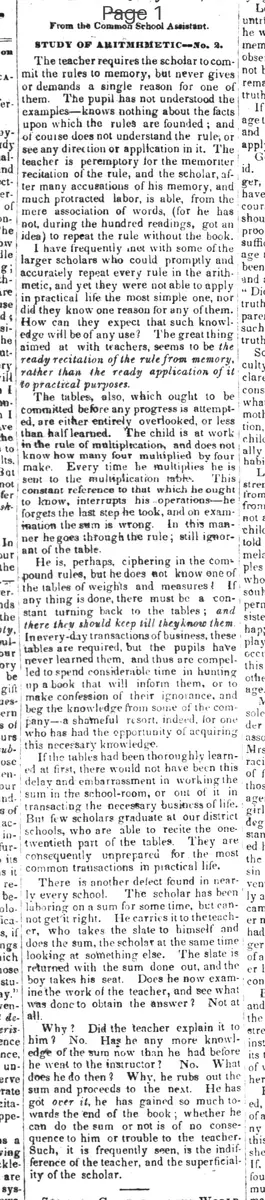
The teacher requires the scholar to commit the rules to memory, but never gives or demands a single reason for one of them. The pupil has not understood the examples—knows nothing about the facts upon which the rules are founded; and of course does not understand the rule, or see any direction or application in it. The teacher is peremptory for the memoriter recitation of the rule, and the scholar, after many accusations of his memory, and much protracted labor, is able, from the mere association of words, (for he has not, during the hundred readings, got an idea) to repeat the rule without the book. I have frequently met with some of the larger scholars who could promptly and accurately repeat every rule in the arithmetic, and yet they were not able to apply in practical life the most simple one, nor did they know one reason for any of them.
How can they expect that such knowledge will be of any use? The great thing aimed at with teachers, seems to be the ready recitation of the rule from memory, rather than the ready application of it to practical purposes.
The tables, also, which ought to be committed before any progress is attempted, are either entirely overlooked, or less than half learned. The child is at work in the rule of multiplication, and does not know how many four multiplied by four make. Every time he multiplies he is sent to the multiplication table. This constant reference to that which he ought to know, interrupts his operations—he forgets the last step he took, and on examination the sum is wrong. In this manner he goes through the rule; still ignorant of the table.
He is, perhaps, ciphering in the compound rules, but he does not know one of the tables of weights and measures. If anything is done, there must be a constant turning back to the tables; and there they should keep till they know them. In every-day transactions of business, these tables are required, but the pupils have never learned them, and thus are compelled to spend considerable time in hunting up a book that will inform them, or to make confession of their ignorance, and beg the knowledge from some of the company—a shameful resort, indeed, for one who has had the opportunity of acquiring this necessary knowledge.
If the tables had been thoroughly learned at first, there would not have been this delay and embarrassment in working the sum in the school-room, or out of it in transacting the necessary business of life. But few scholars graduate at our district schools, who are able to recite the one-twentieth part of the tables. They are consequently unprepared for the most common transactions in practical life.
There is another defect found in nearly every school. The scholar has been laboring on a sum for some time, but cannot get it right. He carries it to the teacher, who takes the slate to himself and does the sum, the scholar at the same time looking at something else. The slate is returned with the sum done out, and the boy takes his seat. Does he now examine the work of the teacher, and see what was done to obtain the answer? Not at all.
Why? Did the teacher explain it to him? No. Has he any more knowledge of the sum now than he had before he went to the instructor? No. What does he do then? Why, he rubs out the sum and proceeds to the next. He has got over it, he has gained so much towards the end of the book: whether he can do the sum or not is of no consequence to him or trouble to the teacher.
Such, it is frequently seen, is the indifference of the teacher, and the superficiality of the scholar.
STUDY OF ARITHMETIC—NO. 2.
The teacher requires the scholar to commit the rules to memory, but never gives or demands a single reason for one of them. The pupil has not understood the examples—knows nothing about the facts upon which the rules are founded; and of course does not understand the rule, or see any direction or application in it. The teacher is peremptory for the memoriter recitation of the rule, and the scholar, after many accusations of his memory, and much protracted labor, is able, from the mere association of words, (for he has not, during the hundred readings, got an idea) to repeat the rule without the book. I have frequently met with some of the larger scholars who could promptly and accurately repeat every rule in the arithmetic, and yet they were not able to apply in practical life the most simple one, nor did they know one reason for any of them.
How can they expect that such knowledge will be of any use? The great thing aimed at with teachers, seems to be the ready recitation of the rule from memory, rather than the ready application of it to practical purposes.
The tables, also, which ought to be committed before any progress is attempted, are either entirely overlooked, or less than half learned. The child is at work in the rule of multiplication, and does not know how many four multiplied by four make. Every time he multiplies he is sent to the multiplication table. This constant reference to that which he ought to know, interrupts his operations—he forgets the last step he took, and on examination the sum is wrong. In this manner he goes through the rule; still ignorant of the table.
He is, perhaps, ciphering in the compound rules, but he does not know one of the tables of weights and measures. If anything is done, there must be a constant turning back to the tables; and there they should keep till they know them. In every-day transactions of business, these tables are required, but the pupils have never learned them, and thus are compelled to spend considerable time in hunting up a book that will inform them, or to make confession of their ignorance, and beg the knowledge from some of the company—a shameful resort, indeed, for one who has had the opportunity of acquiring this necessary knowledge.
If the tables had been thoroughly learned at first, there would not have been this delay and embarrassment in working the sum in the school-room, or out of it in transacting the necessary business of life. But few scholars graduate at our district schools, who are able to recite the one-twentieth part of the tables. They are consequently unprepared for the most common transactions in practical life.
There is another defect found in nearly every school. The scholar has been laboring on a sum for some time, but cannot get it right. He carries it to the teacher, who takes the slate to himself and does the sum, the scholar at the same time looking at something else. The slate is returned with the sum done out, and the boy takes his seat. Does he now examine the work of the teacher, and see what was done to obtain the answer? Not at all.
Why? Did the teacher explain it to him? No. Has he any more knowledge of the sum now than he had before he went to the instructor? No. What does he do then? Why, he rubs out the sum and proceeds to the next. He has got over it, he has gained so much towards the end of the book: whether he can do the sum or not is of no consequence to him or trouble to the teacher.
Such, it is frequently seen, is the indifference of the teacher, and the superficiality of the scholar.
What sub-type of article is it?
Essay
What keywords are associated?
Arithmetic Teaching
Rote Memorization
Practical Application
Multiplication Tables
School Defects
Teacher Indifference
What entities or persons were involved?
From The Common School Assistant
Literary Details
Title
Study Of Arithmetic—No. 2.
Author
From The Common School Assistant
Subject
Critique Of Arithmetic Instruction In Schools
Key Lines
The Great Thing Aimed At With Teachers, Seems To Be The Ready Recitation Of The Rule From Memory, Rather Than The Ready Application Of It To Practical Purposes.
But Few Scholars Graduate At Our District Schools, Who Are Able To Recite The One Twentieth Part Of The Tables.
Such, It Is Frequently Seen, Is The Indifference Of The Teacher, And The Superficiality Of The Scholar.