Thank you for visiting SNEWPapers!
Sign up free
Literary
May 17, 1848
Richmond Palladium
Richmond, Wayne County, Indiana
What is this article about?
A reflective prose essay on the universality of death, which equalizes kings and slaves, rich and poor. It praises the charm of the grave, advocates simplicity over ostentatious monuments, and emphasizes tender recollections and quiet repose for the dead.
Clipping
OCR Quality
95%
Excellent
Full Text
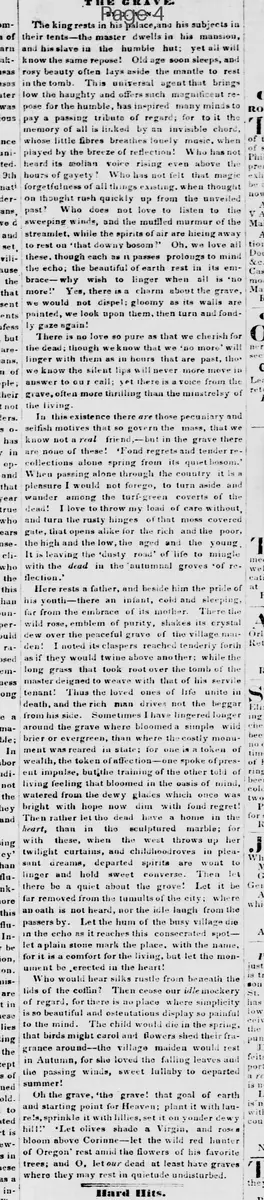
The king rests in his palace, and his subjects in their tents—the master dwells in his mansion, and his slave in the humble hut; yet all will know the same repose! Old age soon sleeps, and rosy beauty often lays aside the mantle to rest in the tomb. This universal agent that brings low the haughty and offers such magnificent repose for the humble, has inspired many minds to pay a passing tribute of regard; for to it the memory of all is linked by an invisible chord, whose little fibres breathes lonely music, when played by the breeze of reflection! Who has not heard its aeolian voice rising even above the hours of gayety? Who has not felt that magic forgetfulness of all things existing, when thought on thought rush quickly up from the unveiled past?
Who does not love to listen to the sweeping winds, and the muffled murmur of the streamlet, while the spirits of air are hieing away to rest on 'that downy bosom?' Oh, we love all these, though each as it passes prolongs to mind the echo; the beautiful of earth rest in its embrace—why wish to linger when all is no more!'
Yes, there is a charm about the grave, we would not dispel; gloomy as its walls are painted, we look upon them, then turn and fondly gaze again! There is no love so pure as that we cherish for the dead; though we know that we 'no more' will linger with them as in hours that are past, those we know the silent lips will never more move in answer to our call; yet there is a voice from the grave, often more thrilling than the minstrelsy of the living.
In this existence there are those pecuniary and selfish motives that so govern the mass, that we know not a real friend,—but in the grave there are none of these! 'Fond regrets and tender recollections alone spring from its quiet bosom.' When passing alone through the country it is a pleasure I would not forego, to turn aside and wander among the turf-green coverts of the dead! I love to throw my load of care without and turn the rusty hinges of that moss covered gate, that opens alike for the rich and the poor, the high and the low, the aged and the young. It is leaving the 'dusty road' of life to mingle with the dead in the 'autumnal groves' of reflection.' Here rests a father, and beside him the pride of his youth—there an infant, cold and sleeping, far from the embrace of its mother. There the wild rose, emblem of purity, shakes its crystal dew over the peaceful grave of the village maiden! I noted its claspers reached tenderly forth as if they would twine above another; while the long grass that took root over the tomb of the master deigned to weave with that of his servile tenant! Thus the loved ones of life unite in death, and the rich man drives not the beggar from his side. Sometimes I have lingered longer around the grave where bloomed a simple wild brier or evergreen, than where the costly monument was reared in state; for one is a token of wealth, the other of affection—one spoke of present impulse, but the training of the other told of living feeling that bloomed in the oasis of mind, watered from the dewy glades which once was bright with hope now dim with fond regret! Then rather let the dead have a home in the heart, than in the sculptured marble; for with these, when the west throws up her twilight curtains, and childhood roves in pleasant dreams, departed spirits are wont to linger and hold sweet converse. Then let there be a quiet about the grove! Let it be far removed from the tumults of the city: where an oath is not heard, nor the idle laugh from the passers by. Let the hum of the busy village die in the echo as it reaches this consecrated spot—let a plain stone mark the place, with the name, for it is a comfort for the living, but let the monument be erected in the heart!
Who would hear silks rustle from beneath the lids of the coffin? Then cease our idle mockery of regard, for there is no place where simplicity is so beautiful and ostentatious display so painful to the mind. The child would die in the spring, that birds might carol and flowers shed their fragrance around—the village maiden would rest in Autumn, for she loved the falling leaves and the passing winds, sweet lullaby to departed summer!
Oh the grave, the grave! that goal of earth and starting point for Heaven; plant it with laurels, sprinkle it with lilies, set it on yonder dewy hill!" Let olives shade a Virgin, and roses bloom above Corinne—let the wild red hunter of Oregon rest amid the flowers of his favorite trees; and O, let our dead at least have graves where they may rest in quietude undisturbed.
Who does not love to listen to the sweeping winds, and the muffled murmur of the streamlet, while the spirits of air are hieing away to rest on 'that downy bosom?' Oh, we love all these, though each as it passes prolongs to mind the echo; the beautiful of earth rest in its embrace—why wish to linger when all is no more!'
Yes, there is a charm about the grave, we would not dispel; gloomy as its walls are painted, we look upon them, then turn and fondly gaze again! There is no love so pure as that we cherish for the dead; though we know that we 'no more' will linger with them as in hours that are past, those we know the silent lips will never more move in answer to our call; yet there is a voice from the grave, often more thrilling than the minstrelsy of the living.
In this existence there are those pecuniary and selfish motives that so govern the mass, that we know not a real friend,—but in the grave there are none of these! 'Fond regrets and tender recollections alone spring from its quiet bosom.' When passing alone through the country it is a pleasure I would not forego, to turn aside and wander among the turf-green coverts of the dead! I love to throw my load of care without and turn the rusty hinges of that moss covered gate, that opens alike for the rich and the poor, the high and the low, the aged and the young. It is leaving the 'dusty road' of life to mingle with the dead in the 'autumnal groves' of reflection.' Here rests a father, and beside him the pride of his youth—there an infant, cold and sleeping, far from the embrace of its mother. There the wild rose, emblem of purity, shakes its crystal dew over the peaceful grave of the village maiden! I noted its claspers reached tenderly forth as if they would twine above another; while the long grass that took root over the tomb of the master deigned to weave with that of his servile tenant! Thus the loved ones of life unite in death, and the rich man drives not the beggar from his side. Sometimes I have lingered longer around the grave where bloomed a simple wild brier or evergreen, than where the costly monument was reared in state; for one is a token of wealth, the other of affection—one spoke of present impulse, but the training of the other told of living feeling that bloomed in the oasis of mind, watered from the dewy glades which once was bright with hope now dim with fond regret! Then rather let the dead have a home in the heart, than in the sculptured marble; for with these, when the west throws up her twilight curtains, and childhood roves in pleasant dreams, departed spirits are wont to linger and hold sweet converse. Then let there be a quiet about the grove! Let it be far removed from the tumults of the city: where an oath is not heard, nor the idle laugh from the passers by. Let the hum of the busy village die in the echo as it reaches this consecrated spot—let a plain stone mark the place, with the name, for it is a comfort for the living, but let the monument be erected in the heart!
Who would hear silks rustle from beneath the lids of the coffin? Then cease our idle mockery of regard, for there is no place where simplicity is so beautiful and ostentatious display so painful to the mind. The child would die in the spring, that birds might carol and flowers shed their fragrance around—the village maiden would rest in Autumn, for she loved the falling leaves and the passing winds, sweet lullaby to departed summer!
Oh the grave, the grave! that goal of earth and starting point for Heaven; plant it with laurels, sprinkle it with lilies, set it on yonder dewy hill!" Let olives shade a Virgin, and roses bloom above Corinne—let the wild red hunter of Oregon rest amid the flowers of his favorite trees; and O, let our dead at least have graves where they may rest in quietude undisturbed.
What sub-type of article is it?
Essay
What themes does it cover?
Death Mortality
Moral Virtue
What keywords are associated?
Grave
Death
Equality
Reflection
Simplicity
Monuments
Recollections
Repose
Literary Details
Form / Style
Meditative Prose Reflection On Death And The Grave
Key Lines
This Universal Agent That Brings Low The Haughty And Offers Such Magnificent Repose For The Humble, Has Inspired Many Minds To Pay A Passing Tribute Of Regard;
There Is No Love So Pure As That We Cherish For The Dead;
Thus The Loved Ones Of Life Unite In Death, And The Rich Man Drives Not The Beggar From His Side.
Then Rather Let The Dead Have A Home In The Heart, Than In The Sculptured Marble;
Oh The Grave, The Grave! That Goal Of Earth And Starting Point For Heaven;