Thank you for visiting SNEWPapers!
Sign up free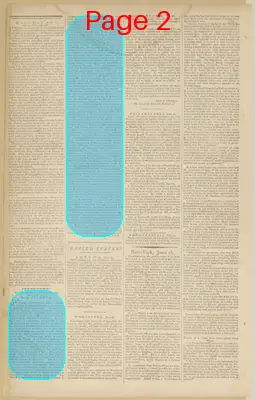
Letter to Editor
June 26, 1787
The New York Packet
New York, New York County, New York
What is this article about?
A critique of John Adams' 'A Vindication of the Constitutions of Government of the United States of America,' arguing it condemns American systems in favor of the English constitution with balancing powers, while defending popular assemblies like Pennsylvania's and mocking Adams' ideas on nobility.
Clipping
OCR Quality
95%
Excellent
Full Text
From the London Public Ledger, March 16, 1787.
To the PRINTER.
SIR,
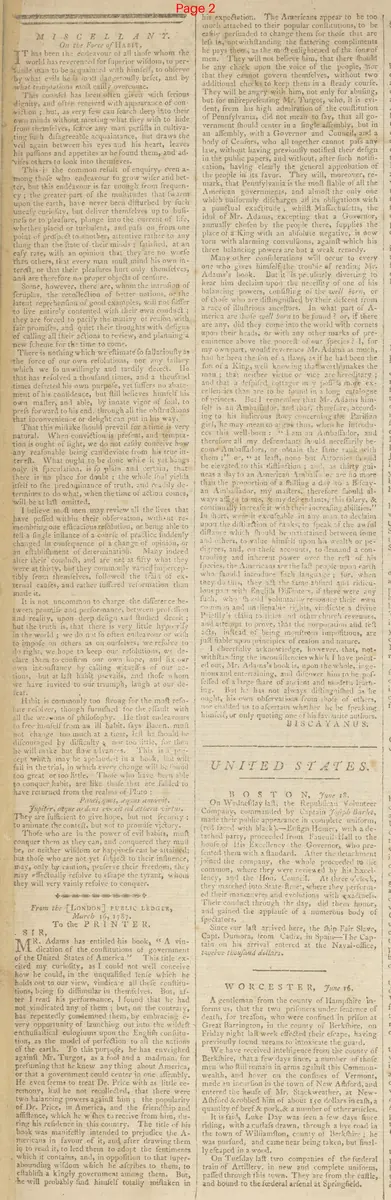
Mr. Adams has entitled his book, "A Vindication of the Constitutions of Government of the United States of America." This title excited my curiosity, as I could not well conceive how he could, in the unqualified sense which he holds out to our view, vindicate all these constitutions, being so dissimilar in themselves. But, after I read his performance, I found that he had not vindicated any of them; but, on the contrary, has repeatedly condemned them, by embracing every opportunity of launching out into the wildest enthusiastical eulogiums upon the English constitution, as the model of perfection to all the nations of the earth. To this purpose, he has inveighed against Mr. Turgot, as a fool and a madman, for presuming that he knew anything about America, or that a government could center in one assembly. He even seems to treat Dr. Price with as little ceremony, had he not recollected, that there were two balancing powers against him; the popularity of Dr. Price, in America, and the friendship and assistance, which he wishes to receive from him, during his residence in this country. The title of his book was manifestly intended to prejudice the Americans in favour of it, and after drawing them in to read it, to lead them to adopt the sentiments which it contains, and, in opposition to that superabounding wisdom which he ascribes to them, to establish a kingly government among them. But, he will probably find himself totally mistaken in his expectation. The Americans appear to be too much attached to their popular constitutions, to be easily persuaded to change them for those that are less so, notwithstanding the flattering compliments he pays them, as the most enlightened of the sons of men. They will not believe him, that there should be any check upon the voice of the people, nor that they cannot govern themselves, without two additional checks to keep them in a steady course. They will be angry with him, not only for abusing, but for misrepresenting Mr. Turgot, who, it is evident, from his high admiration of the constitution of Pennsylvania, did not mean to say, that all government should center in a single assembly, but in an assembly, with a Governor and Council, and a body of Censors, who all together cannot pass any law, without having previously notified their design in the public papers, and without, after such notification, having clearly the general approbation of the people in its favor. They will, moreover, remark, that Pennsylvania is the most stable of all the American governments, and almost the only one which uniformly discharges all its obligations with a punctual exactitude, whilst Massachusetts, the idol of Mr. Adams, excepting that a Governor, annually chosen by the people there, supplies the place of a King with an absolute negative, is now torn with alarming convulsions, against which his three balancing powers are but a weak remedy.
Many other considerations will occur to everyone who gives himself the trouble of reading Mr. Adams's book. But it is peculiarly diverting to hear him declaim upon the necessity of one of his balancing powers, consisting of the well born, or of those who are distinguished by their descent from a race of illustrious ancestors. In what part of America are those well born to be found? or, if there are any, did they come into the world with coronets upon their heads, or with any other marks of pre-eminence above the poorest of our species? I, for my own part, would reverence Mr. Adams as much, had he been the son of a slave, as if he had been the son of a King, well knowing that worth makes the man; that neither virtue nor vice are hereditary; and that a despised cottager may possess more excellencies than are to be found in a long catalogue of princes. But I remember that Mr. Adams himself is an Ambassador, and that, therefore, according to his ludicrous story concerning the Parisian girl, he may mean to argue thus, when he introduces this well-born: "I am an Ambassador, and therefore all my descendants should necessarily become Ambassadors, or obtain the same rank with them;" or, "at least, none but Attorneys should be elevated to this distinction; and, as thirty guineas a day to an American Ambassador, are no more than the proportion of a shilling a day to a Biscayan Ambassador, my masters, therefore should always allow to me, & my descendants, this salary, & continually increase it with their increasing abilities."
In short, were it excusable in any man to declaim upon the distinction of ranks, to speak of the awful distance which should be maintained between some and others, to value himself upon his wealth or pedigrees, and, on these accounts, to demand a controlling and inherent power over the rest of his species, the Americans are the last people upon earth who should introduce such language; for, when they do this, they at the same absurd and ridiculous part with English Dissenters, if there were any such, who should voluntarily renounce their own common and unalienable rights, vindicate a divine Priestly claim to tithes and other church revenues, and attempt to prove, that the corporation and test acts, instead of being monstrous impositions, are justifiable upon principles of reason and nature.
I cheerfully acknowledge, however, that, notwithstanding the inconsistencies which I have pointed out, Mr. Adams's book is, upon the whole, ingenious and entertaining, and discovers him to be possessed of a large share of ancient and modern learning. But he has not always distinguished as he ought, his own observations from those of others, nor enabled us to ascertain whether he be speaking himself, or only quoting one of his favourite authors.
BISCAYANUS.
To the PRINTER.
SIR,
Mr. Adams has entitled his book, "A Vindication of the Constitutions of Government of the United States of America." This title excited my curiosity, as I could not well conceive how he could, in the unqualified sense which he holds out to our view, vindicate all these constitutions, being so dissimilar in themselves. But, after I read his performance, I found that he had not vindicated any of them; but, on the contrary, has repeatedly condemned them, by embracing every opportunity of launching out into the wildest enthusiastical eulogiums upon the English constitution, as the model of perfection to all the nations of the earth. To this purpose, he has inveighed against Mr. Turgot, as a fool and a madman, for presuming that he knew anything about America, or that a government could center in one assembly. He even seems to treat Dr. Price with as little ceremony, had he not recollected, that there were two balancing powers against him; the popularity of Dr. Price, in America, and the friendship and assistance, which he wishes to receive from him, during his residence in this country. The title of his book was manifestly intended to prejudice the Americans in favour of it, and after drawing them in to read it, to lead them to adopt the sentiments which it contains, and, in opposition to that superabounding wisdom which he ascribes to them, to establish a kingly government among them. But, he will probably find himself totally mistaken in his expectation. The Americans appear to be too much attached to their popular constitutions, to be easily persuaded to change them for those that are less so, notwithstanding the flattering compliments he pays them, as the most enlightened of the sons of men. They will not believe him, that there should be any check upon the voice of the people, nor that they cannot govern themselves, without two additional checks to keep them in a steady course. They will be angry with him, not only for abusing, but for misrepresenting Mr. Turgot, who, it is evident, from his high admiration of the constitution of Pennsylvania, did not mean to say, that all government should center in a single assembly, but in an assembly, with a Governor and Council, and a body of Censors, who all together cannot pass any law, without having previously notified their design in the public papers, and without, after such notification, having clearly the general approbation of the people in its favor. They will, moreover, remark, that Pennsylvania is the most stable of all the American governments, and almost the only one which uniformly discharges all its obligations with a punctual exactitude, whilst Massachusetts, the idol of Mr. Adams, excepting that a Governor, annually chosen by the people there, supplies the place of a King with an absolute negative, is now torn with alarming convulsions, against which his three balancing powers are but a weak remedy.
Many other considerations will occur to everyone who gives himself the trouble of reading Mr. Adams's book. But it is peculiarly diverting to hear him declaim upon the necessity of one of his balancing powers, consisting of the well born, or of those who are distinguished by their descent from a race of illustrious ancestors. In what part of America are those well born to be found? or, if there are any, did they come into the world with coronets upon their heads, or with any other marks of pre-eminence above the poorest of our species? I, for my own part, would reverence Mr. Adams as much, had he been the son of a slave, as if he had been the son of a King, well knowing that worth makes the man; that neither virtue nor vice are hereditary; and that a despised cottager may possess more excellencies than are to be found in a long catalogue of princes. But I remember that Mr. Adams himself is an Ambassador, and that, therefore, according to his ludicrous story concerning the Parisian girl, he may mean to argue thus, when he introduces this well-born: "I am an Ambassador, and therefore all my descendants should necessarily become Ambassadors, or obtain the same rank with them;" or, "at least, none but Attorneys should be elevated to this distinction; and, as thirty guineas a day to an American Ambassador, are no more than the proportion of a shilling a day to a Biscayan Ambassador, my masters, therefore should always allow to me, & my descendants, this salary, & continually increase it with their increasing abilities."
In short, were it excusable in any man to declaim upon the distinction of ranks, to speak of the awful distance which should be maintained between some and others, to value himself upon his wealth or pedigrees, and, on these accounts, to demand a controlling and inherent power over the rest of his species, the Americans are the last people upon earth who should introduce such language; for, when they do this, they at the same absurd and ridiculous part with English Dissenters, if there were any such, who should voluntarily renounce their own common and unalienable rights, vindicate a divine Priestly claim to tithes and other church revenues, and attempt to prove, that the corporation and test acts, instead of being monstrous impositions, are justifiable upon principles of reason and nature.
I cheerfully acknowledge, however, that, notwithstanding the inconsistencies which I have pointed out, Mr. Adams's book is, upon the whole, ingenious and entertaining, and discovers him to be possessed of a large share of ancient and modern learning. But he has not always distinguished as he ought, his own observations from those of others, nor enabled us to ascertain whether he be speaking himself, or only quoting one of his favourite authors.
BISCAYANUS.
What sub-type of article is it?
Persuasive
Political
Satirical
What themes does it cover?
Politics
Constitutional Rights
What keywords are associated?
John Adams
American Constitutions
English Constitution
Balancing Powers
Turgot
Price
Pennsylvania
Massachusetts
Well Born
What entities or persons were involved?
Biscayanus
The Printer
Letter to Editor Details
Author
Biscayanus
Recipient
The Printer
Main Argument
john adams' book fails to vindicate american constitutions and instead promotes the english model with balancing powers and nobility, but americans will reject this in favor of their popular systems like pennsylvania's.
Notable Details
Criticizes Adams' Attacks On Turgot And Price
Praises Pennsylvania's Stability Vs. Massachusetts' Convulsions
Mocks Idea Of 'Well Born' In America
References Adams' Ambassador Story And Salary