Thank you for visiting SNEWPapers!
Sign up free
Virginia Argus
Richmond, Virginia
What is this article about?
On July 22, Robert Fulton conducted a torpedo experiment in New York harbor, successfully blowing up a 200-ton brig after an initial failure, demonstrating its potential for marine defense. The event drew crowds and was detailed in Fulton's letter to city officials.
Merged-components note: These two components form a single domestic news story on Fulton's torpedo experiment, including the description and Fulton's accompanying letter, with sequential reading order.
Clipping
OCR Quality
Full Text
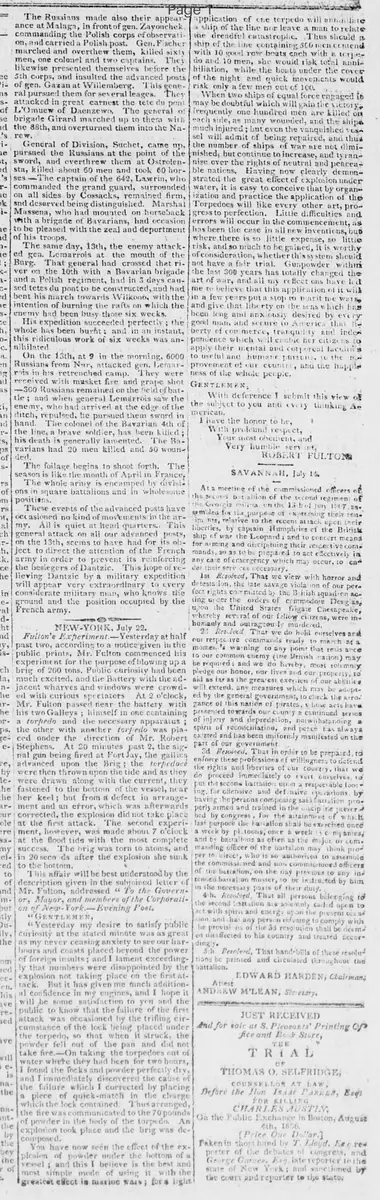
Fulton's Experiment.—Yesterday at half past two, according to a notice given in the public prints, Mr. Fulton commenced his experiment for the purpose of blowing up a brig of 200 tons. Public curiosity had been much excited, and the Battery with the adjacent wharves and windows were crowded with curious spectators. At 2 o'clock, Mr. Fulton passed near the battery with his two Galleys; himself in one containing a torpedo and the necessary apparatus; the other with another torpedo was placed under the direction of Mr. Robert Stephens. At 20 minutes past 2, the signal gun being fired at Fort Jay, the galleys advanced upon the Brig; the torpedoes were then thrown upon the tide and as they were drawn along with the current, they fastened to the bottom of the vessel, near her keel; but from a defect in arrangement and an error, which was afterwards corrected, the explosion did not take place at the first attack. The second experiment, however, was made about 7 o'clock at the flood tide with the most complete success. The brig was torn to atoms, and in 20 seconds after the explosion she sunk to the bottom.
This affair will be best understood by the description given in the subjoined letter of Mr. Fulton, addressed 'To the Governor, Mayor, and members of the Corporation of New-York.'—Evening Post.
'GENTLEMEN,
Yesterday my desire to satisfy public curiosity at the stated minute was as great as my never ceasing anxiety to see our harbours and coasts placed beyond the power of foreign insults; and I lament exceedingly that numbers were disappointed by the explosion not taking place on the first attack. But it has given me much additional confidence in my engines, and I hope it will be some satisfaction to you and the public to know that the failure of the first attack was occasioned by the trifling circumstance of the lock being placed under the torpedo, so that when it struck, the powder fell out of the pan and did not take fire.—On taking the torpedoes out of water where they had been for two hours, I found the locks and powder perfectly dry, and immediately discovered the cause of the failure which I corrected by placing a piece of quick-match in the charge which the lock contained. Thus arranged, the fire was communicated to the 70 pounds of powder in the body of the torpedo. An explosion took place and the brig was decomposed.
You have now seen the effect of the explosion of powder under the bottom of a vessel; and this I believe is the best and most simple mode of using it with the greatest effect in marine war; for a light application of the torpedo will annihilate a ship of the line nor leave a man to relate the dreadful catastrophe. Thus should a ship of the line containing 500 men contend with 10 good row boats each with a torpedo and 10 men, she would risk total annihilation, while the boats under the cover of the night and quick movements would risk only a few men out of 100.
When two ships of equal force engaged it may be doubtful which will gain the victory frequently one hundred men are killed on each side, as many wounded, and the ships much injured; but even the vanquished vessel will admit of being repaired, and thus the number of ships of war are not diminished, but continue to increase, and tyrannise over the rights of neutral and peaceable nations. Having now clearly demonstrated the great effect of explosion under water, it is easy to conceive that by organization and practice the application of the Torpedoes will like every other art, progress to perfection. Little difficulties and errors will occur in the commencement, as has been the case in all new inventions, but where there is so little expense, so little risk, and so much to be gained, it is worthy of consideration, whether this system should not have a fair trial. Gunpowder within the last 300 years has totally changed the art of war, and all my reflections have led me to believe that this application of it will in a few years put a stop to marine wars and give that liberty on the seas which has been long and anxiously desired by every good man, and secure to America that liberty of commerce, tranquility and independence which will enable her citizens to apply their mental and corporal faculties to useful and humane pursuits, to the improvement of our country, and the happiness of the whole people.
GENTLEMEN,
With deference I submit this view of the subject to you and every thinking American.
I have the honor to be,
With profound respect,
Your most obedient, and
Very humble servant,
ROBERT FULTON
What sub-type of article is it?
What keywords are associated?
What entities or persons were involved?
Where did it happen?
Domestic News Details
Primary Location
New York
Event Date
July 22
Key Persons
Outcome
the brig was torn to atoms and sunk in 20 seconds; no human casualties mentioned.
Event Details
Mr. Fulton conducted an experiment to blow up a 200-ton brig using torpedoes from two galleys. Initial attempt at half past two failed due to a defect in the lock, but the second at 7 o'clock succeeded, with the explosion decomposing the vessel. The event was observed by crowds at the Battery and detailed in Fulton's letter explaining the torpedo mechanism and its potential for marine warfare.