Thank you for visiting SNEWPapers!
Sign up free
Editorial
April 23, 1887
The Republican
Oakland, Garrett County, Maryland
What is this article about?
The New York Sun critiques the ineffectiveness of mass petitions and memorials to Congress, noting they are routinely filed away without impact. It advises citizens, including temperance and social societies, to influence legislation through personal letters to representatives instead.
Clipping
OCR Quality
98%
Excellent
Full Text
Petitions to Congress.
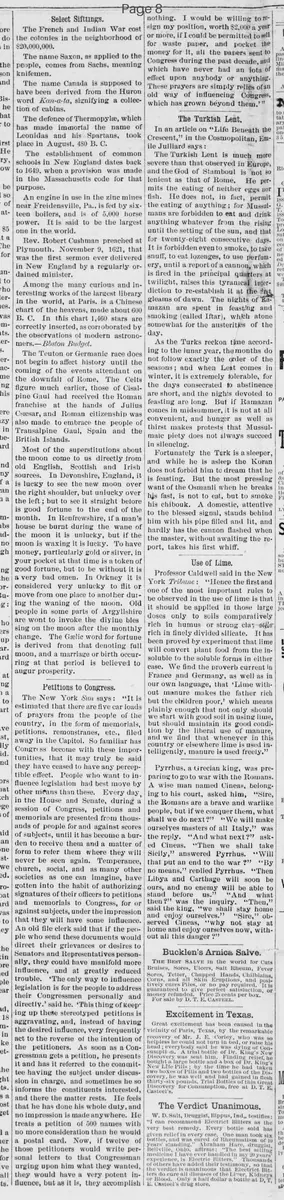
The New York Sun says: "It is estimated that there are five car loads of prayers from the people of the country, in the form of memorials, petitions, remonstrances, etc., filed away in the Capitol. So familiar has Congress become with these importunities, that it may truly be said they have ceased to have any perceptible effect. People who want to influence legislation had best move by other means than these. Every day, in the House and Senate, during a session of Congress, petitions and memorials are presented from thousands of people for and against scores of subjects, until it has become a burden to receive them and a matter of form to refer them where they will never be seen again. Temperance, church, social, and as many other societies as one can imagine, have gotten into the habit of authorizing signatures of their officers to petitions and memorials to Congress, for or against subjects, under the impression that they will have some influence. An old file clerk said that if the people who send these documents would direct their grievances or desires to Senators and Representatives personally, they could have manifold more influence, and at greatly reduced trouble. 'The only way to influence legislation is for the people to address their Congressmen personally and directly,' said he. 'This thing of keeping up these stereotyped petitions is aggravating, and, instead of having the desired influence, very frequently act to the reverse of the intention of the petitioners. As soon as a Congressman gets a petition, he presents it and has it referred to the committee having the subject under discussion in charge, and sometimes he so informs the constituents interested, and there the matter rests. He feels that he has done his whole duty, and no impression is made anywhere. He treats a petition of 500 names with no more consideration than he would a postal card. Now, if twelve of those petitioners would write personal letters to that Congressman urging upon him what they wanted, they would have a very potent influence, but as it is, they accomplish nothing. I would be willing to resign my position, worth $2,000 a year or more, if I could be permitted to sell for waste paper, and pocket the money for it, all the papers sent to Congress during the past decade, and which have never had an iota of effect upon anybody or anything. These prayers are simply relics of an old way of influencing Congress, which has grown beyond them.'"
The New York Sun says: "It is estimated that there are five car loads of prayers from the people of the country, in the form of memorials, petitions, remonstrances, etc., filed away in the Capitol. So familiar has Congress become with these importunities, that it may truly be said they have ceased to have any perceptible effect. People who want to influence legislation had best move by other means than these. Every day, in the House and Senate, during a session of Congress, petitions and memorials are presented from thousands of people for and against scores of subjects, until it has become a burden to receive them and a matter of form to refer them where they will never be seen again. Temperance, church, social, and as many other societies as one can imagine, have gotten into the habit of authorizing signatures of their officers to petitions and memorials to Congress, for or against subjects, under the impression that they will have some influence. An old file clerk said that if the people who send these documents would direct their grievances or desires to Senators and Representatives personally, they could have manifold more influence, and at greatly reduced trouble. 'The only way to influence legislation is for the people to address their Congressmen personally and directly,' said he. 'This thing of keeping up these stereotyped petitions is aggravating, and, instead of having the desired influence, very frequently act to the reverse of the intention of the petitioners. As soon as a Congressman gets a petition, he presents it and has it referred to the committee having the subject under discussion in charge, and sometimes he so informs the constituents interested, and there the matter rests. He feels that he has done his whole duty, and no impression is made anywhere. He treats a petition of 500 names with no more consideration than he would a postal card. Now, if twelve of those petitioners would write personal letters to that Congressman urging upon him what they wanted, they would have a very potent influence, but as it is, they accomplish nothing. I would be willing to resign my position, worth $2,000 a year or more, if I could be permitted to sell for waste paper, and pocket the money for it, all the papers sent to Congress during the past decade, and which have never had an iota of effect upon anybody or anything. These prayers are simply relics of an old way of influencing Congress, which has grown beyond them.'"
What sub-type of article is it?
Partisan Politics
Social Reform
What keywords are associated?
Petitions To Congress
Influencing Legislation
Personal Letters
Mass Petitions
Congressional Influence
Social Societies
What entities or persons were involved?
Congress
New York Sun
Senators And Representatives
File Clerk
Editorial Details
Primary Topic
Ineffectiveness Of Mass Petitions To Congress
Stance / Tone
Critical Of Petitions, Advocates Personal Appeals
Key Figures
Congress
New York Sun
Senators And Representatives
File Clerk
Key Arguments
Mass Petitions And Memorials Are Filed Away Without Effect
Congress Treats Petitions As A Formality And Burden
Temperance, Church, And Social Societies Waste Effort On Signed Petitions
Personal Letters To Congressmen Have Greater Influence
Petitions Can Sometimes Backfire
Petitions Receive No More Attention Than A Postal Card