Thank you for visiting SNEWPapers!
Sign up free
Editorial
July 26, 1924
The Daily Worker
Chicago, Cook County, Illinois
What is this article about?
On the 10th anniversary of World War I, J. Louis Engdahl criticizes American socialists for silence on anti-war efforts, allying with war profiteers like Rudolph Spreckels in the LaFollette campaign, and surrendering to capitalist imperialism, contrasting with Communists' revolutionary anti-war stance.
Clipping
OCR Quality
98%
Excellent
Full Text
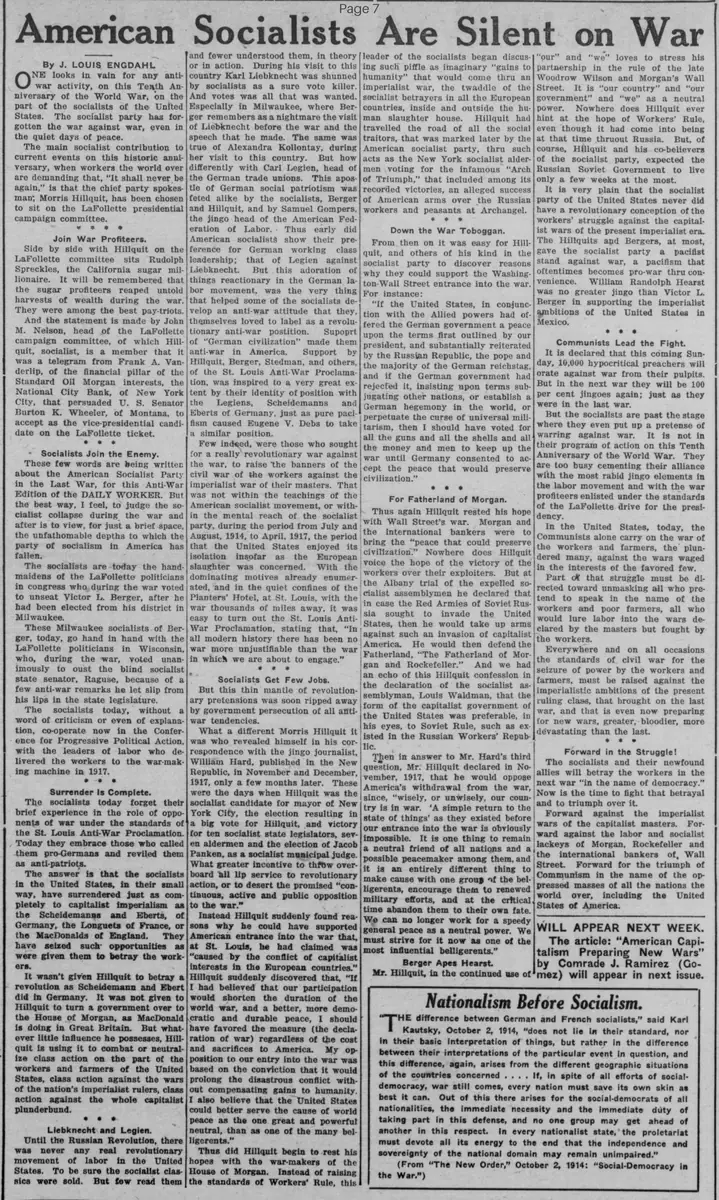
Socialists Are Silent on War
American
By J. LOUIS ENGDAHL
One looks in vain for any anti-war activity, on this Tenth Anniversary of the World War, on the part of the socialists of the United States. The socialist party has forgotten the war against war, even in the quiet days of peace.
The main socialist contribution to current events on this historic anniversary, when workers the world over are demanding that, "It shall never be again," is that the chief party spokesman, Morris Hillquit, has been chosen to sit on the LaFollette presidential campaign committee.
Join War Profiteers.
Side by side with Hillquit on the LaFollette committee sits Rudolph Spreckles, the California sugar millionaire. It will be remembered that the sugar profiteers reaped untold harvests of wealth during the war. They were among the best pay-triots. And the statement is made by John M. Nelson, head of the LaFollette campaign committee, of which Hillquit, socialist, is a member, that it was a telegram from Frank A. Vanderlip, of the financial pillar of the Standard Oil Morgan interests, the National City Bank of New York City, that persuaded U. S. Senator Burton K. Wheeler, of Montana, to accept as the vice-presidential candidate on the LaFollette ticket.
Socialists Join the Enemy.
These few words are being written about the American Socialist Party in the Last War, for this Anti-War Edition of the DAILY WORKER. But the best way, I feel, to judge the socialist collapse during the war and after is to view, for just a brief space, the unfathomable depths to which the party of socialism in America has fallen.
The socialists are today the handmaidens of the LaFollette politicians in congress who during the war voted to unseat Victor L. Berger, after he had been elected from his district in Milwaukee.
These Milwaukee socialists of Berger, today, go hand in hand with the LaFollette politicians in Wisconsin, who, during the war, voted unanimously to oust the blind socialist state senator, Raguse, because of a few anti-war remarks he let slip from his lips in the state legislature.
The socialists today, without a word of criticism or even of explanation, co-operate now in the Conference for Progressive Political Action, with the leaders of labor who delivered the workers to the war-making machine in 1917.
Surrender Is Complete.
The socialists today forget their brief experience in the role of opponents of war under the standards of the St. Louis Anti-War Proclamation. Today they embrace those who called them pro-Germans and reviled them as anti-patriots.
The answer is that the socialists in the United States, in their small way, have surrendered just as completely to capitalist imperialism as the Scheidemanns and Eberts, of Germany, the Longuets of France, or the MacDonalds of England. They have seized such opportunities as were given them to betray the workers.
It wasn't given Hillquit to betray a revolution as Scheidemann and Ebert did in Germany. It was not given to Hillquit to turn a government over to the House of Morgan, as MacDonald is doing in Great Britain. But whatever little influence he possesses, Hillquit is using it to combat or neutralize class action on the part of the workers and farmers of the United States, class action against the wars of the nation's imperialist rulers, class action against the whole capitalist plunderbund.
Liebknecht and Legien.
Until the Russian Revolution, there was never any real revolutionary movement of labor in the United States. To be sure the socialist classics were sold. But few read them and fewer understood them, in theory or in action. During his visit to this country Karl Liebknecht was shunned by socialists as a sure vote killer. And votes was all that was wanted. Especially in Milwaukee, where Berger remembers as a nightmare the visit of Liebknecht before the war and the speech that he made. The same was true of Alexandra Kollontay, during her visit to this country. But how differently with Carl Legien, head of the German trade unions. This apostle of German social patriotism was feted alike by the socialists, Berger and Hillquit, and by Samuel Gompers, the jingo head of the American Federation of Labor. Thus early did American socialists show their preference for German working class leadership; that of Legien against Liebknecht. But this adoration of things reactionary in the German labor movement, was the very thing that helped some of the socialists develop an anti-war attitude that they, themselves loved to label as a revolutionary anti-war position. Support of "German civilization" made them anti-war in America. Support by Hillquit, Berger, Stedman, and others, of the St. Louis Anti-War Proclamation, was inspired to a very great extent by their identity of position with the Legiens, Scheidemanns and Eberts of Germany, just as pure pacifism caused Eugene V. Debs to take a similar position.
Few indeed, were those who sought for a really revolutionary war against the war, to raise the banners of the civil war of the workers against the imperialist war of their masters. That was not within the teachings of the American socialist movement, or within the mental reach of the socialist party, during the period from July and August, 1914, to April, 1917, the period that the United States enjoyed its isolation insofar as the European slaughter was concerned. With the dominating motives already enumerated, and in the quiet confines of the Planters' Hotel, at St. Louis, with the war thousands of miles away, it was easy to turn out the St. Louis Anti-War Proclamation, stating that, "In all modern history there has been no war more unjustifiable than the war in which we are about to engage."
Socialists Get Few Jobs.
But this thin mantle of revolutionary pretensions was soon ripped away by government persecution of all anti-war tendencies.
What a different Morris Hillquit it was who revealed himself in his correspondence with the jingo journalist, William Hard, published in the New Republic, in November and December, 1917, only a few months later. These were the days when Hillquit was the socialist candidate for mayor of New York City, the election resulting in a big vote for Hillquit, and victory for ten socialist state legislators, seven aldermen and the election of Jacob Panken, as a socialist municipal judge.
What greater incentive to throw overboard all lip service to revolutionary action, or to desert the promised "continuous, active and public opposition to the war."
Instead Hillquit suddenly found reasons why he could have supported American entrance into the war that, at St. Louis, he had claimed was "caused by the conflict of capitalist interests in the European countries."
Hillquit suddenly discovered that, "If I had believed that our participation would shorten the duration of the world war, and a better, more democratic and durable peace, I should have favored the measure (the declaration of war) regardless of the cost and sacrifices to America. My opposition to our entry into the war was based on the conviction that it would prolong the disastrous conflict without compensating gains to humanity. I also believe that the United States could better serve the cause of world peace as the one great and powerful neutral, than as one of the many belligerents."
Thus did Hillquit begin to rest his hopes with the war-makers of the House of Morgan. Instead of raising the standards of Workers' Rule, this leader of the socialists began discussing such piffle as imaginary "gains to humanity" that would come thru an imperialist war, the twaddle of the socialist betrayers in all the European countries, inside and outside the human slaughter house. Hillquit had travelled the road of all the social traitors, that was marked later by the American socialist party, thru such acts as the New York socialist aldermen voting for the infamous "Arch of Triumph," that included among its recorded victories, an alleged success of American arms over the Russian workers and peasants at Archangel.
Down the War Toboggan.
From then on it was easy for Hillquit, and others of his kind in the socialist party to discover reasons why they could support the Washington-Wall Street entrance into the war. For instance:
"If the United States, in conjunction with the Allied powers had offered the German government a peace upon the terms first outlined by our president, and substantially reiterated by the Russian Republic, the pope and the majority of the German reichstag, and if the German government had rejected it, insisting upon terms subjugating other nations, or establish a German hegemony in the world, or perpetuate the curse of universal militarism, then I should have voted for all the guns and all the shells and all the money and men to keep up the war until Germany consented to accept the peace that would preserve civilization."
For Fatherland of Morgan.
Thus again Hillquit rested his hope with Wall Street's war. Morgan and the international bankers were to bring the "peace that could preserve civilization." Nowhere does Hillquit voice the hope of the victory of the workers over their exploiters. But at the Albany trial of the expelled socialist assemblymen he declared that in case the Red Armies of Soviet Russia sought to invade the United States, then he would take up arms against such an invasion of capitalist America. He would then defend the Fatherland, "The Fatherland of Morgan and Rockefeller." And we had an echo of this Hillquit confession in the declaration of the socialist assemblyman, Louis Waldman, that the form of the capitalist government of the United States was preferable, in his eyes, to Soviet Rule, such as existed in the Russian Workers' Republic.
Then in answer to Mr. Hard's third question, Mr. Hillquit declared in November, 1917, that he would oppose America's withdrawal from the war, since, "wisely, or unwisely, our country is in war. 'A simple return to the state of things' as they existed before our entrance into the war is obviously impossible. It is one thing to remain a neutral friend of all nations and a possible peacemaker among them, and it is an entirely different thing to make cause with one group of the belligerents, encourage them to renewed military efforts, and at the critical time abandon them to their own fate. We can no longer work for a speedy general peace as a neutral power. We must strive for it now as one of the most influential belligerents."
Berger Apes Hearst.
Mr. Hillquit, in the continued use of "our" and "we" loves to stress his partnership in the rule of the late Woodrow Wilson and Morgan's Wall Street. It is "our country" and "our government" and "we" as a neutral power. Nowhere does Hillquit ever hint at the hope of Workers' Rule, even though it had come into being at that time throughout Russia. But, of course, Hillquit and his co-believers of the socialist party, expected the Russian Soviet Government to live only a few weeks at the most.
It is very plain that the socialist party of the United States never did have a revolutionary conception of the workers' struggle against the capitalist wars of the present imperialist era. The Hillquits and Bergers, at most, gave the socialist party a pacifist stand against war, a pacifism that oftentimes becomes pro-war thru convenience.
William Randolph Hearst was no greater jingo than Victor L. Berger in supporting the imperialist ambitions of the United States in Mexico.
Communists Lead the Fight.
It is declared that this coming Sunday, 10,000 hypocritical preachers will orate against war from their pulpits. But in the next war they will be 100 per cent jingoes again; just as they were in the last war.
But the socialists are past the stage where they even put up a pretense of warring against war. It is not in their program of action on this Tenth Anniversary of the World War. They are too busy cementing their alliance with the most rabid jingo elements in the labor movement and with the war profiteers enlisted under the standards of the LaFollette drive for the presidency.
In the United States, today, the Communists alone carry on the war of the workers and farmers, the plundered many, against the wars waged in the interests of the favored few. Part of that struggle must be directed toward unmasking all who pretend to speak in the name of the workers and poor farmers, all who would lure labor into the wars declared by the masters but fought by the workers.
Everywhere and on all occasions the standards of civil war for the seizure of power by the workers and farmers, must be raised against the imperialistic ambitions of the present ruling class, that brought on the last war, and that is even now preparing for new wars, greater, bloodier, more devastating than the last.
Forward in the Struggle!
The socialists and their newfound allies will betray the workers in the next war in the name of democracy. Now is the time to fight that betrayal and to triumph over it.
Forward against the imperialist wars of the capitalist masters. Forward against the labor and socialist lackeys of Morgan, Rockefeller and the international bankers of Wall Street. Forward for the triumph of Communism in the name of the oppressed masses of all the nations the world over, including the United States of America.
American
By J. LOUIS ENGDAHL
One looks in vain for any anti-war activity, on this Tenth Anniversary of the World War, on the part of the socialists of the United States. The socialist party has forgotten the war against war, even in the quiet days of peace.
The main socialist contribution to current events on this historic anniversary, when workers the world over are demanding that, "It shall never be again," is that the chief party spokesman, Morris Hillquit, has been chosen to sit on the LaFollette presidential campaign committee.
Join War Profiteers.
Side by side with Hillquit on the LaFollette committee sits Rudolph Spreckles, the California sugar millionaire. It will be remembered that the sugar profiteers reaped untold harvests of wealth during the war. They were among the best pay-triots. And the statement is made by John M. Nelson, head of the LaFollette campaign committee, of which Hillquit, socialist, is a member, that it was a telegram from Frank A. Vanderlip, of the financial pillar of the Standard Oil Morgan interests, the National City Bank of New York City, that persuaded U. S. Senator Burton K. Wheeler, of Montana, to accept as the vice-presidential candidate on the LaFollette ticket.
Socialists Join the Enemy.
These few words are being written about the American Socialist Party in the Last War, for this Anti-War Edition of the DAILY WORKER. But the best way, I feel, to judge the socialist collapse during the war and after is to view, for just a brief space, the unfathomable depths to which the party of socialism in America has fallen.
The socialists are today the handmaidens of the LaFollette politicians in congress who during the war voted to unseat Victor L. Berger, after he had been elected from his district in Milwaukee.
These Milwaukee socialists of Berger, today, go hand in hand with the LaFollette politicians in Wisconsin, who, during the war, voted unanimously to oust the blind socialist state senator, Raguse, because of a few anti-war remarks he let slip from his lips in the state legislature.
The socialists today, without a word of criticism or even of explanation, co-operate now in the Conference for Progressive Political Action, with the leaders of labor who delivered the workers to the war-making machine in 1917.
Surrender Is Complete.
The socialists today forget their brief experience in the role of opponents of war under the standards of the St. Louis Anti-War Proclamation. Today they embrace those who called them pro-Germans and reviled them as anti-patriots.
The answer is that the socialists in the United States, in their small way, have surrendered just as completely to capitalist imperialism as the Scheidemanns and Eberts, of Germany, the Longuets of France, or the MacDonalds of England. They have seized such opportunities as were given them to betray the workers.
It wasn't given Hillquit to betray a revolution as Scheidemann and Ebert did in Germany. It was not given to Hillquit to turn a government over to the House of Morgan, as MacDonald is doing in Great Britain. But whatever little influence he possesses, Hillquit is using it to combat or neutralize class action on the part of the workers and farmers of the United States, class action against the wars of the nation's imperialist rulers, class action against the whole capitalist plunderbund.
Liebknecht and Legien.
Until the Russian Revolution, there was never any real revolutionary movement of labor in the United States. To be sure the socialist classics were sold. But few read them and fewer understood them, in theory or in action. During his visit to this country Karl Liebknecht was shunned by socialists as a sure vote killer. And votes was all that was wanted. Especially in Milwaukee, where Berger remembers as a nightmare the visit of Liebknecht before the war and the speech that he made. The same was true of Alexandra Kollontay, during her visit to this country. But how differently with Carl Legien, head of the German trade unions. This apostle of German social patriotism was feted alike by the socialists, Berger and Hillquit, and by Samuel Gompers, the jingo head of the American Federation of Labor. Thus early did American socialists show their preference for German working class leadership; that of Legien against Liebknecht. But this adoration of things reactionary in the German labor movement, was the very thing that helped some of the socialists develop an anti-war attitude that they, themselves loved to label as a revolutionary anti-war position. Support of "German civilization" made them anti-war in America. Support by Hillquit, Berger, Stedman, and others, of the St. Louis Anti-War Proclamation, was inspired to a very great extent by their identity of position with the Legiens, Scheidemanns and Eberts of Germany, just as pure pacifism caused Eugene V. Debs to take a similar position.
Few indeed, were those who sought for a really revolutionary war against the war, to raise the banners of the civil war of the workers against the imperialist war of their masters. That was not within the teachings of the American socialist movement, or within the mental reach of the socialist party, during the period from July and August, 1914, to April, 1917, the period that the United States enjoyed its isolation insofar as the European slaughter was concerned. With the dominating motives already enumerated, and in the quiet confines of the Planters' Hotel, at St. Louis, with the war thousands of miles away, it was easy to turn out the St. Louis Anti-War Proclamation, stating that, "In all modern history there has been no war more unjustifiable than the war in which we are about to engage."
Socialists Get Few Jobs.
But this thin mantle of revolutionary pretensions was soon ripped away by government persecution of all anti-war tendencies.
What a different Morris Hillquit it was who revealed himself in his correspondence with the jingo journalist, William Hard, published in the New Republic, in November and December, 1917, only a few months later. These were the days when Hillquit was the socialist candidate for mayor of New York City, the election resulting in a big vote for Hillquit, and victory for ten socialist state legislators, seven aldermen and the election of Jacob Panken, as a socialist municipal judge.
What greater incentive to throw overboard all lip service to revolutionary action, or to desert the promised "continuous, active and public opposition to the war."
Instead Hillquit suddenly found reasons why he could have supported American entrance into the war that, at St. Louis, he had claimed was "caused by the conflict of capitalist interests in the European countries."
Hillquit suddenly discovered that, "If I had believed that our participation would shorten the duration of the world war, and a better, more democratic and durable peace, I should have favored the measure (the declaration of war) regardless of the cost and sacrifices to America. My opposition to our entry into the war was based on the conviction that it would prolong the disastrous conflict without compensating gains to humanity. I also believe that the United States could better serve the cause of world peace as the one great and powerful neutral, than as one of the many belligerents."
Thus did Hillquit begin to rest his hopes with the war-makers of the House of Morgan. Instead of raising the standards of Workers' Rule, this leader of the socialists began discussing such piffle as imaginary "gains to humanity" that would come thru an imperialist war, the twaddle of the socialist betrayers in all the European countries, inside and outside the human slaughter house. Hillquit had travelled the road of all the social traitors, that was marked later by the American socialist party, thru such acts as the New York socialist aldermen voting for the infamous "Arch of Triumph," that included among its recorded victories, an alleged success of American arms over the Russian workers and peasants at Archangel.
Down the War Toboggan.
From then on it was easy for Hillquit, and others of his kind in the socialist party to discover reasons why they could support the Washington-Wall Street entrance into the war. For instance:
"If the United States, in conjunction with the Allied powers had offered the German government a peace upon the terms first outlined by our president, and substantially reiterated by the Russian Republic, the pope and the majority of the German reichstag, and if the German government had rejected it, insisting upon terms subjugating other nations, or establish a German hegemony in the world, or perpetuate the curse of universal militarism, then I should have voted for all the guns and all the shells and all the money and men to keep up the war until Germany consented to accept the peace that would preserve civilization."
For Fatherland of Morgan.
Thus again Hillquit rested his hope with Wall Street's war. Morgan and the international bankers were to bring the "peace that could preserve civilization." Nowhere does Hillquit voice the hope of the victory of the workers over their exploiters. But at the Albany trial of the expelled socialist assemblymen he declared that in case the Red Armies of Soviet Russia sought to invade the United States, then he would take up arms against such an invasion of capitalist America. He would then defend the Fatherland, "The Fatherland of Morgan and Rockefeller." And we had an echo of this Hillquit confession in the declaration of the socialist assemblyman, Louis Waldman, that the form of the capitalist government of the United States was preferable, in his eyes, to Soviet Rule, such as existed in the Russian Workers' Republic.
Then in answer to Mr. Hard's third question, Mr. Hillquit declared in November, 1917, that he would oppose America's withdrawal from the war, since, "wisely, or unwisely, our country is in war. 'A simple return to the state of things' as they existed before our entrance into the war is obviously impossible. It is one thing to remain a neutral friend of all nations and a possible peacemaker among them, and it is an entirely different thing to make cause with one group of the belligerents, encourage them to renewed military efforts, and at the critical time abandon them to their own fate. We can no longer work for a speedy general peace as a neutral power. We must strive for it now as one of the most influential belligerents."
Berger Apes Hearst.
Mr. Hillquit, in the continued use of "our" and "we" loves to stress his partnership in the rule of the late Woodrow Wilson and Morgan's Wall Street. It is "our country" and "our government" and "we" as a neutral power. Nowhere does Hillquit ever hint at the hope of Workers' Rule, even though it had come into being at that time throughout Russia. But, of course, Hillquit and his co-believers of the socialist party, expected the Russian Soviet Government to live only a few weeks at the most.
It is very plain that the socialist party of the United States never did have a revolutionary conception of the workers' struggle against the capitalist wars of the present imperialist era. The Hillquits and Bergers, at most, gave the socialist party a pacifist stand against war, a pacifism that oftentimes becomes pro-war thru convenience.
William Randolph Hearst was no greater jingo than Victor L. Berger in supporting the imperialist ambitions of the United States in Mexico.
Communists Lead the Fight.
It is declared that this coming Sunday, 10,000 hypocritical preachers will orate against war from their pulpits. But in the next war they will be 100 per cent jingoes again; just as they were in the last war.
But the socialists are past the stage where they even put up a pretense of warring against war. It is not in their program of action on this Tenth Anniversary of the World War. They are too busy cementing their alliance with the most rabid jingo elements in the labor movement and with the war profiteers enlisted under the standards of the LaFollette drive for the presidency.
In the United States, today, the Communists alone carry on the war of the workers and farmers, the plundered many, against the wars waged in the interests of the favored few. Part of that struggle must be directed toward unmasking all who pretend to speak in the name of the workers and poor farmers, all who would lure labor into the wars declared by the masters but fought by the workers.
Everywhere and on all occasions the standards of civil war for the seizure of power by the workers and farmers, must be raised against the imperialistic ambitions of the present ruling class, that brought on the last war, and that is even now preparing for new wars, greater, bloodier, more devastating than the last.
Forward in the Struggle!
The socialists and their newfound allies will betray the workers in the next war in the name of democracy. Now is the time to fight that betrayal and to triumph over it.
Forward against the imperialist wars of the capitalist masters. Forward against the labor and socialist lackeys of Morgan, Rockefeller and the international bankers of Wall Street. Forward for the triumph of Communism in the name of the oppressed masses of all the nations the world over, including the United States of America.
What sub-type of article is it?
War Or Peace
Partisan Politics
Labor
What keywords are associated?
Socialists Betrayal
Anti War Anniversary
Lafollette Campaign
Imperialist Wars
Communist Struggle
Wwi Criticism
Morris Hillquit
Victor Berger
What entities or persons were involved?
Morris Hillquit
Victor L. Berger
Robert Lafollette
Rudolph Spreckles
Frank A. Vanderlip
Burton K. Wheeler
Karl Liebknecht
Carl Legien
Eugene V. Debs
House Of Morgan
Editorial Details
Primary Topic
Criticism Of American Socialists' Surrender To Imperialist War Policies
Stance / Tone
Strongly Anti Socialist And Pro Communist, Calling For Revolutionary Anti War Action
Key Figures
Morris Hillquit
Victor L. Berger
Robert Lafollette
Rudolph Spreckles
Frank A. Vanderlip
Burton K. Wheeler
Karl Liebknecht
Carl Legien
Eugene V. Debs
House Of Morgan
Key Arguments
Socialists Silent On Anti War Activity During Wwi's 10th Anniversary
Hillquit Allies With War Profiteers In Lafollette Campaign
Socialists Surrendered To Capitalist Imperialism Like European Counterparts
St. Louis Anti War Proclamation Was Pacifist, Not Revolutionary
Hillquit Shifted To Support War For Potential Peace Benefits
Socialists Prefer Capitalist Government Over Soviet Rule
Communists Alone Lead True Anti Imperialist Struggle
Call For Civil War By Workers Against Imperialist Wars