Thank you for visiting SNEWPapers!
Sign up free
The Daily Advertiser
New York, New York County, New York
What is this article about?
Scientific account predicting the return of a comet last seen in 1682, with elements matching 1532 observations. Dr. Maskelyne forecasts perihelion on January 1, 1789, visible in December 1788 from southern locations like Cape of Good Hope, approaching within 36 million miles of Earth.
Clipping
OCR Quality
Full Text
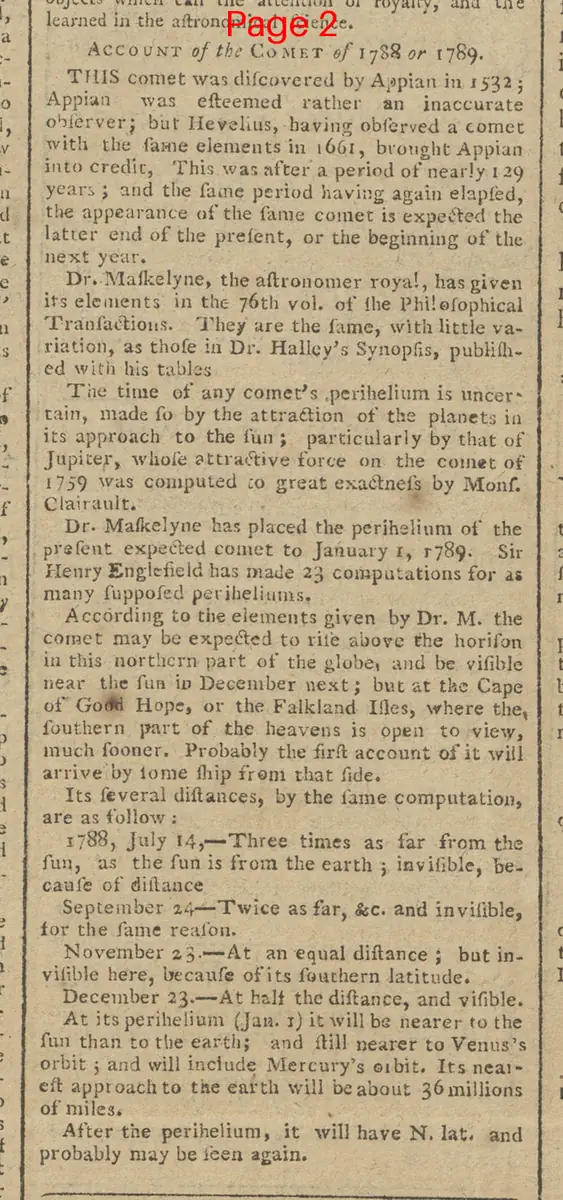
This comet was discovered by Appian in 1532; Appian was esteemed rather an inaccurate observer; but Hevelius, having observed a comet with the same elements in 1682, brought Appian into credit. This was after a period of nearly 129 years; and the same period having again elapsed, the appearance of the same comet is expected the latter end of the present, or the beginning of the next year.
Dr. Maskelyne, the astronomer royal, has given its elements in the 76th vol. of the Philosophical Transactions. They are the same, with little variation, as those in Dr. Halley's Synopsis, published with his tables.
The time of any comet's perihelion is uncertain, made so by the attraction of the planets in its approach to the sun; particularly by that of Jupiter, whose attractive force on the comet of 1759 was computed to great exactness by Mons. Clairault.
Dr. Maskelyne has placed the perihelion of the present expected comet to January 1, 1789. Sir Henry Englefield has made 23 computations for as many supposed perihelions.
According to the elements given by Dr. M. the comet may be expected to rise above the horizon in this northern part of the globe, and be visible near the sun in December next; but at the Cape of Good Hope, or the Falkland Isles, where the southern part of the heavens is open to view, much sooner. Probably the first account of it will arrive by some ship from that side.
Its several distances, by the same computation, are as follow:
1788, July 14,-Three times as far from the sun, as the sun is from the earth; invisible, because of distance.
September 24-Twice as far, &c. and invisible, for the same reason.
November 23.-At an equal distance; but invisible here, because of its southern latitude.
December 23.-At half the distance, and visible.
At its perihelion (Jan. 1) it will be nearer to the sun than to the earth; and still nearer to Venus's orbit; and will include Mercury's orbit. Its nearest approach to the earth will be about 36 millions of miles.
After the perihelion, it will have N. lat. and probably may be seen again.
What sub-type of article is it?
What keywords are associated?
What entities or persons were involved?
Foreign News Details
Event Date
1788 1789
Key Persons
Outcome
expected visibility in december 1788 from southern locations; perihelion january 1, 1789; nearest approach to earth 36 million miles.
Event Details
The comet, previously observed in 1532 by Appian and 1682 by Hevelius, is predicted to return after 129 years. Elements provided by Dr. Maskelyne match Halley's synopsis. Perihelion uncertain due to planetary attractions, especially Jupiter. Visibility details: invisible until December 23, 1788, when at half distance from sun; visible near sun in northern globe then, earlier in south.