Thank you for visiting SNEWPapers!
Sign up free
The Enquirer
Richmond, Henrico County, Virginia
What is this article about?
Newspaper article presents William Ellis's journal from 1814, detailing his capture by British and Creek Indians near Mobile, their raids on American settlements, retreat to Spanish Pensacola, and the governor's non-neutral support for enemies, justifying U.S. General Jackson's entry into the town.
Clipping
OCR Quality
Full Text
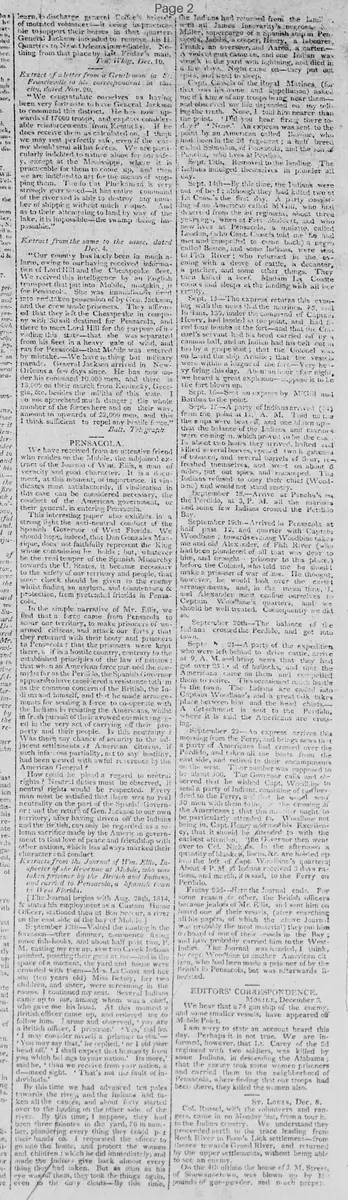
We have received from an attentive friend who resides on the Mobile, the subjoined extract of the Journal of Wm. Ellis, a man of veracity and good character. It is a document, at this moment, of importance. It vindicates most satisfactorily, if vindication in this case can be considered necessary, the conduct of the American government, or their general, in entering Pensacola.
This interesting paper also exhibits in a strong light the anti-neutral conduct of the Spanish Governor of West Florida. We should hope, indeed, that Don Gonzales Manrique, does not faithfully represent the King whose commission he holds; but, whatever be the real temper of the Spanish Monarchy towards the U. States, it became necessary to the safety of our territory and people, that some check should be given to the enemy whilst finding an asylum, and countenance & protection, from pretended friends in Pensacola.
In the simple narrative of Mr. Ellis, we find that a force came from Pensacola to scour our territory, to make prisoners of unarmed citizens, and attack our forts; that they returned with their booty and prisoners to Pensacola: that the prisoners were kept there, as if in a hostile country, contrary to the established principles of the law of nations: that when an American force pursued the enemy as far as the Perdido, the Spanish Governor appears to have considered a resistance to them as the common concern of the British, the Indians and himself, and that he made arrangements for sending a force to co-operate with the Indians in resisting the Americans, whilst in fresh pursuit of their avowed enemies engaged in the very act of carrying off their property and their people. Is this neutrality? Was there any chance of security to the adjacent settlements of American citizens, if such infamous partiality, not to say hostility, had been viewed with awful reverence by the American General?
How could he plead a regard to neutral rights? Neutral duties must be observed, if neutral rights would be respected. Every man must be satisfied that there was no real neutrality on the part of the Spanish Governor: and the return of Gen. Jackson to our own territory, after having driven off the Indians and the British, can only be regarded as a solemn sacrifice made by the American government to that love of peace and friendship with other nations, which has always marked their character and conduct.
Extracts from the Journal of Wm. Ellis, Inspector of the Revenue at Mobile, who was taken prisoner by the British and Indians, and carried to Pensacola, a Spanish town in West Florida.
(The Journal begins with Aug. 28th, 1814, & states his employment as a Custom House Officer, stationed then at Bon Secour, a river on the east side of the bay of Mobile.)
September 12th—Visited the landing in the forenoon—after dinner, Commence fixing some fish-hooks, and about half past two, P. M. casting my eye up, saw two Creek Indians painted, pointing their guns at me—and in the space of a moment, the yard and house were crowded with them—Mrs. LaCoast and her son (ten years old) Miss Betsey, her two children, and sister, were screaming in the rooms. I continued my seat. Several Indians came up to me, among whom was a chief, who gave me his hand. At this moment a British officer came up, and ordered me to follow him. I arose and observed, 'you are a British officer, I presume.' 'Yes.' said he. 'I may consider myself a prisoner to you.'—'You may say that,' he replied, 'or I cut your head off.' 'I shall expect that humanity from you which belongs to your nation.' 'Its more,' said he, 'than we receive from your nation, a damned sight.' 'That's not the fault of individuals.'
By this time we had advanced ten poles towards the river, and the Indians had taken all the canoes, and about forty started over to the landing on the other side of the river. By this time, I suppose, they had been three minutes in the yard, 70 in number, plundering every thing they could put their hands on. I requested the officer to go into the house, and protect the women and children; which he did immediately, and made the Indians give back almost every thing they had taken. But as soon as his eye was off them, they took the things again, even the dirty clouts—By this time, the Indians had returned from the landing, with all James Innerarity's negroes, viz. Miller, supercargo of a Spanish ship in Pensacola, Jacobs, a cooper, Henry, a labourer, Frank, an overseer, and Aaron, a carter.
A violent gust came on, and one Indian was struck in the yard with lightning, and died in a few days. Night came on—they put out spies, and went to sleep.
Capt. Nicolls of the Royal Marines (for that was his name and appellation) asked me if I knew of any troops being near them—and observed my life depended on my telling the truth. None, I told him nearer than the fort. 'Did you hear firing there to-day?' 'None.' An express was sent to the fort by an American called Burdine, who had been in the 2d regiment; a half breed called Sebastian, of Pensacola, and the son at Pancha, who lives at Perdido.
Sept. 13th—Removed to the landing. The Indians indulged themselves in plunder all day.
Sept. 14th—By this time, the Indians were out of beef; although they had killed two of La Coast's the first day. A party consisting of an American called M'Gin, who had deserted from the 4th regiment, about three years ago, when at Fort Stoddert, and who now lives at Pensacola, a mulatto, called London, (who Capt. Nicolls told me he had met and compelled to come back) a negro called Boston, and some Indians, were sent to Fish River: who returned in the evening with a drove of cattle, a decanter, a pitcher, and some other things. They then killed a beef. Madam La Coast comes and sleeps at the landing with all her family.
Sept. 15—The express returns this evening with the news that the marines, 75, and Indians, 130, under the command of Captain Henry, had landed at the fort, and had fired four shots at the fort—and that the Colonel's servant had his head carried off by cannon ball, and an Indian had his belt cut in two by a grape shot; that the Colonel was on board the ship Hermes; that the vessels were within a league of the fort.—Very heavy firing this day. About an hour after night, we heard a great explosion—suppose it to be the fort blown up.
Sept. 16th—Sent an express by M'Gin and Burdine to the fort.
Sept. 17th—A party of Indians arrived (24) from the fort at 11, A. M. told us that the ships were beat off, and one blown up—that the balance of the Indians and marines were coming on, which proved to be the case.
In about two hours they arrived, halted and killed several beeves, opened two hogsheads of tobacco, and several barrels of flour, refreshed themselves, and went on about 6 miles, put out spies, and encamped. The Indians refused to obey their chief (Woodbine) and would not stand sentry.
September 18.—Arrived at Pancha's on the Perdido, at 3, P. M. all the marines and some few Indians crossed the Perdido Bay.
September 19th—Arrived in Pensacola at half past 12, and quarter with Captain Woodbine; towards evening Woodbine takes me and old Alexander, of Fish River (who had been plundered of all that was dear to him, and brought a prisoner to this place.) before the Colonel, who told me he should make a prisoner of war of me. He thought, however, he would look over the cartel arrangements, and, in the mean time, I and Alexander must confine ourselves to Captain Woodbine's quarters, and we should be well treated. Consequently we did so.
September 20th—The balance of the Indians crossed the Perdido, and got into town.
Sept. 21st—A party of the expedition who were left behind to drive cattle, arrive at 9, A. M. and bring news that they had got over 25 head of bullocks, and that the Americans came on them and compelled them to retire. This occasioned much bustle in the town. The Indians are called into Captain Woodbine's and a great talk takes place between, him and the head chiefs.—A detachment is sent to the Perdido, where it is said the Americans are crossing.
September 22nd—An express arrives this morning from the Ferry, and brings news that a party of Americans had crossed over the Perdido, and taken all the boats from the east side, and retired to their encampments on the west. Their number was supposed to be about 500. The Governor calls and observed that he wished Capt. Woodbine, to send a party of Indians, consisting of two hundred to the Ferry, and that he would send 50 men with them to guard the crossing of the Americans; that this pass ought to be particularly attended to. Woodbine not being in, Capt. Henry informed his Excellency, that it should be attended to with the earliest attention. The Governor then went over to Col. Nicholls'. In the afternoon a quantity of blankets, linens, &cc. are hoisted up into the loft of Capt. Woodbine's quarters! About 4 P.M. 55 Indians received 3 days rations, and march, it is said, to the Ferry on Perdido.
Friday 23d—Here the Journal ends. For some reason or other, the British officers became jealous of Mr. Ellis, and sent him on board one of their vessels, (after searching all his papers, of which the above Journal was probably the most material) they put him on board of one of their vessels in the Bay; and have probably carried him to the West-Indies. The Journal was handed, I think, by Capt. Woodbine to another American citizen, who had been made a prisoner by the British in Pensacola, but was afterwards liberated.
What sub-type of article is it?
What themes does it cover?
What keywords are associated?
What entities or persons were involved?
Where did it happen?
Story Details
Key Persons
Location
Pensacola, West Florida; Mobile; Perdido River; Bon Secour
Event Date
August 28th, 1814 To September 23rd, 1814
Story Details
William Ellis, a U.S. revenue inspector, is captured by British officer Capt. Nicolls and Creek Indians during a raid on American settlements near Mobile. The group plunders, attacks Fort Bowyer, retreats to Spanish Pensacola with prisoners, where Governor Manrique aids them against pursuing Americans, breaching neutrality.