Thank you for visiting SNEWPapers!
Sign up free
Editorial
October 28, 1948
The Durant News
Durant, Holmes County, Mississippi
What is this article about?
Mississippi editorial opposes two proposed constitutional amendments for the November 2, 1948 election: one mandating annual legislative sessions, citing high costs, member sacrifices, and excess laws; the other requiring 'good moral character' for voting, seen as a dangerous precedent enabling voter intimidation.
Clipping
OCR Quality
98%
Excellent
Full Text
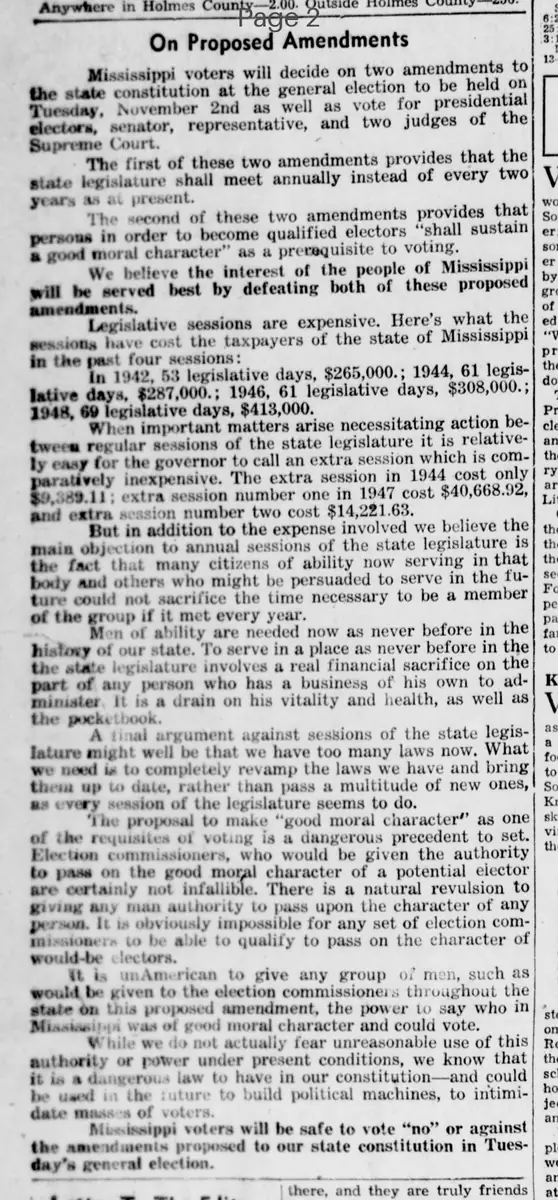
On Proposed Amendments
Mississippi voters will decide on two amendments to the state constitution at the general election to be held on Tuesday, November 2nd as well as vote for presidential electors, senator, representative, and two judges of the Supreme Court.
The first of these two amendments provides that the state legislature shall meet annually instead of every two years as at present.
Legislative sessions are expensive. Here's what the sessions have cost the taxpayers of the state of Mississippi in the past four sessions:
In 1942, 53 legislative days, $265,000.; 1944, 61 legislative days, $287,000.; 1946, 61 legislative days, $308,000.; 1948, 69 legislative days, $413,000.
When important matters arise necessitating action between regular sessions of the state legislature it is relatively easy for the governor to call an extra session which is comparatively inexpensive. The extra session in 1944 cost only $9,389.11; extra session number one in 1947 cost $40,668.92, and extra session number two cost $14,221.63.
But in addition to the expense involved we believe the main objection to annual sessions of the state legislature is the fact that many citizens of ability now serving in that body and others who might be persuaded to serve in the future could not sacrifice the time necessary to be a member of the group if it met every year.
Men of ability are needed now as never before in the history of our state. To serve in the state legislature involves a real financial sacrifice on the part of any person who has a business of his own to administer. It is a drain on his vitality and health, as well as the pocketbook.
A final argument against sessions of the state legislature might well be that we have too many laws now. What we need is to completely revamp the laws we have and bring them up to date, rather than pass a multitude of new ones, as every session of the legislature seems to do.
The proposal to make "good moral character" as one of the requisites of voting is a dangerous precedent to set.
Election commissioners, who would be given the authority to pass on the good moral character of a potential elector are certainly not infallible. There is a natural revulsion to giving any man authority to pass upon the character of any person. It is obviously impossible for any set of election commissioners to be able to qualify to pass on the character of would-be electors.
It is unAmerican to give any group of men, such as would be given to the election commissioners throughout the state on this proposed amendment, the power to say who in Mississippi was of good moral character and could vote.
While we do not actually fear unreasonable use of this authority or power under present conditions, we know that it is a dangerous law to have in our constitution and could be used in the future to build political machines, to intimidate masses of voters.
Mississippi voters will be safe to vote "no" or against the amendments proposed to our state constitution in Tuesday's general election.
We believe the interest of the people of Mississippi will be served best by defeating both of these proposed amendments.
The second of these two amendments provides that persons in order to become qualified electors "shall sustain a good moral character" as a prerequisite to voting.
Mississippi voters will decide on two amendments to the state constitution at the general election to be held on Tuesday, November 2nd as well as vote for presidential electors, senator, representative, and two judges of the Supreme Court.
The first of these two amendments provides that the state legislature shall meet annually instead of every two years as at present.
Legislative sessions are expensive. Here's what the sessions have cost the taxpayers of the state of Mississippi in the past four sessions:
In 1942, 53 legislative days, $265,000.; 1944, 61 legislative days, $287,000.; 1946, 61 legislative days, $308,000.; 1948, 69 legislative days, $413,000.
When important matters arise necessitating action between regular sessions of the state legislature it is relatively easy for the governor to call an extra session which is comparatively inexpensive. The extra session in 1944 cost only $9,389.11; extra session number one in 1947 cost $40,668.92, and extra session number two cost $14,221.63.
But in addition to the expense involved we believe the main objection to annual sessions of the state legislature is the fact that many citizens of ability now serving in that body and others who might be persuaded to serve in the future could not sacrifice the time necessary to be a member of the group if it met every year.
Men of ability are needed now as never before in the history of our state. To serve in the state legislature involves a real financial sacrifice on the part of any person who has a business of his own to administer. It is a drain on his vitality and health, as well as the pocketbook.
A final argument against sessions of the state legislature might well be that we have too many laws now. What we need is to completely revamp the laws we have and bring them up to date, rather than pass a multitude of new ones, as every session of the legislature seems to do.
The proposal to make "good moral character" as one of the requisites of voting is a dangerous precedent to set.
Election commissioners, who would be given the authority to pass on the good moral character of a potential elector are certainly not infallible. There is a natural revulsion to giving any man authority to pass upon the character of any person. It is obviously impossible for any set of election commissioners to be able to qualify to pass on the character of would-be electors.
It is unAmerican to give any group of men, such as would be given to the election commissioners throughout the state on this proposed amendment, the power to say who in Mississippi was of good moral character and could vote.
While we do not actually fear unreasonable use of this authority or power under present conditions, we know that it is a dangerous law to have in our constitution and could be used in the future to build political machines, to intimidate masses of voters.
Mississippi voters will be safe to vote "no" or against the amendments proposed to our state constitution in Tuesday's general election.
We believe the interest of the people of Mississippi will be served best by defeating both of these proposed amendments.
The second of these two amendments provides that persons in order to become qualified electors "shall sustain a good moral character" as a prerequisite to voting.
What sub-type of article is it?
Constitutional
Suffrage
Legal Reform
What keywords are associated?
Constitutional Amendments
Annual Sessions
Legislative Costs
Moral Character Voting
Voter Qualifications
Mississippi Election
What entities or persons were involved?
Mississippi Legislature
Governor
Election Commissioners
Mississippi Voters
Editorial Details
Primary Topic
Opposition To Amendments On Annual Legislative Sessions And Moral Character For Voting
Stance / Tone
Strongly Against Both Amendments
Key Figures
Mississippi Legislature
Governor
Election Commissioners
Mississippi Voters
Key Arguments
Legislative Sessions Are Expensive, Costing Hundreds Of Thousands Per Session
Extra Sessions Are Cheaper And Sufficient For Urgent Matters
Annual Sessions Would Deter Able Citizens Due To Time And Financial Sacrifice
State Needs To Revise Existing Laws Rather Than Pass More
Requiring 'Good Moral Character' For Voting Sets A Dangerous Precedent
Election Commissioners Are Not Infallible Judges Of Character
Such Power Is Unamerican And Could Enable Political Machines And Voter Intimidation