Thank you for visiting SNEWPapers!
Sign up free
Editorial
December 22, 1809
Norfolk Gazette And Publick Ledger
Norfolk, Virginia
What is this article about?
The editorial analyzes the Peace of Vienna (1809) between Austria and France, critiquing Napoleon's strategic concessions to Austria as a means to focus on subjugating Britain via Spain and Portugal, while lamenting Austria's territorial and moral losses.
Clipping
OCR Quality
95%
Excellent
Full Text
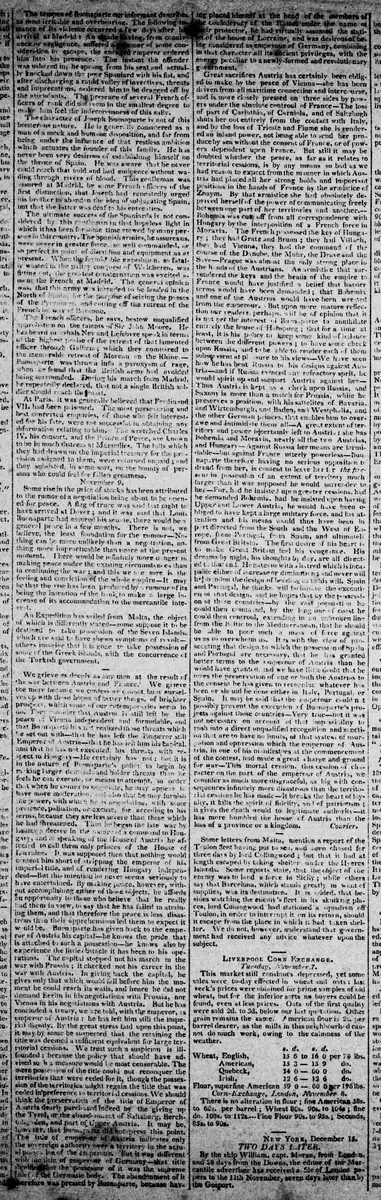
We grieve as deeply as any men at the result of the war between Austria and France. We grieve the more because we confess we cannot buoy ourselves up with those hopes of better things, of brighter prospect, which some of our contemporaries seem to do. They consider that Austria is still left by the peace of Vienna independent and formidable, and that Buonaparte has not realized those threats which he set out with—that he has left the Emperor still Emperor of Austria—that he has left him his Capital, and that he has not executed his threats with respect to Hungary. He certainly has not: but it is in the nature of Buonaparte's policy to begin by making larger demand, and bolder threats than he feels he can execute, or means to attempt, in order that when he comes to negotiate, he may appear to have more moderation, and also that he may furnish the power, with which he is negotiating, with some pretext, palliation, or excuse, for acceding to his terms, because they are less severe than those which he had threatened. Thus he began the late war by issuing a decree in the nature of a command to Hungary, and in speaking of the House of Austria, he affected to call them only princes of the House of Lorraine. It was supposed then that nothing would content him short of stripping the emperor of his imperial title, and of rendering Hungary independent. But this intention he never seems seriously to have entertained. By making peace, however, without accomplishing either of those objects, he affords an opportunity to those who believe that he really had them in view, to say that he has failed in attaining them, and that therefore the peace is less disastrous than their apprehensions led them to expect it would be. Buonaparte has given back to the emperor of Austria his capital—he knows the pride that is attached to such a possession—he knows also by experience the little obstacle it has been to his operations. The capital stopped not his march in the war with Prussia; it checked not his career in the war with Austria. In giving back the capital, he gives only that which would fall before him the moment he could reach its walls, and hence he did not demand Berlin in his negotiations with Prussia, nor Vienna in his negotiations with Austria. But he has concluded a treaty, we are told, with the emperor, as emperor of Austria: he has left him still the imperial dignity. By the great stress laid upon this point, it may by some be suspected that the retaining the title was deemed a sufficient equivalent for large territorial cessions. We trust such a suspicion is ill-founded: because the policy that should have advised such a measure would be most censurable. The mere possession of the title could not reconquer the territories that were ceded for it, though the possession of the territories might regain the title that was ceded in preference to territorial cessions. We should think the preservation of the title of Emperor of Austria dearly purchased indeed by the giving up of the Tyrol, or the abandonment of Saltzburg, Berchtesgaden, and part of Upper Austria. It may be, however, that Buonaparte did not press this point. The title of emperor of Austria indicates only the sovereign authority over a territory in the actual possession of the emperor. But it was different with the title of emperor of Germany. That title signified that the possessor of it was the supreme chief of the Germanic body. The abandonment of it therefore was pressed by Buonaparte, because having placed himself at the head of the members of the confederacy of the Rhine under the name of their protector, he had virtually assumed the station of the house of Lorraine, and was desirous of being considered as emperor of Germany, combining in that character all its ancient privileges, with the energy peculiar to a newly-formed and revolutionary government.
Great sacrifices Austria has certainly been obliged to make by the peace of Vienna—she has been driven from all maritime connection and intercourse, and is more closely pressed on three sides by powers under the absolute controul of France. The loss of part of Carinthia, of Carniola, and of Saltzburg shuts her out entirely from the contact with Italy, and by the loss of Trieste and Fiume she is rendered an inland power, not being able to send her produce by sea without the consent of France, or of powers dependent upon France. But still it may be doubted whether the peace, as far as it relates to territorial cessions, is by any means so bad as we had reason to expect from the manner in which Austria had placed all her strong holds and important positions in the hands of France by the armistice of Znaim. By that armistice she had absolutely deprived herself of the power of communicating freely between one part of her territories and another.—Bohemia was cut off from all correspondence with Hungary by the interposition of a French force in Moravia. The French possessed the key of Hungary; they had Gratz and Brunn: they had Villach, they had Vienna, they had the command of the course of the Danube, the Muhr, the Drave and the Save—Prague was almost the only strong place in the hands of the Austrians. An armistice that surrendered the keys and the heart of the empire to France would have justified a belief that harder terms would have been demanded; that Bohemia and one of the Austrias would have been wrested from the emperor. But upon more mature reflection our readers, perhaps, will be of opinion that it is not yet the interest of Buonaparte to annihilate entirely the house of Hapsburg; that for a time at least, it is his policy to keep some kind of balance between the different powers; to have some check upon Russia, and to be able to render each of them subservient at pleasure to his views—We have seen how he has bent Russia to his designs against Austria—and if Russia evinced any refractory spirit, he would spirit up and support Austria against her. Thus Austria is kept as a check upon Russia, and Saxony is more than a match for Prussia, while he preserves a position, with his satellites of Bavaria, and Wirtemberg, and Baden, and Westphalia, and the other German princes, that enables him to over-awe and intimidate them all—A great extent of territory and power is certainly left to Austria: she has Bohemia and Moravia, nearly all the two Austrias, and Hungary—Against Russia her means are formidable—but against France utterly powerless—Buonaparte therefore having no serious opposition to dread from her, is content to leave her for the present in possession of an extent of territory much larger than it was supposed he would surrender to her—For, had he insisted upon greater cessions, had he demanded Bohemia, had he insisted upon having Upper and Lower Austria, he would have been obliged to have kept a large military force, and his attention and his means would thus have been in part directed from the South and the West of Europe, from Portugal, from Spain, and ultimately from Great Britain. The first desire of his heart is to make Great Britain feel his vengeance. His dreams by night, his thoughts by day, are all directed to that end. He hates us with a hatred which is incapable either of increase or diminution; and never will he abandon the design of bending us to his will. Spain and Portugal, he thinks, will facilitate the execution of that design, and he hopes that by the possession of these countries—by the vast population he could then command, by the long line of coast he could then controul, extending in an unbroken line from the Baltic to the Mediterranean, that he should be able to pour such a mass of force against us as to overwhelm us. It is with the view of pursuing that design, to which the possession of Spain and Portugal are necessary, that he has granted better terms to the emperor of Austria than he would have granted, and we have little doubt that he owes the preservation of one or both the Austrias to the consent he has given to recognize whatever has been or shall be done either in Italy, Portugal, or Spain. It may be said that the emperor could not possibly prevent the execution of Buonaparte's projects against those countries—Very true—but it was not necessary on account of this impossibility to rush into a direct unqualified recognition and sanction that are to have no limits, of that system of usurpation and oppression which the emperor of Austria, in one of his manifestoes at the commencement of the contest, had made a great charge and ground for war—This moral cession, this cession of character on the part of the emperor of Austria, we consider as much more disgraceful, as big with consequences infinitely more disastrous than the territorial cessions he has made—it breaks the heart of loyalty, it kills the spirit of fidelity, and of patriotism; it gives the death wound to legitimate authority—it has more humbled the house of Austria than the loss of a province or a kingdom.
Courier.
Great sacrifices Austria has certainly been obliged to make by the peace of Vienna—she has been driven from all maritime connection and intercourse, and is more closely pressed on three sides by powers under the absolute controul of France. The loss of part of Carinthia, of Carniola, and of Saltzburg shuts her out entirely from the contact with Italy, and by the loss of Trieste and Fiume she is rendered an inland power, not being able to send her produce by sea without the consent of France, or of powers dependent upon France. But still it may be doubted whether the peace, as far as it relates to territorial cessions, is by any means so bad as we had reason to expect from the manner in which Austria had placed all her strong holds and important positions in the hands of France by the armistice of Znaim. By that armistice she had absolutely deprived herself of the power of communicating freely between one part of her territories and another.—Bohemia was cut off from all correspondence with Hungary by the interposition of a French force in Moravia. The French possessed the key of Hungary; they had Gratz and Brunn: they had Villach, they had Vienna, they had the command of the course of the Danube, the Muhr, the Drave and the Save—Prague was almost the only strong place in the hands of the Austrians. An armistice that surrendered the keys and the heart of the empire to France would have justified a belief that harder terms would have been demanded; that Bohemia and one of the Austrias would have been wrested from the emperor. But upon more mature reflection our readers, perhaps, will be of opinion that it is not yet the interest of Buonaparte to annihilate entirely the house of Hapsburg; that for a time at least, it is his policy to keep some kind of balance between the different powers; to have some check upon Russia, and to be able to render each of them subservient at pleasure to his views—We have seen how he has bent Russia to his designs against Austria—and if Russia evinced any refractory spirit, he would spirit up and support Austria against her. Thus Austria is kept as a check upon Russia, and Saxony is more than a match for Prussia, while he preserves a position, with his satellites of Bavaria, and Wirtemberg, and Baden, and Westphalia, and the other German princes, that enables him to over-awe and intimidate them all—A great extent of territory and power is certainly left to Austria: she has Bohemia and Moravia, nearly all the two Austrias, and Hungary—Against Russia her means are formidable—but against France utterly powerless—Buonaparte therefore having no serious opposition to dread from her, is content to leave her for the present in possession of an extent of territory much larger than it was supposed he would surrender to her—For, had he insisted upon greater cessions, had he demanded Bohemia, had he insisted upon having Upper and Lower Austria, he would have been obliged to have kept a large military force, and his attention and his means would thus have been in part directed from the South and the West of Europe, from Portugal, from Spain, and ultimately from Great Britain. The first desire of his heart is to make Great Britain feel his vengeance. His dreams by night, his thoughts by day, are all directed to that end. He hates us with a hatred which is incapable either of increase or diminution; and never will he abandon the design of bending us to his will. Spain and Portugal, he thinks, will facilitate the execution of that design, and he hopes that by the possession of these countries—by the vast population he could then command, by the long line of coast he could then controul, extending in an unbroken line from the Baltic to the Mediterranean, that he should be able to pour such a mass of force against us as to overwhelm us. It is with the view of pursuing that design, to which the possession of Spain and Portugal are necessary, that he has granted better terms to the emperor of Austria than he would have granted, and we have little doubt that he owes the preservation of one or both the Austrias to the consent he has given to recognize whatever has been or shall be done either in Italy, Portugal, or Spain. It may be said that the emperor could not possibly prevent the execution of Buonaparte's projects against those countries—Very true—but it was not necessary on account of this impossibility to rush into a direct unqualified recognition and sanction that are to have no limits, of that system of usurpation and oppression which the emperor of Austria, in one of his manifestoes at the commencement of the contest, had made a great charge and ground for war—This moral cession, this cession of character on the part of the emperor of Austria, we consider as much more disgraceful, as big with consequences infinitely more disastrous than the territorial cessions he has made—it breaks the heart of loyalty, it kills the spirit of fidelity, and of patriotism; it gives the death wound to legitimate authority—it has more humbled the house of Austria than the loss of a province or a kingdom.
Courier.
What sub-type of article is it?
Foreign Affairs
War Or Peace
What keywords are associated?
Peace Of Vienna
Austria France War
Buonaparte Policy
Napoleonic Threats
Austrian Concessions
European Balance
Britain Invasion
What entities or persons were involved?
Buonaparte
Emperor Of Austria
House Of Hapsburg
Russia
Prussia
Great Britain
Editorial Details
Primary Topic
Analysis Of The Peace Of Vienna Between Austria And France
Stance / Tone
Critical Of Austrias Concessions And Napoleons Strategic Moderation
Key Figures
Buonaparte
Emperor Of Austria
House Of Hapsburg
Russia
Prussia
Great Britain
Key Arguments
Buonaparte Uses Exaggerated Threats To Make Concessions Appear Moderate
Austria Retains Capital And Imperial Title But Loses Territories Like Tyrol And Trieste
Peace Terms Better Than Expected Due To Armistice Of Znaim
Napoleon Preserves Austria As Check On Russia To Focus On Britain Via Spain And Portugal
Austrias Moral Recognition Of Napoleons Usurpations More Disastrous Than Territorial Losses