Thank you for visiting SNEWPapers!
Sign up free
The National Republican
Washington, District Of Columbia
What is this article about?
Mr. Lowe warns in Parliament that England's reform bill will trigger a non-violent constitutional revolution, requiring American-style checks like an elective senate and elected prime minister to balance democratic excesses.
Clipping
OCR Quality
Full Text
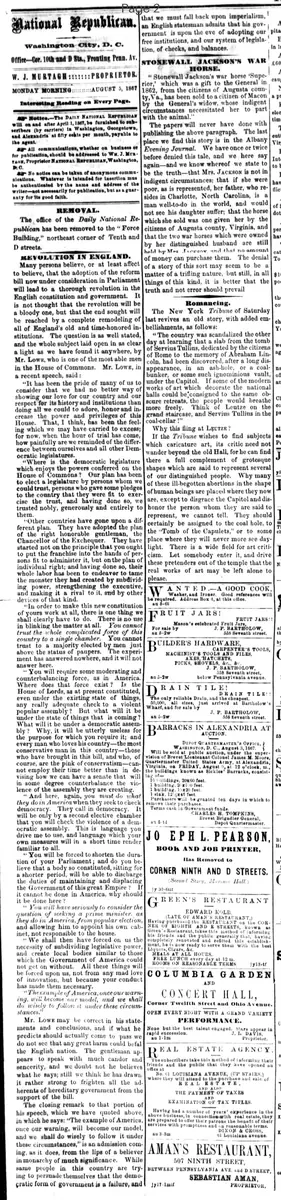
Many persons believe, or at least affect to believe, that the adoption of the reform bill now under consideration in Parliament will lead to a thorough revolution in the English constitution and government. It is not thought that the revolution will be a bloody one, but that the end sought will be reached by a complete remodeling of all of England's old and time-honored institutions. The question is as well stated, and the whole subject laid open in as clear a light as we have found it anywhere, by Mr. Lowe, who is one of the most able men in the House of Commons. Mr. Lowe, in a recent speech, said:
'It has been the pride of many of us to consider that we had no better way of showing our love for our country and our respect for its history and institutions than doing all we could to adore, honor and increase the power and privileges of this House. That, I think, has been the feeling which we may have carried to excess; for now, when the hour of trial has come, how painfully are we reminded of the difference between ourselves and all other Democratic legislatures.
'Where is the democratic legislature which enjoys the powers conferred on the House of Commons? Our plan has been to elect a legislature by persons whom we could trust, persons who gave some pledges to the country that they were fit to exercise the trust, and having done so, we trusted nobly, generously and entirely to them.
'Other countries have gone upon a different plan. They have adopted the plan of the right honorable gentleman, the Chancellor of the Exchequer. They have started not on the principle that you ought to put the franchise into the hands of persons fit to administer it, but on the plan of individual right; and having done so, their whole labor has been to endeavor to tame the monster they had created by subdividing power, strengthening the executive and making it a rival to it, and by other devices of that kind.
'In order to make this new constitution of yours work at all, there is one thing we shall clearly have to do. There is no use in blinking the matter at all. You cannot trust the whole complicated force of this country to a single chamber. You cannot trust to a majority elected by men just above the status of paupers. The experiment has answered nowhere, and it will not answer here.
'You will require some moderating and counterbalancing force, as in America. Where does that force exist? Is the House of Lords, as at present constituted, even under the existing state of things, any really adequate check to a violent popular assembly? But what will it be under the state of things that is coming? What will it be under a democratic assembly? Why, it will be utterly useless for the purpose for which you require it; and every man who loves his country—the most conservative man in this country—those who have brought in this bill, and who, of course, are the pink of conservatism—cannot employ their time better than in devising how we can have a senate that will in some degree counterbalance the violence of the assembly they are creating.
'And here, again, you must do what they do in America when they seek to check democracy. They call in democracy. It will be only by a second elective chamber that you will check the violence of a democratic assembly. This is language you drive me to use, and language which your own measures will in a short time render familiar to all.
'You will be forced to shorten the duration of your Parliament; and do you believe that a body so constituted, sitting for a shorter period, will be able to discharge the duties of maintaining and displacing the Government of this great Empire? If it cannot be done in America, why should it be done here?
'You will have seriously to consider the question of seeking a prime minister, as they do in America, from popular election, and allowing him to appoint his own cabinet, not responsible to the house.
'We shall then have forced on us the necessity of subdividing legislative power, and create local bodies similar to those which the Government of America could not get on without. All these things will be forced upon us, not from any mad love of innovation, but because your conduct has made them necessary.
'The example of America, once our warning, will become our model, and we shall do wisely to follow it under these circumstances.'
Mr. Lowe may be correct in his statements and conclusions, and if what he predicts should actually come to pass we do not see that any great harm could befall the English nation. The gentleman appears to speak with much candor and sincerity, and we doubt not he believes what he says; still we think he has drawn it rather strong to frighten all the adherents of hereditary government from the support of the bill.
The closing remark to that portion of his speech, which we have quoted above, in which he says: 'The example of America, once our warning, will become our model, and we shall do wisely to follow it under these circumstances,' is an admission coming, as it does, from the lips of a believer in monarchy of much significance. While some people in this country are trying to persuade themselves that the democratic form of government is a failure, and that we must fall back upon imperialism, an English statesman admits that his government is upon the eve of adopting our free institutions, and our system of legislation, of checks, and balances.
What sub-type of article is it?
What keywords are associated?
What entities or persons were involved?
Where did it happen?
Foreign News Details
Primary Location
England
Key Persons
Outcome
predicted constitutional remodeling including a second elective chamber, shortened parliament duration, elected prime minister, and local bodies similar to america, without bloodshed.
Event Details
Mr. Lowe's speech in the House of Commons argues that the reform bill will lead to a thorough, non-bloody revolution in England's constitution by remodeling institutions, necessitating checks like a senate, following the American model of democracy.