Thank you for visiting SNEWPapers!
Sign up free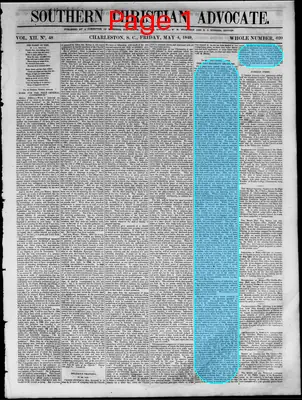
Literary
May 4, 1849
Southern Christian Advocate
Charleston, Charleston County, South Carolina
What is this article about?
First-person narrative of two brothers emigrating from Alabama to the West in 1844. Their steamboat Buckeye sinks in a collision, drowning the elder brother Richard; the younger Jefferson survives. The narrator searches for and finds him, then experiences religious conversion in 1845, later influencing his brother's salvation. Reflects on family redemption.
Clipping
OCR Quality
98%
Excellent
Full Text
For the Southern Christian Advocate.
THE TWO EMIGRANT BROTHERS.
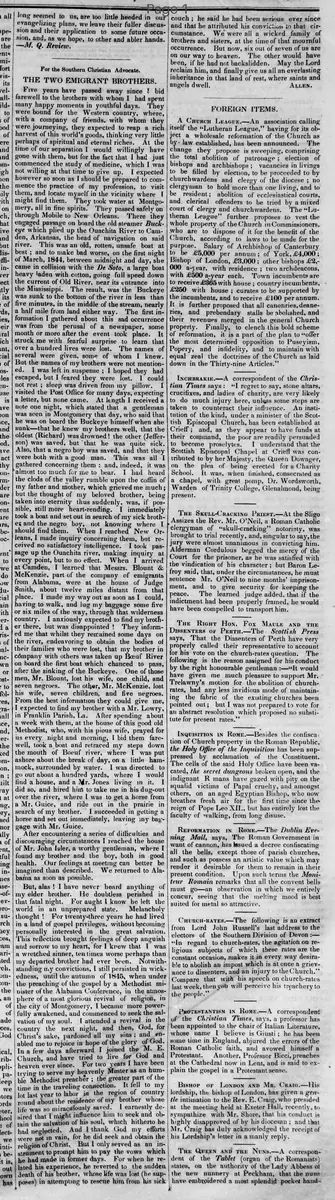
Five years have passed away since I bid farewell to the brothers with whom I had spent many happy moments in youthful days. They were bound for the Western country, where, with a company of friends, with whom they were journeying, they expected to reap a rich harvest of this world's goods, thinking very little perhaps of spiritual and eternal riches. At the time of our separation I would willingly have gone with them, but for the fact that I had just commenced the study of medicine, which I was not willing at that time to give up. I expected however so soon as I should be prepared to commence the practice of my profession, to visit them, and locate myself in the vicinity where I might find them. They took water at Montgomery, all in fine spirits. They passed safely on through Mobile to New Orleans. There they engaged passage on board the old steamer Buckeye which plied up the Ouachita River to Camden, Arkansas, the head of navigation on said river. This was an old, rotten, unsafe boat at best; and to make bad worse, on the first night of March, 1844, between midnight and day, she came in collision with the De Soto, a large boat heavy laden with cotton, going full speed down the current of Old River, near its entrance into the Mississippi. The result, was the Buckeye was sunk to the bottom of the river in less than five minutes, in the middle of the stream, nearly a half mile from land either way. The first information I gathered about this sad occurrence was from the perusal of a newspaper, some month or more after the event took place. It struck me with fearful surprise to learn that over a hundred lives were lost. The names of several were given, some of whom I knew. But the names of my brothers were not mentioned. I was left in suspense; I hoped they had escaped, but I feared they were lost. I could not rest; sleep was driven from my pillow. I visited the Post Office for many days, expecting a letter, but none came. At length I received a note one night, which stated that a gentleman was seen in Montgomery that day, who said that he was on board the Buckeye himself when she sunk—that he knew my brothers well, that the oldest (Richard) was drowned! the other (Jefferson) was saved, but that he was quite sick. Also, that a negro boy was saved, and that they were both with a good man. This was all I gathered concerning them: and, indeed, it was almost too much for me to bear. I had heard the clods of the valley rumble upon the coffin of my father and mother, which grieved me much; but the thought of my beloved brother, being taken into eternity thus suddenly, was, if possible, still more heart-rending. I immediately took a boat and set out in search of my sick brother and the negro boy, not knowing where I should find them. When I reached New Orleans, I made inquiry concerning them, but received no satisfactory intelligence. I took passage up the Ouachita river, making inquiry at every point, but to no effect. When I arrived at Camden, I learned that Messrs. Blount & McKenzie, part of the company of emigrants from Alabama, were at the house of Judge Smith, about twelve miles distant from that place. I made my way out as soon as I could, having to walk, and lug my baggage some five or six miles of the way, through that wilderness country. I anxiously expected to find my brother there, but was disappointed! They informed me that whilst they remained some days on the river, endeavoring to obtain the bodies of their families who were lost, that my brother in company with others was taken up Bayou Boeuf River on board the first boat which chanced to pass, after the sinking of the Buckeye. One of those men, Mr. Blount, lost his wife, one child, and seven negroes. The other, Mr. McKenzie, lost his wife, seven children, and five negroes. From the best information they could give me, I expected to find my brother with a Mr. Lowry, in Franklin Parish, La. After spending about a week with them, at the house of this good old Methodist, who, with his pious wife, prayed for us every night and morning, I bid them farewell, took a boat and retraced my steps down to the mouth of Boeuf river, where I was put ashore about the break of day, on a little hammock, surrounded by water. I was directed to go out about a hundred yards, where I would find a house, and a Mr. Jones living in it. I did so, and hired him to take me in his dug-out over the river, where I was to get a horse from a Mr. Guice, and ride out in the prairie in search of my brother. I succeeded in getting a horse and set out immediately, leaving my baggage with Mr. Guice. After encountering a series of difficulties and discouraging circumstances I reached the house of Mr. John Isler, a worthy gentleman, where I found my brother and the boy, both in good health. Our feelings at meeting can better be imagined than described. We returned to Alabama as soon as possible.
But, alas! I have never heard anything of my elder brother. He doubtless perished in that fatal night. For aught I know he left the world in an unprepared state. Melancholy thought! For twenty-three years he had lived in a land of gospel privileges, without becoming personally interested in the great salvation. This reflection brought feelings of deep anguish and sorrow to my heart, for I knew that I was a wretched sinner, ten times worse perhaps than my departed brother had ever been. Notwithstanding my convictions, I still persisted in wickedness, until the autumn of 1845, when under the preaching of the gospel by a Methodist minister of the Alabama Conference, in the atmosphere of a most glorious revival of religion, in the city of Montgomery, I became more powerfully awakened, and commenced to seek the salvation of my soul. I attended a revival in the country the next night, and then, God, for Christ's sake, pardoned all my sins; and enabled me to rejoice in hope of the glory of God. In a few days afterward I joined the M. E. Church, and have tried to live for God and heaven ever since. For two years I have been trying to serve my heavenly Master as an humble Methodist preacher; the greater part of the time in the traveling connection. It fell to my lot last year to labor in the region of country round about the residence of my brother whose life was so miraculously saved. I earnestly desired that I might influence him to seek and obtain the salvation of his soul, which hitherto he had neglected. And I thank God my efforts were not in vain, for he did seek and obtain the religion of Christ. But I only served as an instrument to prompt him to pay the vows which he had made in former days. For when he related his experience, he reverted to the sudden death of his brother, whose life was lost (he supposes) in attempting to rescue him from his sick couch; he said he had been serious ever since and that he attributed his conviction to that circumstance. We were all a wicked family of brothers and sisters, at the time of that mournful occurrence. But now, six out of seven of us are on our way to heaven. The other would have been, if he had not backslidden. May the Lord reclaim him, and finally give us all an everlasting inheritance in that land of rest, where saints and angels dwell.
ALLEN.
THE TWO EMIGRANT BROTHERS.
Five years have passed away since I bid farewell to the brothers with whom I had spent many happy moments in youthful days. They were bound for the Western country, where, with a company of friends, with whom they were journeying, they expected to reap a rich harvest of this world's goods, thinking very little perhaps of spiritual and eternal riches. At the time of our separation I would willingly have gone with them, but for the fact that I had just commenced the study of medicine, which I was not willing at that time to give up. I expected however so soon as I should be prepared to commence the practice of my profession, to visit them, and locate myself in the vicinity where I might find them. They took water at Montgomery, all in fine spirits. They passed safely on through Mobile to New Orleans. There they engaged passage on board the old steamer Buckeye which plied up the Ouachita River to Camden, Arkansas, the head of navigation on said river. This was an old, rotten, unsafe boat at best; and to make bad worse, on the first night of March, 1844, between midnight and day, she came in collision with the De Soto, a large boat heavy laden with cotton, going full speed down the current of Old River, near its entrance into the Mississippi. The result, was the Buckeye was sunk to the bottom of the river in less than five minutes, in the middle of the stream, nearly a half mile from land either way. The first information I gathered about this sad occurrence was from the perusal of a newspaper, some month or more after the event took place. It struck me with fearful surprise to learn that over a hundred lives were lost. The names of several were given, some of whom I knew. But the names of my brothers were not mentioned. I was left in suspense; I hoped they had escaped, but I feared they were lost. I could not rest; sleep was driven from my pillow. I visited the Post Office for many days, expecting a letter, but none came. At length I received a note one night, which stated that a gentleman was seen in Montgomery that day, who said that he was on board the Buckeye himself when she sunk—that he knew my brothers well, that the oldest (Richard) was drowned! the other (Jefferson) was saved, but that he was quite sick. Also, that a negro boy was saved, and that they were both with a good man. This was all I gathered concerning them: and, indeed, it was almost too much for me to bear. I had heard the clods of the valley rumble upon the coffin of my father and mother, which grieved me much; but the thought of my beloved brother, being taken into eternity thus suddenly, was, if possible, still more heart-rending. I immediately took a boat and set out in search of my sick brother and the negro boy, not knowing where I should find them. When I reached New Orleans, I made inquiry concerning them, but received no satisfactory intelligence. I took passage up the Ouachita river, making inquiry at every point, but to no effect. When I arrived at Camden, I learned that Messrs. Blount & McKenzie, part of the company of emigrants from Alabama, were at the house of Judge Smith, about twelve miles distant from that place. I made my way out as soon as I could, having to walk, and lug my baggage some five or six miles of the way, through that wilderness country. I anxiously expected to find my brother there, but was disappointed! They informed me that whilst they remained some days on the river, endeavoring to obtain the bodies of their families who were lost, that my brother in company with others was taken up Bayou Boeuf River on board the first boat which chanced to pass, after the sinking of the Buckeye. One of those men, Mr. Blount, lost his wife, one child, and seven negroes. The other, Mr. McKenzie, lost his wife, seven children, and five negroes. From the best information they could give me, I expected to find my brother with a Mr. Lowry, in Franklin Parish, La. After spending about a week with them, at the house of this good old Methodist, who, with his pious wife, prayed for us every night and morning, I bid them farewell, took a boat and retraced my steps down to the mouth of Boeuf river, where I was put ashore about the break of day, on a little hammock, surrounded by water. I was directed to go out about a hundred yards, where I would find a house, and a Mr. Jones living in it. I did so, and hired him to take me in his dug-out over the river, where I was to get a horse from a Mr. Guice, and ride out in the prairie in search of my brother. I succeeded in getting a horse and set out immediately, leaving my baggage with Mr. Guice. After encountering a series of difficulties and discouraging circumstances I reached the house of Mr. John Isler, a worthy gentleman, where I found my brother and the boy, both in good health. Our feelings at meeting can better be imagined than described. We returned to Alabama as soon as possible.
But, alas! I have never heard anything of my elder brother. He doubtless perished in that fatal night. For aught I know he left the world in an unprepared state. Melancholy thought! For twenty-three years he had lived in a land of gospel privileges, without becoming personally interested in the great salvation. This reflection brought feelings of deep anguish and sorrow to my heart, for I knew that I was a wretched sinner, ten times worse perhaps than my departed brother had ever been. Notwithstanding my convictions, I still persisted in wickedness, until the autumn of 1845, when under the preaching of the gospel by a Methodist minister of the Alabama Conference, in the atmosphere of a most glorious revival of religion, in the city of Montgomery, I became more powerfully awakened, and commenced to seek the salvation of my soul. I attended a revival in the country the next night, and then, God, for Christ's sake, pardoned all my sins; and enabled me to rejoice in hope of the glory of God. In a few days afterward I joined the M. E. Church, and have tried to live for God and heaven ever since. For two years I have been trying to serve my heavenly Master as an humble Methodist preacher; the greater part of the time in the traveling connection. It fell to my lot last year to labor in the region of country round about the residence of my brother whose life was so miraculously saved. I earnestly desired that I might influence him to seek and obtain the salvation of his soul, which hitherto he had neglected. And I thank God my efforts were not in vain, for he did seek and obtain the religion of Christ. But I only served as an instrument to prompt him to pay the vows which he had made in former days. For when he related his experience, he reverted to the sudden death of his brother, whose life was lost (he supposes) in attempting to rescue him from his sick couch; he said he had been serious ever since and that he attributed his conviction to that circumstance. We were all a wicked family of brothers and sisters, at the time of that mournful occurrence. But now, six out of seven of us are on our way to heaven. The other would have been, if he had not backslidden. May the Lord reclaim him, and finally give us all an everlasting inheritance in that land of rest, where saints and angels dwell.
ALLEN.
What sub-type of article is it?
Essay
What themes does it cover?
Religious
Death Mortality
Moral Virtue
What keywords are associated?
Emigrant Brothers
Steamboat Wreck
Religious Conversion
Methodist Revival
Family Salvation
Ouachita River
Buckeye Sinking
What entities or persons were involved?
Allen.
Literary Details
Title
The Two Emigrant Brothers.
Author
Allen.
Subject
Emigration, Shipwreck, And Religious Conversion.
Form / Style
Personal Narrative Essay.
Key Lines
But, Alas! I Have Never Heard Anything Of My Elder Brother. He Doubtless Perished In That Fatal Night.
For Aught I Know He Left The World In An Unprepared State. Melancholy Thought!
I Attended A Revival In The Country The Next Night, And Then, God, For Christ's Sake, Pardoned All My Sins;
But Now, Six Out Of Seven Of Us Are On Our Way To Heaven.
May The Lord Reclaim Him, And Finally Give Us All An Everlasting Inheritance In That Land Of Rest, Where Saints And Angels Dwell.