Thank you for visiting SNEWPapers!
Sign up free
Story
December 30, 1842
Southern Christian Advocate
Charleston, Charleston County, South Carolina
What is this article about?
Charles Dickens recounts his visit to Father Taylor's chapel in Boston, detailing the preacher's engaging, sea-themed sermon to seamen, drawing on biblical text to illustrate spiritual redemption and divine support.
Clipping
OCR Quality
98%
Excellent
Full Text
MISCELLANY
FATHER TAYLOR.
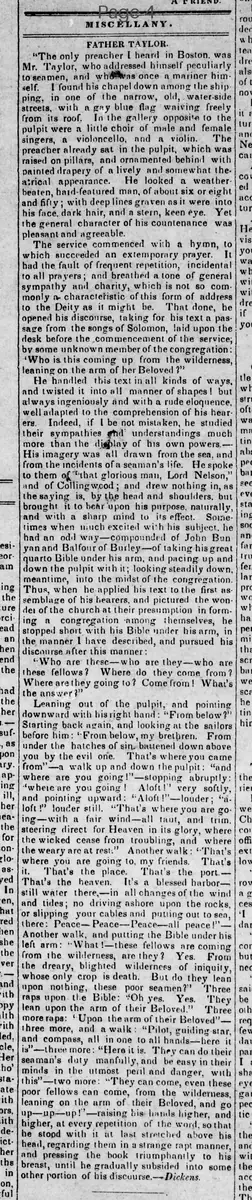
"The only preacher I heard in Boston, was Mr. Taylor, who addressed himself peculiarly to seamen, and who was once a mariner himself. I found his chapel down among the shipping, in one of the narrow, old, water-side streets, with a gay blue flag waving freely from its roof. In the gallery opposite to the pulpit were a little choir of male and female singers, a violoncello, and a violin. The preacher already sat in the pulpit, which was raised on pillars, and ornamented behind with painted drapery of a lively and somewhat theatrical appearance. He looked a weather-beaten, hard-featured man, of about sixty or sixty-eight, with deep lines graven as it were into his face, dark hair, and a stern, keen eye. Yet the general character of his countenance was pleasant and agreeable.
The service commenced with a hymn, to which succeeded an extemporary prayer. It had the fault of frequent repetition, incidental to all prayers; and breathed a tone of general sympathy and charity, which is not so commonly a characteristic of this form of address to the Deity as it might be. That done, he opened his discourse, taking for his text a passage from the songs of Solomon, laid upon the desk before the commencement of the service: by some unknown member of the congregation: "Who is this coming up from the wilderness, leaning on the arm of her Beloved?"
He handled this text in all kinds of ways, and twisted it into all manner of shapes; but always ingeniously, and with a rude eloquence, well adapted to the comprehension of his hearers. Indeed, if I be not mistaken, he studied their sympathies and understandings much more than the display of his own powers.—His imagery was all drawn from the sea, and from the incidents of a seaman's life. He spoke to them of "that glorious man, Lord Nelson, and of Collingwood; and drew nothing in, as the saying is, by the head and shoulders, but brought it to bear upon his purpose, naturally, and with a sharp mind to its effect. Sometimes when much excited with his subject, he had an odd way—compounded of John Bunyan and Balfour of Burley—of taking his great quarto Bible under his arm, and pacing up and down the pulpit with it; looking steadily down, meantime, into the midst of the congregation. Thus, when he applied his text to the first assemblage of his hearers, and pictured the wonder of the church at their presumption in forming a congregation among themselves, he stopped short with his Bible under his arm, in the manner I have described, and pursued his discourse after this manner:
"Who are these—who are they—who are these fellows? Where do they come from? Where are they going to? Come from! What's the answer?" Leaning out of the pulpit, and pointing downward with his right hand: "From below?" Starting back again, and looking at the sailors before him: "From below, my brethren. From under the hatches of sin battened down above you by the evil one. That's where you came from"—a walk up and down the pulpit: "and where are you going!"—stopping abruptly: "where are you going! Aloft!" very softly, and pointing upward: "Aloft!"—louder; "aloft!" louder still. "That's where you are going—with a fair wind—all taut, and trim, steering direct for Heaven in its glory, where the wicked cease from troubling, and where the weary are at rest:" Another walk: "That's where you are going to, my friends. That's it. That's the place. That's the port. That's the heaven. It's a blessed harbor—still water there, in all changes of the wind and tides; no driving ashore upon the rocks, or slipping your cables and putting out to sea, there: Peace—Peace—Peace—all peace!" Another walk, and putting the Bible under his left arm: "What!—these fellows are coming from the wilderness, are they? Yes. From the dreary, blighted wilderness of iniquity, whose only crop is death. But do they lean upon nothing, these poor seamen?" Three raps upon the Bible: "Oh yes. Yes. They lean upon the arm of their Beloved." Three more raps: "Upon the arm of their Beloved"—three more, and a walk: "Pilot, guiding-star and compass, all in one to all hands—here it is"—three more: "Here it is. They can do their seaman's duty manfully, and be easy in their minds in the utmost peril and danger, with this"—two more: "They can come, even these poor fellows can come, from the wilderness, leaning on the arm of their Beloved, and go up—up—up!"—raising his hands higher, and higher, at every repetition of the word, so that he stood with it at last stretched above his head, regarding them in a strange rapt manner, and pressing the book triumphantly to his breast, until he gradually subsided into some other portion of his discourse.—Dickens.
FATHER TAYLOR.
"The only preacher I heard in Boston, was Mr. Taylor, who addressed himself peculiarly to seamen, and who was once a mariner himself. I found his chapel down among the shipping, in one of the narrow, old, water-side streets, with a gay blue flag waving freely from its roof. In the gallery opposite to the pulpit were a little choir of male and female singers, a violoncello, and a violin. The preacher already sat in the pulpit, which was raised on pillars, and ornamented behind with painted drapery of a lively and somewhat theatrical appearance. He looked a weather-beaten, hard-featured man, of about sixty or sixty-eight, with deep lines graven as it were into his face, dark hair, and a stern, keen eye. Yet the general character of his countenance was pleasant and agreeable.
The service commenced with a hymn, to which succeeded an extemporary prayer. It had the fault of frequent repetition, incidental to all prayers; and breathed a tone of general sympathy and charity, which is not so commonly a characteristic of this form of address to the Deity as it might be. That done, he opened his discourse, taking for his text a passage from the songs of Solomon, laid upon the desk before the commencement of the service: by some unknown member of the congregation: "Who is this coming up from the wilderness, leaning on the arm of her Beloved?"
He handled this text in all kinds of ways, and twisted it into all manner of shapes; but always ingeniously, and with a rude eloquence, well adapted to the comprehension of his hearers. Indeed, if I be not mistaken, he studied their sympathies and understandings much more than the display of his own powers.—His imagery was all drawn from the sea, and from the incidents of a seaman's life. He spoke to them of "that glorious man, Lord Nelson, and of Collingwood; and drew nothing in, as the saying is, by the head and shoulders, but brought it to bear upon his purpose, naturally, and with a sharp mind to its effect. Sometimes when much excited with his subject, he had an odd way—compounded of John Bunyan and Balfour of Burley—of taking his great quarto Bible under his arm, and pacing up and down the pulpit with it; looking steadily down, meantime, into the midst of the congregation. Thus, when he applied his text to the first assemblage of his hearers, and pictured the wonder of the church at their presumption in forming a congregation among themselves, he stopped short with his Bible under his arm, in the manner I have described, and pursued his discourse after this manner:
"Who are these—who are they—who are these fellows? Where do they come from? Where are they going to? Come from! What's the answer?" Leaning out of the pulpit, and pointing downward with his right hand: "From below?" Starting back again, and looking at the sailors before him: "From below, my brethren. From under the hatches of sin battened down above you by the evil one. That's where you came from"—a walk up and down the pulpit: "and where are you going!"—stopping abruptly: "where are you going! Aloft!" very softly, and pointing upward: "Aloft!"—louder; "aloft!" louder still. "That's where you are going—with a fair wind—all taut, and trim, steering direct for Heaven in its glory, where the wicked cease from troubling, and where the weary are at rest:" Another walk: "That's where you are going to, my friends. That's it. That's the place. That's the port. That's the heaven. It's a blessed harbor—still water there, in all changes of the wind and tides; no driving ashore upon the rocks, or slipping your cables and putting out to sea, there: Peace—Peace—Peace—all peace!" Another walk, and putting the Bible under his left arm: "What!—these fellows are coming from the wilderness, are they? Yes. From the dreary, blighted wilderness of iniquity, whose only crop is death. But do they lean upon nothing, these poor seamen?" Three raps upon the Bible: "Oh yes. Yes. They lean upon the arm of their Beloved." Three more raps: "Upon the arm of their Beloved"—three more, and a walk: "Pilot, guiding-star and compass, all in one to all hands—here it is"—three more: "Here it is. They can do their seaman's duty manfully, and be easy in their minds in the utmost peril and danger, with this"—two more: "They can come, even these poor fellows can come, from the wilderness, leaning on the arm of their Beloved, and go up—up—up!"—raising his hands higher, and higher, at every repetition of the word, so that he stood with it at last stretched above his head, regarding them in a strange rapt manner, and pressing the book triumphantly to his breast, until he gradually subsided into some other portion of his discourse.—Dickens.
What sub-type of article is it?
Biography
Historical Event
Curiosity
What themes does it cover?
Moral Virtue
Providence Divine
Fate Providence
What keywords are associated?
Father Taylor
Seamen Preacher
Boston Chapel
Nautical Sermon
Dickens Account
What entities or persons were involved?
Father Taylor
Mr. Taylor
Charles Dickens
Where did it happen?
Boston, Down Among The Shipping In Narrow Old Water Side Streets
Story Details
Key Persons
Father Taylor
Mr. Taylor
Charles Dickens
Location
Boston, Down Among The Shipping In Narrow Old Water Side Streets
Story Details
Charles Dickens describes attending Father Taylor's chapel service in Boston, where the former mariner preaches to seamen using vivid nautical imagery from the Song of Solomon, emphasizing redemption and divine guidance.