Thank you for visiting SNEWPapers!
Sign up free
Letter to Editor
March 1, 1805
Berkeley And Jefferson Intelligencer
Martinsburg, Berkeley County, Virginia
What is this article about?
A religious essay praising Jesus Christ as the embodiment of all virtues, drawing from Plato and scripture to emphasize piety, love for God and neighbor, and Christianity's superiority over paganism.
Clipping
OCR Quality
98%
Excellent
Full Text
MONITORIAL!
For the Intelligencer.
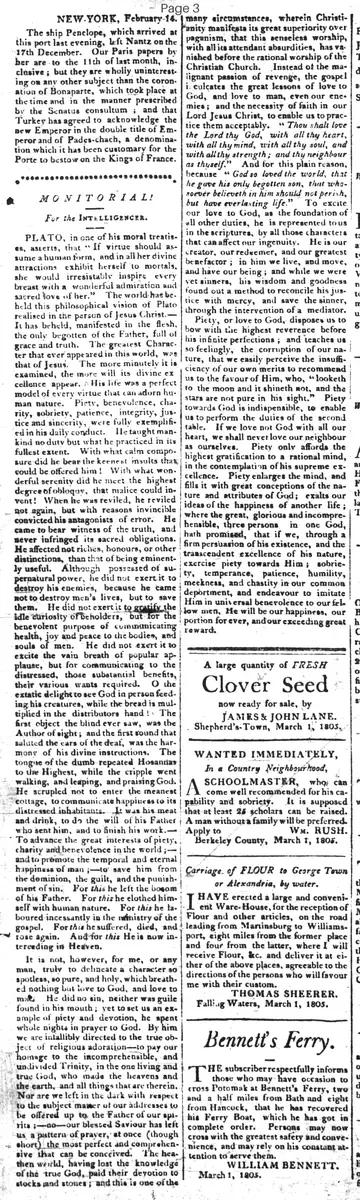
PLATO, in one of his moral treatises, asserts, that 'If virtue should assume a human form, and in all her divine attractions exhibit herself to mortals, she would irresistibly inspire every breast with a wonderful admiration and sacred love of her.' The world has beheld this philosophical vision of Plato realised in the person of Jesus Christ. It has beheld, manifested in the flesh, the only begotten of the Father, full of grace and truth. The greatest Character that ever appeared in this world, was that of Jesus. The more minutely it is examined, the more will its divine excellence appear. His life was a perfect model of every virtue that can adorn human nature. Piety, benevolence, charity, sobriety, patience, integrity, justice and sincerity, were fully exemplified in his daily conduct. He taught mankind no duty but what he practiced in its fullest extent. With what calm composure did he bear the keenest insults that could be offered him! With what wonderful serenity did he meet the highest degree of obloquy, that malice could invent! When he was reviled, he reviled not again, but with reasons invincible convicted his antagonists of error. He came to bear witness of the truth, and never infringed its sacred obligations. He affected not riches, honours, or other distinctions, than that of being eminently useful. Although possessed of supernatural power, he did not exert it to destroy his enemies, because he came not to destroy men's lives, but to save them. He did not exert it to gratify the idle curiosity of beholders, but for the benevolent purpose of communicating health, joy and peace to the bodies, and souls of men. He did not exert it to excite the vain breath of popular applause, but for communicating to the distressed, those substantial benefits, their various wants required. O the ecstatic delight to see God in person feeding his creatures, while the bread is multiplied in the distributor's hand! The first object the blind ever saw, was the Author of light: and the first sound that saluted the ears of the deaf, was the harmony of his divine instructions. The tongue of the dumb re-echoed Hosannas to the Highest, while the cripple went walking, and leaping, and praising God. He scrupled not to enter the meanest cottage, to communicate happiness to its distressed inhabitants. It was his meat and drink, to do the will of his Father who sent him, and to finish his work. To advance the great interests of piety, charity and benevolence in the world; and to promote the temporal and eternal happiness of man; to save him from the dominion, the guilt, and the punishment of sin. For this he left the bosom of his Father. For this he clothed himself with human nature. For this he laboured incessantly in the ministry of the gospel. For this he suffered, died, and rose again. And for this He is now interceding in Heaven.
It is not, however, for me, or any man, truly to delineate a character so spotless, so pure, and holy, which breathed nothing but love to God, and love to man. He did no sin, neither was guile found in his mouth; yet to set us an example of piety and devotion, he spent whole nights in prayer to God. By him we are infallibly directed to the true object of religious adoration--to pay our homage to the incomprehensible, and undivided Trinity, in the one living and true God, who made the heavens and the earth, and all things that are therein. Nor are we left in the dark with respect to the subject matter of our addresses to be offered up to the Father of our spirits; no--Our blessed Saviour has left us a pattern of prayer, at once (though short) the most perfect and comprehensive that can be conceived. The heathen world, having lost the knowledge of the true God, paid their devotion to stocks and stones; and this is one of the many circumstances, wherein Christianity manifests its great superiority over paganism, that this senseless worship, with all its attendant absurdities, has vanished before the rational worship of the Christian Church. Instead of the malignant passion of revenge, the gospel inculcates the great lessons of love to God, and love to man, even our enemies; and the necessity of faith in our Lord Jesus Christ, to enable us to practice them acceptably. 'Thou shalt love the Lord thy God, with all thy heart, and with all thy mind, with all thy soul, and with all thy strength; and thy neighbour as thyself.' And for this plain reason, because 'God so loved the world, that he gave his only begotten son, that whosoever believeth in him should not perish, but have everlasting life.' To excite our love to God, as the foundation of all other duties, he is represented to us in the scriptures, by all those characters that can affect our ingenuity. He is our creator, our redeemer, and our greatest benefactor: in him we live, and move, and have our being; and while we were yet sinners, his wisdom and goodness found out a method to reconcile his justice with mercy, and save the sinner, through the intervention of a mediator. Piety, or love to God, disposes us to bow with the highest reverence before his infinite perfections; and teaches us so feelingly, the corruption of our nature, that we easily perceive the insufficiency of our own merits to recommend us to the favour of Him, who, 'looketh to the moon and it shineth not, and the stars are not pure in his sight.' Piety towards God is indispensable, to enable us to perform the duties of the second table. If we love not God with all our heart, we shall never love our neighbour as ourselves. Piety only affords the highest gratification to a rational mind, in the contemplation of his supreme excellence. Piety enlarges the mind, and fills it with great conceptions of the nature and attributes of God; exalts our ideas of the happiness of another life: where the great, glorious and incomprehensible, three persons, in one God, hath promised, that if we, through a firm persuasion of his existence, and the transcendent excellence of his nature, exercise piety towards Him; sobriety, temperance, patience, humility, meekness, and chastity in our common deportment, and endeavour to imitate Him in universal benevolence to our fellow men, He will be our happiness, our portion for ever, and our exceeding great reward.
For the Intelligencer.
PLATO, in one of his moral treatises, asserts, that 'If virtue should assume a human form, and in all her divine attractions exhibit herself to mortals, she would irresistibly inspire every breast with a wonderful admiration and sacred love of her.' The world has beheld this philosophical vision of Plato realised in the person of Jesus Christ. It has beheld, manifested in the flesh, the only begotten of the Father, full of grace and truth. The greatest Character that ever appeared in this world, was that of Jesus. The more minutely it is examined, the more will its divine excellence appear. His life was a perfect model of every virtue that can adorn human nature. Piety, benevolence, charity, sobriety, patience, integrity, justice and sincerity, were fully exemplified in his daily conduct. He taught mankind no duty but what he practiced in its fullest extent. With what calm composure did he bear the keenest insults that could be offered him! With what wonderful serenity did he meet the highest degree of obloquy, that malice could invent! When he was reviled, he reviled not again, but with reasons invincible convicted his antagonists of error. He came to bear witness of the truth, and never infringed its sacred obligations. He affected not riches, honours, or other distinctions, than that of being eminently useful. Although possessed of supernatural power, he did not exert it to destroy his enemies, because he came not to destroy men's lives, but to save them. He did not exert it to gratify the idle curiosity of beholders, but for the benevolent purpose of communicating health, joy and peace to the bodies, and souls of men. He did not exert it to excite the vain breath of popular applause, but for communicating to the distressed, those substantial benefits, their various wants required. O the ecstatic delight to see God in person feeding his creatures, while the bread is multiplied in the distributor's hand! The first object the blind ever saw, was the Author of light: and the first sound that saluted the ears of the deaf, was the harmony of his divine instructions. The tongue of the dumb re-echoed Hosannas to the Highest, while the cripple went walking, and leaping, and praising God. He scrupled not to enter the meanest cottage, to communicate happiness to its distressed inhabitants. It was his meat and drink, to do the will of his Father who sent him, and to finish his work. To advance the great interests of piety, charity and benevolence in the world; and to promote the temporal and eternal happiness of man; to save him from the dominion, the guilt, and the punishment of sin. For this he left the bosom of his Father. For this he clothed himself with human nature. For this he laboured incessantly in the ministry of the gospel. For this he suffered, died, and rose again. And for this He is now interceding in Heaven.
It is not, however, for me, or any man, truly to delineate a character so spotless, so pure, and holy, which breathed nothing but love to God, and love to man. He did no sin, neither was guile found in his mouth; yet to set us an example of piety and devotion, he spent whole nights in prayer to God. By him we are infallibly directed to the true object of religious adoration--to pay our homage to the incomprehensible, and undivided Trinity, in the one living and true God, who made the heavens and the earth, and all things that are therein. Nor are we left in the dark with respect to the subject matter of our addresses to be offered up to the Father of our spirits; no--Our blessed Saviour has left us a pattern of prayer, at once (though short) the most perfect and comprehensive that can be conceived. The heathen world, having lost the knowledge of the true God, paid their devotion to stocks and stones; and this is one of the many circumstances, wherein Christianity manifests its great superiority over paganism, that this senseless worship, with all its attendant absurdities, has vanished before the rational worship of the Christian Church. Instead of the malignant passion of revenge, the gospel inculcates the great lessons of love to God, and love to man, even our enemies; and the necessity of faith in our Lord Jesus Christ, to enable us to practice them acceptably. 'Thou shalt love the Lord thy God, with all thy heart, and with all thy mind, with all thy soul, and with all thy strength; and thy neighbour as thyself.' And for this plain reason, because 'God so loved the world, that he gave his only begotten son, that whosoever believeth in him should not perish, but have everlasting life.' To excite our love to God, as the foundation of all other duties, he is represented to us in the scriptures, by all those characters that can affect our ingenuity. He is our creator, our redeemer, and our greatest benefactor: in him we live, and move, and have our being; and while we were yet sinners, his wisdom and goodness found out a method to reconcile his justice with mercy, and save the sinner, through the intervention of a mediator. Piety, or love to God, disposes us to bow with the highest reverence before his infinite perfections; and teaches us so feelingly, the corruption of our nature, that we easily perceive the insufficiency of our own merits to recommend us to the favour of Him, who, 'looketh to the moon and it shineth not, and the stars are not pure in his sight.' Piety towards God is indispensable, to enable us to perform the duties of the second table. If we love not God with all our heart, we shall never love our neighbour as ourselves. Piety only affords the highest gratification to a rational mind, in the contemplation of his supreme excellence. Piety enlarges the mind, and fills it with great conceptions of the nature and attributes of God; exalts our ideas of the happiness of another life: where the great, glorious and incomprehensible, three persons, in one God, hath promised, that if we, through a firm persuasion of his existence, and the transcendent excellence of his nature, exercise piety towards Him; sobriety, temperance, patience, humility, meekness, and chastity in our common deportment, and endeavour to imitate Him in universal benevolence to our fellow men, He will be our happiness, our portion for ever, and our exceeding great reward.
What sub-type of article is it?
Religious
Philosophical
Ethical Moral
What themes does it cover?
Religion
Morality
What keywords are associated?
Jesus Christ
Virtue
Piety
Christianity
Morality
Trinity
Love God
Benevolence
What entities or persons were involved?
Monitorial
For The Intelligencer
Letter to Editor Details
Author
Monitorial
Recipient
For The Intelligencer
Main Argument
jesus christ embodies perfect virtue and serves as the ultimate model for piety, love of god and neighbor, and christian living, surpassing pagan worship and emphasizing faith for salvation.
Notable Details
References Plato's Vision Of Virtue Realized In Jesus
Describes Jesus' Miracles And Humility
Quotes Biblical Commandments On Love
Contrasts Christianity With Paganism