Thank you for visiting SNEWPapers!
Sign up free
Story
December 11, 1858
Springfield Weekly Republican
Springfield, Hampden County, Massachusetts
What is this article about?
In a Virginia Democratic convention in Richmond last week, the faction of Gov. Wise and the Richmond Enquirer is defeated; John Letcher is nominated for governor, endorsing Buchanan but rejecting Douglas and slavery legislation for territories.
Clipping
OCR Quality
95%
Excellent
Full Text
The Virginia Democracy.
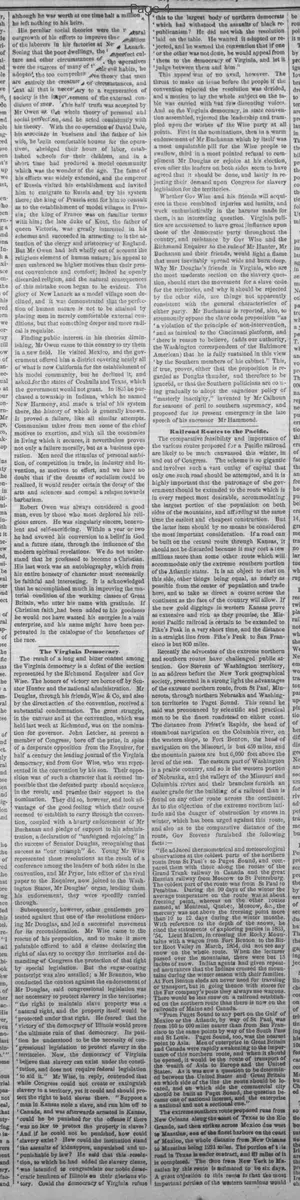
The result of a long and bitter contest among the Virginia democracy is a defeat of the section represented by the Richmond Enquirer and Gov Wise. The honors of victory are borne off by Senator Hunter and the national administration. Mr Douglas, through his friends, Wise & Co, and also by the direct action of the convention, received a substantial condemnation. The great struggle, in the canvass and at the convention, which was held last week at Richmond, was on the nomination for governor. John Letcher, at present a member of Congress, bore off the prize, in spite of a desperate opposition from the Enquirer, for half a century the leading journal of the Virginia democracy, and from Gov Wise, who was represented in the convention by his son. Their opposition was of such a character that it seemed impossible that the defeated party should acquiesce in the result, and promise their support to the nomination. They did so, however, and took advantage of the good feeling which their course seemed to establish to carry through the convention, coupled with a hearty endorsement of Mr Buchanan and pledge of support to his administration, a declaration of "unfeigned rejoicing" in the success of Senator Douglas, recognizing that success as "our triumph" &c. Young Mr Wise represented these resolutions as the result of a conference among the leaders of both sides in the convention, and Mr Pryor, late editor of the rival paper to the Enquirer, now joined to the Washington States, Mr Douglas' organ, lending them his endorsement, they were speedily carried through.
Subsequently, however, other gentlemen protested against that one of the resolutions endorsing Mr Douglas, and led a successful movement for its reconsideration. Mr Wise came to the rescue of his proposition, and to make it more palatable offered to add a clause declaring the right of slavery to occupy the territories and demanding of Congress the protection of that right by special legislation. But the sugar-coating postscript was also assailed; a Mr Brannon, who conducted the contest against the endorsement of Mr Douglas, said congressional legislation was not necessary to protect slavery in the territories; "the right to maintain slave property was a natural right, and the property itself would be protected under that right. He feared that the victory of the democracy of Illinois would prove the ultimate ruin of that democracy. Its position he understood to be the necessity of congressional legislation to protect slavery in the territories. Now, the democracy of Virginia believe that slavery can exist under the constitution, and does not require federal legislation to aid it." Mr Wise, in reply, contended that while Congress could not create or extinguish slavery in a territory, yet it could and should protect the right to hold slaves there. "Suppose a man in Kansas stole a slave, and run him off to Canada, and was afterwards arrested in Kansas, could he be punished for the offense if there was no law to protect the property in slaves? And if he could not be punished, how could slavery exist? How could the institution stand the assaults of kidnappers, unpunished and unpunishable by law? He said that this resolution, to which he had added the slavery clause, was intended to congratulate our noble democratic brethren of Illinois on their glorious victory. Could the democracy of Virginia refuse this to the largest body of northern democrats which had withstood the assaults of black republicanism? He did not wish the resolution laid on the table. He wanted it adopted or rejected, and he warned the convention that if one or the other was not done, he would appeal from them to the democracy of Virginia, and let it judge between them and him."
This appeal was of no avail, however. The threat to make an issue before the people if the convention rejected the resolution was derided, and a motion to lay the whole subject on the table was carried with but few dissenting voices. And so the Virginia democracy, in state convention assembled, rejected the leadership and trampled upon the wishes of the Wise party at all points. First in the nominations, then in a warm endorsement of Mr Buchanan which by itself was a most unpalatable pill for the Wise people to swallow, third in a most pointed refusal to compliment Mr Douglas or rejoice at his election, even after the leaders on both sides seem to have agreed that it should be done, and lastly in rejecting their demand upon Congress for slavery legislation for the territories.
Whether Gov Wise and his friends will acquiesce in these combined injuries and insults, and work enthusiastically in the harness made for them, is an interesting question. Virginia politics are accustomed to have great influence upon those of the democratic party throughout the country, and resistance by Gov Wise and the Richmond Enquirer to the rule of Mr Hunter, Mr Buchanan and their friends, would light a flame that must inevitably spread wide and burn deep. Why Mr Douglas's friends in Virginia, who are the most moderate section on the slavery question, should start the movement for a slave code for the territories, and why it should be rejected by the other side, are things not apparently consistent with the general characteristics of either party. Mr Buchanan is reported, also, to strenuously oppose the slave code proposition "as a violation of the principle of non-intervention, and as inimical to the Cincinnati platform, and there is reason to believe, (adds our authority, the Washington correspondent of the Baltimore American) that he is fully sustained in this view by the Southern members of his cabinet." This, if true, proves, either that the proposition is regarded as Douglas thunder, and therefore to be ignored, or that the Southern politicians are coming gradually to adopt the sagacious policy of "masterly inactivity," invented by Mr Calhoun for seasons of peril to southern supremacy, and proposed for its present emergency in the late speech of his successor Mr Hammond.
The result of a long and bitter contest among the Virginia democracy is a defeat of the section represented by the Richmond Enquirer and Gov Wise. The honors of victory are borne off by Senator Hunter and the national administration. Mr Douglas, through his friends, Wise & Co, and also by the direct action of the convention, received a substantial condemnation. The great struggle, in the canvass and at the convention, which was held last week at Richmond, was on the nomination for governor. John Letcher, at present a member of Congress, bore off the prize, in spite of a desperate opposition from the Enquirer, for half a century the leading journal of the Virginia democracy, and from Gov Wise, who was represented in the convention by his son. Their opposition was of such a character that it seemed impossible that the defeated party should acquiesce in the result, and promise their support to the nomination. They did so, however, and took advantage of the good feeling which their course seemed to establish to carry through the convention, coupled with a hearty endorsement of Mr Buchanan and pledge of support to his administration, a declaration of "unfeigned rejoicing" in the success of Senator Douglas, recognizing that success as "our triumph" &c. Young Mr Wise represented these resolutions as the result of a conference among the leaders of both sides in the convention, and Mr Pryor, late editor of the rival paper to the Enquirer, now joined to the Washington States, Mr Douglas' organ, lending them his endorsement, they were speedily carried through.
Subsequently, however, other gentlemen protested against that one of the resolutions endorsing Mr Douglas, and led a successful movement for its reconsideration. Mr Wise came to the rescue of his proposition, and to make it more palatable offered to add a clause declaring the right of slavery to occupy the territories and demanding of Congress the protection of that right by special legislation. But the sugar-coating postscript was also assailed; a Mr Brannon, who conducted the contest against the endorsement of Mr Douglas, said congressional legislation was not necessary to protect slavery in the territories; "the right to maintain slave property was a natural right, and the property itself would be protected under that right. He feared that the victory of the democracy of Illinois would prove the ultimate ruin of that democracy. Its position he understood to be the necessity of congressional legislation to protect slavery in the territories. Now, the democracy of Virginia believe that slavery can exist under the constitution, and does not require federal legislation to aid it." Mr Wise, in reply, contended that while Congress could not create or extinguish slavery in a territory, yet it could and should protect the right to hold slaves there. "Suppose a man in Kansas stole a slave, and run him off to Canada, and was afterwards arrested in Kansas, could he be punished for the offense if there was no law to protect the property in slaves? And if he could not be punished, how could slavery exist? How could the institution stand the assaults of kidnappers, unpunished and unpunishable by law? He said that this resolution, to which he had added the slavery clause, was intended to congratulate our noble democratic brethren of Illinois on their glorious victory. Could the democracy of Virginia refuse this to the largest body of northern democrats which had withstood the assaults of black republicanism? He did not wish the resolution laid on the table. He wanted it adopted or rejected, and he warned the convention that if one or the other was not done, he would appeal from them to the democracy of Virginia, and let it judge between them and him."
This appeal was of no avail, however. The threat to make an issue before the people if the convention rejected the resolution was derided, and a motion to lay the whole subject on the table was carried with but few dissenting voices. And so the Virginia democracy, in state convention assembled, rejected the leadership and trampled upon the wishes of the Wise party at all points. First in the nominations, then in a warm endorsement of Mr Buchanan which by itself was a most unpalatable pill for the Wise people to swallow, third in a most pointed refusal to compliment Mr Douglas or rejoice at his election, even after the leaders on both sides seem to have agreed that it should be done, and lastly in rejecting their demand upon Congress for slavery legislation for the territories.
Whether Gov Wise and his friends will acquiesce in these combined injuries and insults, and work enthusiastically in the harness made for them, is an interesting question. Virginia politics are accustomed to have great influence upon those of the democratic party throughout the country, and resistance by Gov Wise and the Richmond Enquirer to the rule of Mr Hunter, Mr Buchanan and their friends, would light a flame that must inevitably spread wide and burn deep. Why Mr Douglas's friends in Virginia, who are the most moderate section on the slavery question, should start the movement for a slave code for the territories, and why it should be rejected by the other side, are things not apparently consistent with the general characteristics of either party. Mr Buchanan is reported, also, to strenuously oppose the slave code proposition "as a violation of the principle of non-intervention, and as inimical to the Cincinnati platform, and there is reason to believe, (adds our authority, the Washington correspondent of the Baltimore American) that he is fully sustained in this view by the Southern members of his cabinet." This, if true, proves, either that the proposition is regarded as Douglas thunder, and therefore to be ignored, or that the Southern politicians are coming gradually to adopt the sagacious policy of "masterly inactivity," invented by Mr Calhoun for seasons of peril to southern supremacy, and proposed for its present emergency in the late speech of his successor Mr Hammond.
What sub-type of article is it?
Historical Event
What themes does it cover?
Fortune Reversal
What keywords are associated?
Virginia Democracy
Political Convention
Governor Nomination
Douglas Endorsement
Slavery Protection
Wise Defeat
What entities or persons were involved?
Gov Wise
Senator Hunter
John Letcher
Mr Douglas
Mr Buchanan
Richmond Enquirer
Where did it happen?
Richmond, Virginia
Story Details
Key Persons
Gov Wise
Senator Hunter
John Letcher
Mr Douglas
Mr Buchanan
Richmond Enquirer
Location
Richmond, Virginia
Event Date
Last Week
Story Details
The Virginia Democratic convention defeats the faction led by Gov. Wise and the Richmond Enquirer, nominating John Letcher for governor and supporting Senator Hunter and the national administration. Resolutions endorsing Mr. Douglas and demanding congressional protection for slavery in territories are rejected after debate.