Thank you for visiting SNEWPapers!
Sign up free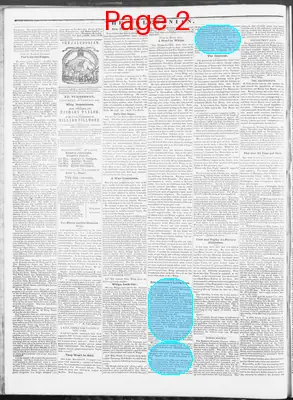
Editorial
October 14, 1848
The Caledonian
Saint Johnsbury, Caledonia County, Vermont
What is this article about?
A critical editorial from the Palo Alto recounts Lewis Cass's career highlights negatively, portraying him as a selfish politician involved in Federalism, territorial governance, war secretary duties, senatorial votes, and presidential candidacy, accusing him of corruption, sycophancy, and inconsistency.
Clipping
OCR Quality
98%
Excellent
Full Text
From the Palo Alto.
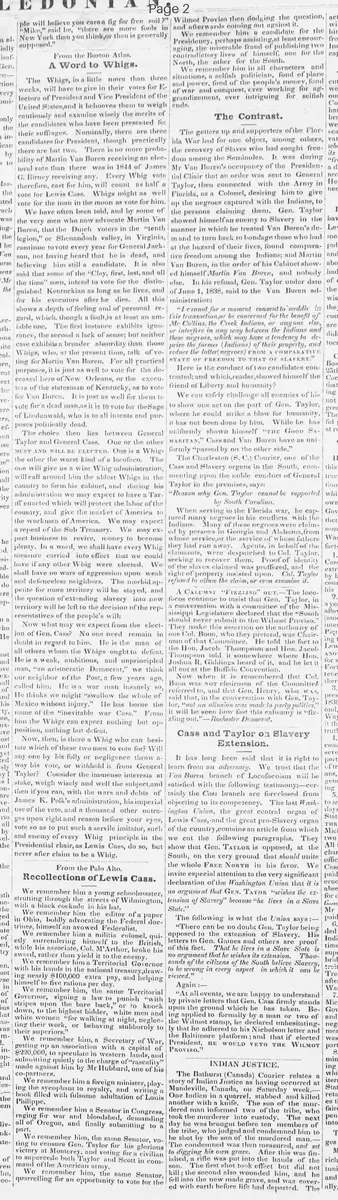
Recollections of Lewis Cass.
We remember him a young schoolmaster, strutting through the streets of Wilmington, with a black cockade in his hat.
We remember him the editor of a paper in Ohio, boldly advocating the Federal doctrines, himself an avowed Federalist.
We remember him a militia colonel, quietly surrendering himself to the British, while his associate, Col. McArthur, broke his sword, rather than yield it to the enemy.
We remember him a Territorial Governor with his hands in the national treasury, drawing nearly $100,000 extra pay, and helping himself to five rations per day.
We remember him, the same Territorial Governor, signing a law to punish "with stripes upon the bare back," or to knock down, to the highest bidder, white men and white women: "for walking at night, neglecting their work, or behaving stubbornly to their superiors."
We remember him, a Secretary of War, getting up an association with a capital of $220,000, to speculate in western lands, and submitting quietly to the charge of "rascality" made against him by Mr Hubbard, one of his co-partners.
We remember him a foreign minister, playing the sycophant to royalty, and writing a book filled with fulsome adulation of Louis Philippe.
We remember him a Senator in Congress, raging for war and bloodshed, demanding all of Oregon, and finally submitting to a part.
We remember him, the same Senator, voting to censure Gen. Taylor for his glorious victory at Monterey, and voting for a civilian to supersede both Taylor and Scott in command of the American army.
We remember him, the same Senator, quarrelling for an opportunity to vote for the Wilmot Proviso then dodging the question, and afterwards coming out against it.
We remember him a candidate for the Presidency, perhaps assisting, at least encouraging, the miserable fraud of publishing two contradictory lives of himself, one for the North, the other for the South.
We remember him in all characters and situations, a selfish politician, fond of place and power, fond of the people's money, fond of war and conquest, ever working for aggrandizement, ever intriguing for selfish ends.
Recollections of Lewis Cass.
We remember him a young schoolmaster, strutting through the streets of Wilmington, with a black cockade in his hat.
We remember him the editor of a paper in Ohio, boldly advocating the Federal doctrines, himself an avowed Federalist.
We remember him a militia colonel, quietly surrendering himself to the British, while his associate, Col. McArthur, broke his sword, rather than yield it to the enemy.
We remember him a Territorial Governor with his hands in the national treasury, drawing nearly $100,000 extra pay, and helping himself to five rations per day.
We remember him, the same Territorial Governor, signing a law to punish "with stripes upon the bare back," or to knock down, to the highest bidder, white men and white women: "for walking at night, neglecting their work, or behaving stubbornly to their superiors."
We remember him, a Secretary of War, getting up an association with a capital of $220,000, to speculate in western lands, and submitting quietly to the charge of "rascality" made against him by Mr Hubbard, one of his co-partners.
We remember him a foreign minister, playing the sycophant to royalty, and writing a book filled with fulsome adulation of Louis Philippe.
We remember him a Senator in Congress, raging for war and bloodshed, demanding all of Oregon, and finally submitting to a part.
We remember him, the same Senator, voting to censure Gen. Taylor for his glorious victory at Monterey, and voting for a civilian to supersede both Taylor and Scott in command of the American army.
We remember him, the same Senator, quarrelling for an opportunity to vote for the Wilmot Proviso then dodging the question, and afterwards coming out against it.
We remember him a candidate for the Presidency, perhaps assisting, at least encouraging, the miserable fraud of publishing two contradictory lives of himself, one for the North, the other for the South.
We remember him in all characters and situations, a selfish politician, fond of place and power, fond of the people's money, fond of war and conquest, ever working for aggrandizement, ever intriguing for selfish ends.
What sub-type of article is it?
Partisan Politics
Military Affairs
Foreign Affairs
What keywords are associated?
Lewis Cass
Political Career
Federalist
Territorial Governor
Secretary Of War
Senator
Presidential Candidate
Wilmot Proviso
Oregon Territory
What entities or persons were involved?
Lewis Cass
Col. Mcarthur
Gen. Taylor
Scott
Louis Philippe
Mr Hubbard
Editorial Details
Primary Topic
Critical Recollections Of Lewis Cass's Political Career
Stance / Tone
Strongly Critical And Condemnatory
Key Figures
Lewis Cass
Col. Mcarthur
Gen. Taylor
Scott
Louis Philippe
Mr Hubbard
Key Arguments
Surrendered To British As Militia Colonel While Associate Resisted
Drew Excessive Pay And Rations As Territorial Governor
Signed Harsh Punishment Laws For White Laborers
Involved In Land Speculation As Secretary Of War, Accused Of Rascality
Sycophantic As Foreign Minister, Adulated Louis Philippe
Demanded All Of Oregon In Senate But Settled For Part
Voted To Censure Gen. Taylor And Replace Military Leaders With Civilian
Inconsistent On Wilmot Proviso
Encouraged Contradictory Biographies In Presidential Campaign
Overall Selfish Politician Seeking Power And Money