Thank you for visiting SNEWPapers!
Sign up free
Editorial
May 13, 1789
Gazette Of The United States
New York, New York County, New York
What is this article about?
This philosophical essay critiques the human tendency to blindly revere ancient institutions and history, attributing it to imagination, comparative judgments, and delight in tragic events. It advises caution in youth's reading of history to avoid fallacious opinions.
Clipping
OCR Quality
98%
Excellent
Full Text
No. IX.
ORIGINAL COMMUNICATIONS.
THE TABLET.
NUMBER IX.
"The imagination of man is naturally sublime, delighted with whatever is remote and extraordinary, and running without controul into the most distant parts of space and time, in order to avoid the objects, which custom has rendered too familiar to it."
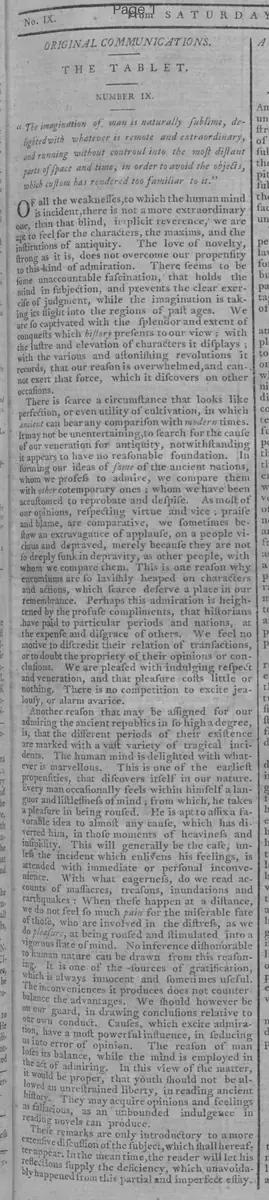
Of all the weaknesses, to which the human mind is incident, there is not a more extraordinary one, than that blind, implicit reverence, we are apt to feel for the institutions of antiquity. The love of novelty, strong as it is, does not overcome our propensity to this kind of admiration. There seems to be some unaccountable fascination, that holds the mind in subjection, and prevents the clear exercise of judgment, while the imagination is taking its flight into the regions of past ages. We are so captivated with the splendor and extent of conquests which history presents to our view; with the lustre and elevation of characters it displays; with the various and astonishing revolutions it records, that our reason is overwhelmed, and cannot exert that force, which it discovers on other occasions.
There is scarce a circumstance that looks like perfection, or even utility of cultivation, in which ancient can bear any comparison with modern times. It may not be unentertaining, to search for the cause of our veneration for antiquity, notwithstanding it appears to have no reasonable foundation. In forming our ideas of some of the ancient nations, whom we profess to admire, we compare them with other cotemporary ones; whom we have been accustomed to reprobate and despise. As most of our opinions, respecting virtue and vice; praise and blame, are comparative, we sometimes bestow an extravagance of applause, on a people vicious and depraved, merely because they are not so deeply sunk in depravity, as other people, with whom we compare them. This is one reason why encomiums are so lavishly heaped on characters and actions, which scarce deserve a place in our remembrance. Perhaps this admiration is heightened by the profuse compliments, that historians have paid to particular periods and nations, at the expense and disgrace of others. We feel no motive to discredit their relation of transactions, or to doubt the propriety of their opinions or conclusions. We are pleased with indulging respect and veneration, and that pleasure costs little or nothing. There is no competition to excite jealousy, or alarm avarice.
Another reason that may be assigned for our admiring the ancient republics in so high a degree, is, that the different periods of their existence are marked with a vast variety of tragical incidents. The human mind is delighted with whatever is marvellous. This is one of the earliest propensities, that discovers itself in our nature. Every man occasionally feels within himself a languor and listlessness of mind; from which, he takes a pleasure in being roused. He is apt to affix a favorable idea to almost any cause, which has diverted him, in those moments of heaviness and insipidity. This will generally be the case, unless the incident which enlivens his feelings, is attended with immediate or personal inconvenience. With what eagerness, do we read accounts of massacres, treasons, inundations and earthquakes: When these happen at a distance, we do not feel so much pain for the miserable fate of those, who are involved in the distress, as we do pleasure, at being roused and stimulated into a vigorous state of mind. No inference dishonorable to human nature can be drawn from this reasoning. It is one of the sources of gratification, which is always innocent and sometimes useful. The inconveniences it produces does not counterbalance the advantages. We should however be on our guard, in drawing conclusions relative to our own conduct. Causes, which excite admiration, have a most powerful influence, in seducing us into error of opinion. The reason of man loses its balance, while the mind is employed in the act of admiring.
In this view of the matter, it would be proper, that youth should not be allowed an unrestrained liberty in reading history. They may acquire opinions and feelings as fallacious, as an unbounded indulgence in reading novels can produce. These remarks are only introductory to a more extensive discussion of the subject, which shall hereafter appear. In the mean time, the reader will let his reflections supply the deficiency, which unavoidably happened from this partial and imperfect essay.
ORIGINAL COMMUNICATIONS.
THE TABLET.
NUMBER IX.
"The imagination of man is naturally sublime, delighted with whatever is remote and extraordinary, and running without controul into the most distant parts of space and time, in order to avoid the objects, which custom has rendered too familiar to it."
Of all the weaknesses, to which the human mind is incident, there is not a more extraordinary one, than that blind, implicit reverence, we are apt to feel for the institutions of antiquity. The love of novelty, strong as it is, does not overcome our propensity to this kind of admiration. There seems to be some unaccountable fascination, that holds the mind in subjection, and prevents the clear exercise of judgment, while the imagination is taking its flight into the regions of past ages. We are so captivated with the splendor and extent of conquests which history presents to our view; with the lustre and elevation of characters it displays; with the various and astonishing revolutions it records, that our reason is overwhelmed, and cannot exert that force, which it discovers on other occasions.
There is scarce a circumstance that looks like perfection, or even utility of cultivation, in which ancient can bear any comparison with modern times. It may not be unentertaining, to search for the cause of our veneration for antiquity, notwithstanding it appears to have no reasonable foundation. In forming our ideas of some of the ancient nations, whom we profess to admire, we compare them with other cotemporary ones; whom we have been accustomed to reprobate and despise. As most of our opinions, respecting virtue and vice; praise and blame, are comparative, we sometimes bestow an extravagance of applause, on a people vicious and depraved, merely because they are not so deeply sunk in depravity, as other people, with whom we compare them. This is one reason why encomiums are so lavishly heaped on characters and actions, which scarce deserve a place in our remembrance. Perhaps this admiration is heightened by the profuse compliments, that historians have paid to particular periods and nations, at the expense and disgrace of others. We feel no motive to discredit their relation of transactions, or to doubt the propriety of their opinions or conclusions. We are pleased with indulging respect and veneration, and that pleasure costs little or nothing. There is no competition to excite jealousy, or alarm avarice.
Another reason that may be assigned for our admiring the ancient republics in so high a degree, is, that the different periods of their existence are marked with a vast variety of tragical incidents. The human mind is delighted with whatever is marvellous. This is one of the earliest propensities, that discovers itself in our nature. Every man occasionally feels within himself a languor and listlessness of mind; from which, he takes a pleasure in being roused. He is apt to affix a favorable idea to almost any cause, which has diverted him, in those moments of heaviness and insipidity. This will generally be the case, unless the incident which enlivens his feelings, is attended with immediate or personal inconvenience. With what eagerness, do we read accounts of massacres, treasons, inundations and earthquakes: When these happen at a distance, we do not feel so much pain for the miserable fate of those, who are involved in the distress, as we do pleasure, at being roused and stimulated into a vigorous state of mind. No inference dishonorable to human nature can be drawn from this reasoning. It is one of the sources of gratification, which is always innocent and sometimes useful. The inconveniences it produces does not counterbalance the advantages. We should however be on our guard, in drawing conclusions relative to our own conduct. Causes, which excite admiration, have a most powerful influence, in seducing us into error of opinion. The reason of man loses its balance, while the mind is employed in the act of admiring.
In this view of the matter, it would be proper, that youth should not be allowed an unrestrained liberty in reading history. They may acquire opinions and feelings as fallacious, as an unbounded indulgence in reading novels can produce. These remarks are only introductory to a more extensive discussion of the subject, which shall hereafter appear. In the mean time, the reader will let his reflections supply the deficiency, which unavoidably happened from this partial and imperfect essay.
What sub-type of article is it?
Moral Or Religious
Education
What keywords are associated?
Antiquity Reverence
Human Imagination
Historical Admiration
Virtue Vice Comparison
Reading History Caution
What entities or persons were involved?
Ancient Republics
Historians
Editorial Details
Primary Topic
Blind Reverence For Ancient Institutions
Stance / Tone
Philosophical Critique And Cautionary
Key Figures
Ancient Republics
Historians
Key Arguments
Human Mind Blindly Reveres Antiquity Due To Imagination And Fascination With The Remote
Comparative Judgments Inflate Praise For Ancient Nations Over More Depraved Contemporaries
Admiration Heightened By Historians' Biased Compliments
Delight In Marvelous And Tragic Historical Incidents Rouses The Mind
Unrestricted Reading Of History Can Lead Youth To Fallacious Opinions