Thank you for visiting SNEWPapers!
Sign up free
Lynchburg Virginian
Lynchburg, Virginia
What is this article about?
Domestic intelligence from Florida reports U.S. Army operations against Seminole Indians in January 1837, including steamboat arrivals, troop advances under Generals Jesup and Eustis to establish Fort Taylor, capture of an Indian guide, burning of towns by Col. Taylor, battle casualties on the 25th involving Cols. Gentry and Thompson, injury to M.L.W. Dudley on the John Adams, discovery of a sulphur spring, and mishandling of Missouri regiment's horses causing many deaths.
Clipping
OCR Quality
Full Text
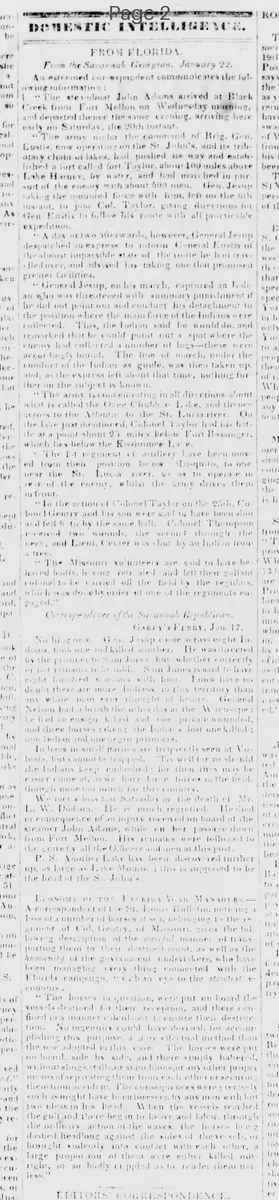
FROM FLORIDA
From the Savannah Georgian, January 22.
An esteemed correspondent communicates the following information:
"The steamboat John Adams arrived at Black Creek from Fort Mellon on Wednesday morning, and departed thence the same evening, arriving here early on Sunday, the 20th instant.
"The army under the command of Brig. Gen. Eustis, now operating on the St. John's, and its tributary chain of lakes, had pushed its way and established a fort called Fort Taylor, about 100 miles above Lake George, by water, and hand marched in pursuit of the enemy with about 500 men. Gen. Jesup taking the mounted force with him, left on the 15th instant, to join Col. Taylor, giving directions for Gen. Eustis to follow his route with all practicable expedition.
A day or two afterwards, however, General Jesup despatched an express to Gen. Eustis of the almost impassable state of the route he had taken. He desired his taking one that promised greater facilities.
"General Jesup, on his march, captured an Indian who was threatened with summary punishment if he did not point out and conduct his detachment to the position where the main force of the Indians were collected. Thus, the Indian said he would do, and remarked that he could point out a spot where the enemy had collected a number of logs—these were accordingly sought. The route of march, under the conduct of the Indian as guide, was then taken up and, as the express left about that time, nothing further on the subject is known.
"The army is co-operating in all directions about what is called the Ocklawaha and Kissimmee Lakes, which thence crosses to the Atlantic to the St. Lucie river on the East. Just mentioned. Colonel Taylor has burnt the towns at a point about 70 miles below Fort Basinger, which lies below the Kissimmee Lake.
The 1st regiment of artillery have been moved from their post on Lowe Indian-quo, to one near the St. Lucie river, or is to operate in rear of the Indians, while the army tries them in front.
"In the action of Colonel Taylor on the 25th, Cols. Gentry and his son were said to have been slain by the same ball. Colonel Thompson received two wounds, one through the knee, and Lieut. Catter was shot by an Indian in a tree.
"The Missouri volunteers are said to have behaved handsomely, having remained at their posts and left their gallant colonel to the care of the field by the surgeons which was doubtlessly owing to the regiment's being so much exhausted.
From the Savannah Republican.
GAINESVILLE, Jan. 7.
[Note: The following section appears garbled due to OCR errors and is preserved with minimal corrections where unambiguous.]
By the last accounts we have eight Indians killed and one missing. He was shot by the pickets on St. Johns but whether mortally or not we are unable to say. St. Johns is supposed to be the chief hunting ground of the Seminoles in this territory than any white man ever thought of before. General Nelson has pushed on with the wagons: he had an ensign who led and commanded. To the horses there: the U.S. lost one killed; our only just sure it's true.
Indians are said to be frequently seen at Volusia, the Indians kept cattle there than any may he ever come all. We need it to tease the led though himself might that county.
We lament to state that M. L. W. Dudley, Esq., is much injured, crushed in consequence of an injury received on board of the steamer John Adams, while on his passage down from Fort Mellon. His limbs were thought to be all the worse at this post.
P. S. A sulphur spring has been discovered up there, as large as Lake Monroe, this supposed to be the head of the St. Johns river.
A correspondent to the St. Johns bull, noting the cruel manner of transporting the regiment of Col. Gentry of Missouri, has the following description of the cruel manner of transporting them to their destination, as well as the inhumanity of the government teamsters, who have been managing every thing connected with the Florida campaign by sea to the strictest economy.
"The horses in question were put on board the vessels destined for their reception, and there confined in a manner calculated to ensure their destruction. No measure can have been devised, for accomplishing this purpose, a more effectual method than the one adopted in this case. The horses were put on board, side by side, and there simply haltered, without slings or stanchions, or any other proper means of supporting them or making their position secure. The consequences were necessarily such as might have been foreseen by any man with less than two grains of brains in his head. When the vessels reached the inlet and there began to heave and pitch through the only path out to the ocean, the horses being dashed heavily against the sides, the vessel suddenly brought into contact with each other, a large proportion of them were either killed outright, or so badly injured as to render them useless."
What sub-type of article is it?
What keywords are associated?
What entities or persons were involved?
Where did it happen?
Domestic News Details
Primary Location
Florida
Event Date
January 1837 (Reported 7th And 22nd)
Key Persons
Outcome
cols. gentry and son slain by same ball; col. thompson wounded twice (one through knee); lieut. catter shot; m. l. w. dudley injured on steamer; many horses killed or injured during transport; eight indians killed and one missing.
Event Details
Steamboat John Adams arrived from Fort Mellon on January 20. Army under Gen. Eustis established Fort Taylor and pursued enemy; Gen. Jesup with mounted force joined Col. Taylor on 15th instant, later redirected route. Jesup captured Indian guide to lead to main Indian force and logs. Operations around Ocklawaha and Kissimmee Lakes to St. Lucie River; Col. Taylor burnt towns 70 miles below Fort Basinger. 1st Artillery moved to St. Lucie. Action on 25th with casualties; Missouri volunteers behaved well despite exhaustion. From Gainesville: Possible Indian encounters; Dudley injured on John Adams; sulphur spring discovered near St. Johns head. Cruel transport of Col. Gentry's Missouri regiment horses led to many deaths.