Thank you for visiting SNEWPapers!
Sign up free
The Wilmington Morning Star
Wilmington, New Hanover County, North Carolina
What is this article about?
The National Geographic Society describes French Indochina as a tropical crossroads of Asia amid fighting between French forces and nationalists. It covers the region's history from 16th-century French exploration to post-WWII nationalist movements establishing the Republic of Viet-Nam and Cochin China, with unsettled boundaries.
Clipping
OCR Quality
Full Text
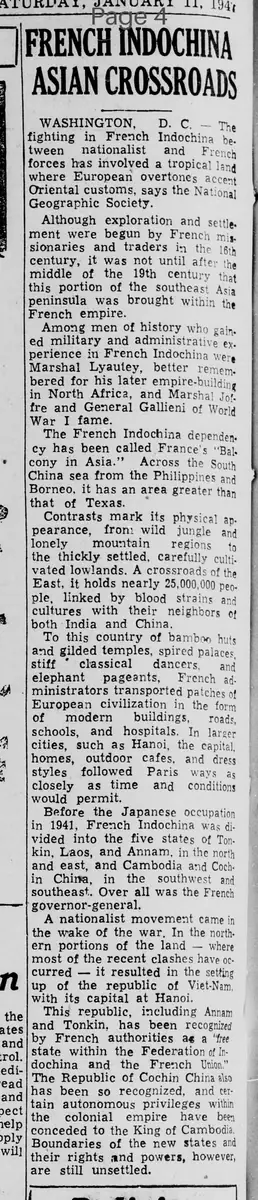
WASHINGTON, D. C.
The fighting in French Indochina between nationalist and French forces has involved a tropical land where European overtones accent Oriental customs, says the National Geographic Society.
Although exploration and settlement were begun by French missionaries and traders in the 16th century, it was not until after the middle of the 19th century that this portion of the southeast Asia peninsula was brought within the French empire.
Among men of history who gained military and administrative experience in French Indochina were Marshal Lyautey, better remembered for his later empire-building in North Africa, and Marshal Joffre and General Gallieni of World War I fame.
The French Indochina dependency has been called France's 'Balcony in Asia."
Across the South China sea from the Philippines and Borneo, it has an area greater than that of Texas.
Contrasts mark its physical appearance, from wild jungle and lonely mountain regions to the thickly settled, carefully cultivated lowlands. A crossroads of the East, it holds nearly 25,000,000 people, linked by blood strains and cultures with their neighbors of both India and China.
To this country of bamboo huts and gilded temples, spired palaces, stiff classical dancers, and elephant pageants, French administrators transported patches of European civilization in the form of modern buildings, roads, schools, and hospitals. In larger cities, such as Hanoi, the capital, homes, outdoor cafes, and dress styles followed Paris ways as closely as time and conditions would permit.
Before the Japanese occupation in 1941, French Indochina was divided into the five states of Tonkin, Laos, and Annam, in the north and east, and Cambodia and Cochin China, in the southwest and southeast. Over all was the French governor-general.
A nationalist movement came in the wake of the war. In the northern portions of the land - where most of the recent clashes have occurred - it resulted in the setting up of the republic of Viet-Nam, with its capital at Hanoi.
This republic, including Annam and Tonkin, has been recognized by French authorities as a 'free state within the Federation of Indochina and the French Union."
The Republic of Cochin China also has been so recognized, and certain autonomous privileges within the colonial empire have been conceded to the King of Cambodia.
Boundaries of the new states and their rights and powers, however, are still unsettled.
What sub-type of article is it?
What keywords are associated?
What entities or persons were involved?
Where did it happen?
Foreign News Details
Primary Location
French Indochina
Key Persons
Outcome
republic of viet-nam, including annam and tonkin, recognized as a free state within the federation of indochina and the french union; republic of cochin china recognized similarly; autonomous privileges conceded to the king of cambodia; boundaries and rights still unsettled.
Event Details
Fighting between nationalist and French forces in French Indochina, a tropical land blending European and Oriental elements. French exploration began in the 16th century, formalized in the mid-19th. Historical figures like Lyautey, Joffre, and Gallieni gained experience there. Area larger than Texas, with diverse landscapes and 25 million people influenced by India and China. French introduced modern infrastructure in cities like Hanoi. Pre-1941 division into Tonkin, Laos, Annam, Cambodia, Cochin China under a governor-general. Post-war nationalist movement led to Republic of Viet-Nam in the north with capital at Hanoi.