Thank you for visiting SNEWPapers!
Sign up free
Daily National Intelligencer
Washington, District Of Columbia
What is this article about?
In the U.S. House of Representatives on Dec. 9, 1812, Mr. Stow spoke in a debate on merchants' petitions for remission of bonds on $20 million in British imports, arguing no violation of non-importation laws occurred due to changed circumstances, urging against forfeiture as unjust and impolitic amid war.
Clipping
OCR Quality
Full Text
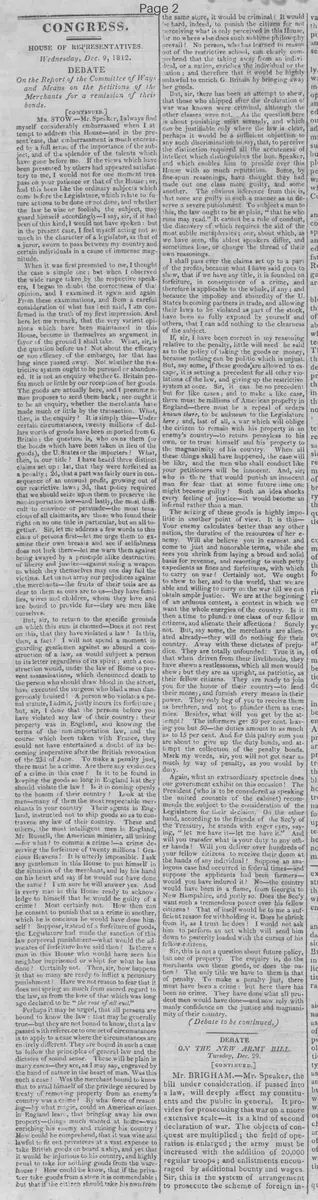
HOUSE OF REPRESENTATIVES.
Wednesday, Dec. 9, 1812.
DEBATE
On the Report of the Committee of Ways and Means on the petitions of the Merchants for a remission of their bonds.
CONTINUED.
Mr. STOW.—Mr. Speaker, I always find myself considerably embarrassed when I attempt to address this House—and in the present case, that embarrassment is much increased by a full sense of the importance of the subject, and of the splendor of the talents which have gone before me. If the views which have been presented by others had appeared satisfactory to me, I would not for one moment trespass on your patience or that of the House; or, had this been like the ordinary subjects which come before the Legislature, which relate to future actions to be done or not done, and whether the law be wise or foolish, the subject may guard himself accordingly—I say, sir, if it had been of this kind, I would not have spoken: but in the present case, I feel myself acting not so much in the character of a legislator, as that of a juror, sworn to pass between my country and certain individuals in a cause of immense magnitude.
When it was first presented to me, I thought the case a simple one; but when I observed the wide range taken by the respective speakers, I began to doubt the correctness of that opinion, and I examined it again and again. From these examinations, and from a careful consideration of what has been said, I am confirmed in the truth of my first impression. And here let me remark, that the very variant opinions which have been maintained in this House, become in themselves an argument in favor of the ground I shall take. What, sir, is the question before us? Not about the efficacy or non efficacy of the embargo, for that has long since passed away. Not whether the restrictive system ought to be pursued or abandoned. It is not an enquiry whether G. Britain profits much or little by our reception of her goods. The goods are actually here, and I presume no man proposes to send them back; nor ought it to be an enquiry, whether the merchants have made much or little by the transaction. What, then, is the enquiry? It is simply this—Under certain circumstances, twenty millions of dollars worth of goods have been imported from G. Britain; the question is, who owns them (or the bonds which have been taken in lieu of the goods), the U. States or the importers? What, then, is our title? I have heard three distinct claims set up: 1st, that they were forfeited as a penalty; 2d, that a part was fairly ours in consequence of an unusual profit, growing out of our restrictive laws; 3d, that policy required that we should seize upon them to preserve the non-importation law—and lastly, the most difficult to convince or persuade—the most tenacious of all claimants, are those who found their right on no one title in particular, but on all together. Sir, let me address a few words to this class of persons first—let me urge them to examine their own breasts and see if selfishness does not lurk there—let me warn them against being swayed by a principle alike destructive of liberty and justice—against using a weapon to which they themselves may one day fall the victims. Let us not array our prejudices against the merchants—the fruits of their toils are as dear to them as ours are to us—they have families, wives and children, whom they love and are bound to provide for—they are men like ourselves,
But, sir, to return to the specific grounds on which this sum is claimed—Does it not rest on this, that they have violated a law? Is this, then, a fact? I will not spend a moment in guarding gentlemen against so absurd a construction of a law, as would subject a person to its letter regardless of its spirit; such a construction would, under the law of Rome to prevent assassinations, which denounced death to the person who should draw blood in the street, have executed the surgeon who bled a man dangerously bruised! A person who violates a penal statute, I admit, justly incurs its forfeiture; but, sir, I deny that the persons before you have violated any law of their country: their property was in England, and knowing the terms of the non-importation law, and the course which had been taken with France, they could not have entertained a doubt of its becoming inoperative after the British revocation of the 23d of June. To make a penalty just, there must be a crime. Are there any evidences of a crime in this case? Is it to be found in keeping the goods so long in England lest they should violate the law? Is it in coming openly to the bosom of their country? Look at the men—many of them the most respectable merchants in your country. Their agents in England, instructed not to ship goods so as to contravene any law of their country. These and others, the most intelligent men in England, Mr. Russell, the American minister, all uniting—for what? to commit a crime! a crime deserving the forfeiture of twenty millions! Gracious Heavens! It is utterly impossible. I ask any gentleman in this House to put himself in the situation of the merchant, and lay his hand on his heart and say if he would not have done the same? I am sure he will answer yes. And is every man in this House ready to acknowledge to himself that he would be guilty of a crime? Most certainly not. How then can he consent to punish that as a crime in another, which he is conscious he would have done himself? Suppose, instead of a forfeiture of goods, the Legislature had made the sanction of this law corporeal punishment—what would the advocates of forfeiture have said then? Is there a man in this House who would have seen his neighbor imprisoned or whipped for what he has done? Certainly not. Then, sir, how happens it that so many are ready to inflict a pecuniary punishment? Have we not reason to fear that it does not spring so much from sacred regard to the law, as from the love of that which was long ago declared to be "the root of all evil."
Perhaps it may be urged, that all persons are bound to know the law: that may be generally true—but they are not bound to know, that a law passed with reference to one set of circumstances is to apply to a case where the circumstances are entirely different. They are bound in such a case to follow the principles of general law and the dictates of sound sense. These will be plain in many cases—they are, as I may say, engraved by the hand of nature in the heart of man. Was this such a case? Was the merchant bound to know that to avail himself of the privilege secured by treaty of removing property from an enemy's country was a crime? By what force of reasoning—by what magic, could an American citizen in England learn, that bringing away his own property—things much wanted at home—was enriching his enemy and ruining his country? How could he comprehend, that it was wise and lawful to fit out privateers at a vast expense to take British goods on board a ship, and yet that it would be injurious to his country, and highly penal to take for nothing goods from the warehouse? How could he know, that if the privateer take goods from a store it is commendable; but that if the citizen should take his own from the same store, it would be criminal? It would be hard, indeed, to punish the citizen for not perceiving what is only perceived in this House. For no where else does such sublime philosophy prevail! No person, who has learned to reason out of the restrictive school, can clearly comprehend that the taking away from an individual, or a nation, enriches the individual or the nation; and therefore that it would be highly unlawful to enrich G. Britain by bringing away her goods.
But, sir, there has been an attempt to shew that those who shipped after the declaration of war was known were criminal, although the other classes were not. As the question here is about punishing most severely, and which can be justifiable only where the law is clear, perhaps it would be a sufficient objection to any such discrimination to say, that, to perceive the distinction required all the accuteness of intellect which distinguishes the hon. Speaker and which enables him to preside over this House with so much reputation. Some, by fine-spun reasonings, have thought they had made out one class more guilty, and some another. The obvious inference from this is, that none are guilty in such a manner as to deserve a severe punishment. To subject a man to this, the law ought to be so plain "that he who runs may read." It cannot be a rule of conduct, the discovery of which requires the aid of the most subtle metaphysics; one, about which, as we have seen, the ablest speakers differ, and sometimes lose, or change the thread of their own reasonings.
I shall pass over the claims set up to a part of the profits, because what I have said goes to shew that if we have any title, it is founded on forfeiture, in consequence of a crime, and therefore is applicable to the whole, if any: and because the impolicy and absurdity of the U. States becoming partners in trade, and allowing their laws to be violated as part of the stock, have been so fully exposed by yourself and others, that I can add nothing to the clearness of the subject.
If, sir, I have been correct in my reasoning relative to the penalty, little will need be said as to the policy of taking the goods or money, because nothing can be politic which is unjust. But, say some, if these goods are allowed to escape, it is setting a precedent for all other violations of the law, and giving up the restrictive system at once. Sir, it can be no precedent but for like cases; and to make a like case, there must be millions of American property in England—there must be a repeal of orders known there, to be unknown to the Legislature here; and, last of all, a war which will oblige the citizen to remain with his property in an enemy's country—to return pennyless to his own, or to trust himself and his property to the magnanimity of his country. When all these things shall have happened, the case will be like, and the men who shall conduct like your petitioners will be innocent. And, sir, who is there that would punish an innocent man for fear that at some future time one might become guilty? Such an idea shocks every feeling of justice—it would become an infernal rather than a man.
The seizing of these goods is highly impolitic in another point of view. It is this—Your enemy calculates better than any other nation, the duration of the resources of her enemy. Will she believe you in earnest, and come to just and honorable terms, while she sees you shrink from laying a broad and solid basis for revenue, and resorting to such petty expedients as fines and forfeitures, with which to carry on war? Certainly not. We ought to shew to her, and to the world, that we are able and willing to carry on the war till we can obtain ample justice. We are at the beginning of an arduous contest, a contest in which we want the whole energies of the country. Is it then a time to plunder one class of our fellow citizens, and alienate their affections! Surely not. But, say some, the merchants are alienated already—they will do nothing for their country. Away with these dictates of prejudice. They are totally unfounded. True it is, that when driven from their livelihoods, they have shewn a restlessness, which all men would shew; but they are as upright, as patriotic, as their fellow citizens. They are ready to join you for the honor of their country—to lend their money, and furnish every means in their power. They only beg of you to receive them as brethren, and not to plunder them as enemies. Besides, what will you get by the attempt? The informers get 50 per cent. leaving you but 50—the duties amount to as much as to 15 per cent. And for this paltry sum you are about to give up the duty bonds, and attempt the collection of the penalty bonds. Mark my words, sir, you will not get near as much by way of penalty, as you would by duty.
Again, what an extraordinary spectacle does our government exhibit on this occasion! The President (who is to be considered as speaking the united counsels of the cabinet) recommends the subject to the consideration of the Legislature for their decision. On the other hand, according to the friends of the Sec'y of the Treasury, he stands with eager eyes, saying "let me have it—let me have it." And will you transfer what is your duty to any other hands? Will you deliver over hundreds of your fellow citizens to receive their doom at the hands of any individual? Suppose an analogous case had occurred in federal times—and suppose the applicants had been farmers—would you have endured it? No—the country would have been in a flame, from Georgia to New Hampshire, and justly so. Does the Sec'y want such a tremendous power over his fellow citizens? That of itself would be to me a sufficient reason for withholding it. Does he shrink from it, as I trust he does? I would not ask him to perform an act which will send him down to posterity loaded with the curses of his fellow citizens.
Sir, this is not a question about future policy, but one of property. The enquiry is, do the merchants own these goods, or does the nation? The only title we have to them is that of penalty. To make a penalty just, there must have been a crime: but here there has been no crime. They have done what all prudent men would have done—and now rely with manly confidence on the justice and magnanimity of their country.
(Debate to be continued.)
What sub-type of article is it?
What keywords are associated?
What entities or persons were involved?
Where did it happen?
Domestic News Details
Primary Location
United States House Of Representatives
Event Date
Wednesday, Dec. 9, 1812
Key Persons
Outcome
debate continued; no resolution mentioned
Event Details
Mr. Stow argues against forfeiture of merchants' bonds for importing goods from Great Britain, claiming no crime was committed under the non-importation law given the revocation of orders and declaration of war. He refutes claims of penalty, unusual profits, and policy needs for seizure, emphasizing justice, impolicy of alienation, and comparison to other sanctions.