Thank you for visiting SNEWPapers!
Sign up free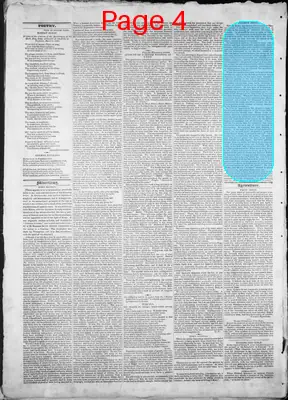
Concord Register
Concord, Merrimack County, New Hampshire
What is this article about?
Biographical sketch of Patrick Henry, detailing his unpromising youth, early failures in farming and business, rise as an orator in the 'Parsons' Cause,' and pivotal role in igniting the American Revolution through his defiant speeches against British taxation, culminating in his famous 'Give me liberty or give me death' address in 1774.
Clipping
OCR Quality
Full Text
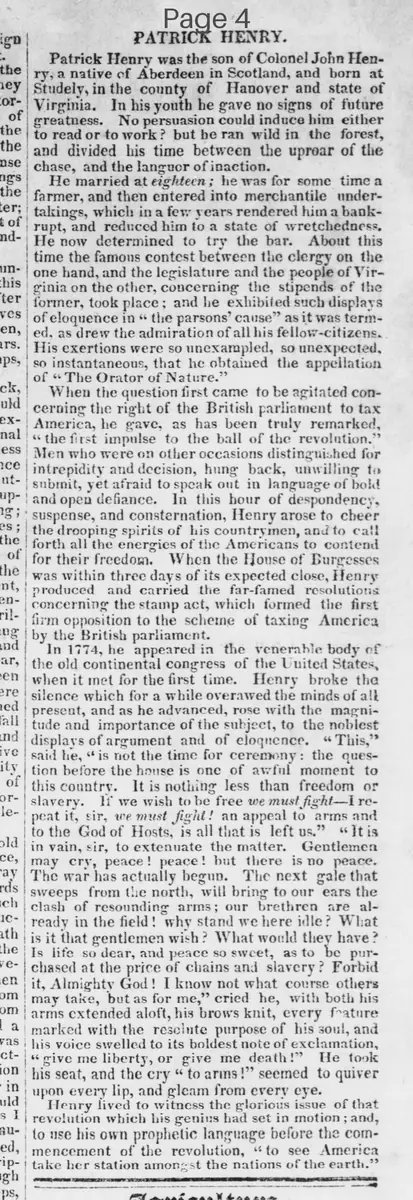
Patrick Henry was the son of Colonel John Henry, a native of Aberdeen in Scotland, and born at Studley, in the county of Hanover and state of Virginia. In his youth he gave no signs of future greatness. No persuasion could induce him either to read or to work; but he ran wild in the forest, and divided his time between the uproar of the chase, and the languor of inaction.
He married at eighteen; he was for some time a farmer, and then entered into mercantile undertakings, which in a few years rendered him a bankrupt, and reduced him to a state of wretchedness. He now determined to try the bar. About this time the famous contest between the clergy on the one hand, and the legislature and the people of Virginia on the other, concerning the stipends of the former, took place; and he exhibited such displays of eloquence in "the parsons' cause" as it was termed, as drew the admiration of all his fellow-citizens. His exertions were so unexampled, so unexpected, so instantaneous, that he obtained the appellation of "The Orator of Nature."
When the question first came to be agitated concerning the right of the British parliament to tax America, he gave, as has been truly remarked, "the first impulse to the ball of the revolution." Men who were on other occasions distinguished for intrepidity and decision, hung back, unwilling to submit, yet afraid to speak out in language of bold and open defiance. In this hour of despondency, suspense, and consternation, Henry arose to cheer the drooping spirits of his countrymen, and to call forth all the energies of the Americans to contend for their freedom. When the House of Burgesses was within three days of its expected close, Henry produced and carried the far-famed resolutions concerning the stamp act, which formed the first firm opposition to the scheme of taxing America by the British parliament.
In 1774, he appeared in the venerable body of the old continental congress of the United States, when it met for the first time. Henry broke the silence which for a while overawed the minds of all present, and as he advanced, rose with the magnitude and importance of the subject, to the noblest displays of argument and of eloquence. "This," said he, "is not the time for ceremony: the question before the house is one of awful moment to this country. It is nothing less than freedom or slavery. If we wish to be free we must fight—I repeat it, sir, we must fight! an appeal to arms and to the God of Hosts, is all that is left us." "It is in vain, sir, to extenuate the matter. Gentlemen may cry, peace! peace! but there is no peace. The war has actually begun. The next gale that sweeps from the north, will bring to our ears the clash of resounding arms; our brethren are already in the field! why stand we here idle? What is it that gentlemen wish? What would they have? Is life so dear, and peace so sweet, as to be purchased at the price of chains and slavery? Forbid it, Almighty God! I know not what course others may take, but as for me," cried he, with both his arms extended aloft, his brows knit, every feature marked with the resolute purpose of his soul, and his voice swelled to its boldest note of exclamation, "give me liberty, or give me death!" He took his seat, and the cry "to arms!" seemed to quiver upon every lip, and gleam from every eye.
Henry lived to witness the glorious issue of that revolution which his genius had set in motion; and, to use his own prophetic language before the commencement of the revolution, "to see America take her station amongst the nations of the earth."
What sub-type of article is it?
What themes does it cover?
What keywords are associated?
What entities or persons were involved?
Where did it happen?
Story Details
Key Persons
Location
Virginia, United States
Story Details
Patrick Henry, son of Colonel John Henry, showed no early promise, preferring idleness over work or study. After marrying at 18, he failed as a farmer and merchant, leading to bankruptcy. He turned to law and gained fame in the 'Parsons' Cause' for his eloquence, earning the title 'The Orator of Nature.' He led opposition to British taxation, introducing resolutions against the Stamp Act and delivering the iconic 'Give me liberty or give me death' speech at the 1774 Continental Congress, sparking the Revolution.