Thank you for visiting SNEWPapers!
Sign up free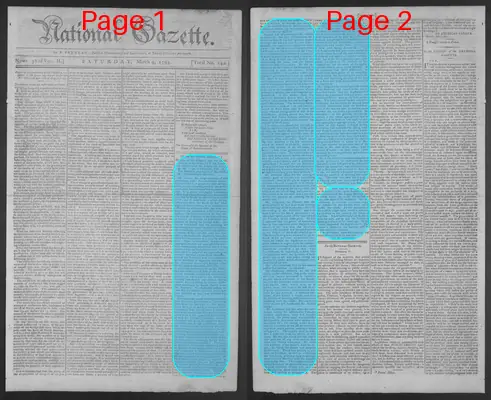
National Gazette
Philadelphia, Philadelphia County, Pennsylvania
What is this article about?
In a House committee session on February 23, Mr. Giles led an inquiry into the Secretary of the Treasury's handling of foreign loans, alleging unauthorized use of principal for interest payments and excessive drafts. Defenders like Messrs. Sedgwick, Fitzsimons, and Lawrence argued the actions were lawful, economical, and sanctioned, refuting the charges. The committee reported progress.
Merged-components note: Continuation of minutes of congressional enquiry into the Secretary of the Treasury's conduct across pages 1 and 2; relabeled from 'story' to 'domestic_news' as it fits government proceedings.
Clippings
1 of 2
OCR Quality
Full Text
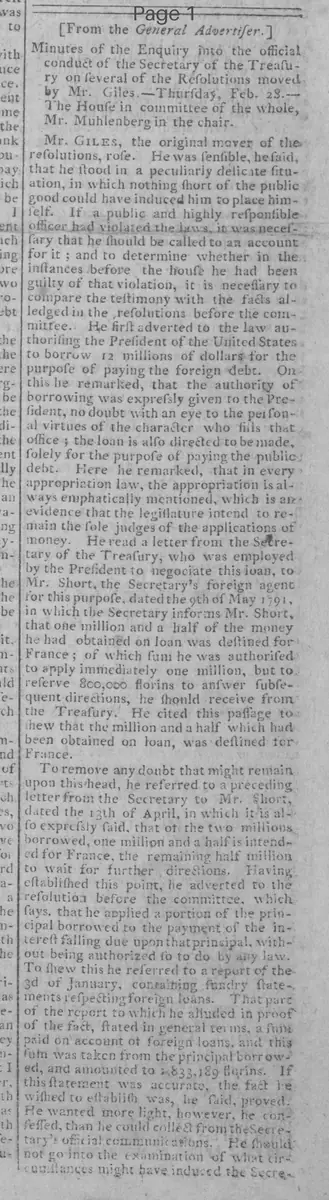
Minutes of the Enquiry into the official conduct of the Secretary of the Treasury on several of the Resolutions moved by Mr. Giles.—Thursday, Feb. 23.—
The House in committee of the whole,
Mr. Muhlenberg in the chair.
Mr. GILES, the original mover of the resolutions, rose. He was sensible, he said, that he stood in a peculiarly delicate situation, in which nothing short of the public good could have induced him to place himself. If a public and highly responsible officer had violated the laws, it was necessary that he should be called to an account for it: and to determine whether in the instances before the house he had been guilty of that violation, it is necessary to compare the testimony with the facts alleged in the resolutions before the committee. He first adverted to the law authorising the President of the United States to borrow 12 millions of dollars for the purpose of paying the foreign debt. On this he remarked, that the authority of borrowing was expressly given to the President, no doubt with an eye to the personal virtues of the character who fills that office; the loan is also directed to be made, solely for the purpose of paying the public debt. Here he remarked, that in every appropriation law, the appropriation is always emphatically mentioned, which is an evidence that the legislature intend to remain the sole judges of the applications of money. He read a letter from the Secretary of the Treasury, who was employed by the President to negotiate this loan, to Mr. Short, the Secretary's foreign agent for this purpose, dated the 9th of May 1791, in which the Secretary informs Mr. Short, that one million and a half of the money he had obtained on loan was destined for France; of which sum he was authorised to apply immediately one million, but to reserve 800,000 florins to answer subsequent directions, he should receive from the Treasury. He cited this passage to show that the million and a half which had been obtained on loan, was destined for France.
To remove any doubt that might remain upon this head, he referred to a preceding letter from the Secretary to Mr. Short, dated the 13th of April, in which it is also expressly said, that of the two millions borrowed, one million and a half is intended for France, the remaining half million to wait for further directions. Having established this point, he adverted to the resolution before the committee, which says, that he applied a portion of the principal borrowed to the payment of the interest falling due upon that principal, without being authorized so to do by any law.
To shew this he referred to a report of the 3d of January, containing sundry statements respecting foreign loans. That part of the report to which he alluded in proof of the fact, stated in general terms, a sum paid on account of foreign loans. and this sum was taken from the principal borrowed, and amounted to—833,189 florins. If this statement was accurate. the fact he wished to establish was, he said, proved.
He wanted more light, however, he confessed, than he could collect from the Secretary's official communications. He should not go into the examination of what circumstances might have induced the Secretary...
century to deviate from the positive injunctions of the law, or to make any remarks upon his conduct until he had heard what gentlemen would lay to controvert the charge he wished to establish.
Another fact of consequence he wished to prove, viz. that part of the money obtained on loan in Europe had been drawn over though not wanted here for any public purpose; this appeared, he said, from other papers. He turned to the instructions from the President to the Secretary of the Treasury, authorizing him to borrow 12,000,000 of dollars, in which the Secretary is cautioned to keep in view the two several acts authorizing the loans, and the distinct conditions they contemplate. By the instructions of the President the Secretary is authorized to apply the monies. In the execution of the trust confided to him, the President generally directs him to employ Mr. Short to negotiate the loans, to borrow in the manner prescribed by the acts, and to discharge immediately the arrears of interest due to the French, to which purpose and to the complete payment of that debt the 12 million loan was altogether appropriated. If this money, then, was shown to have been drawn here, it was neither warranted by law nor by the President's instructions. The Secretary did begin to draw as early as 1790, and had continued to draw from time to time, till 1793, without giving notice of this to the Legislature. Having shown that the Secretary had drawn without authority to draw, he next proceeded to consider the purpose of those drafts.
The money thus drawn for was not, he stated, applied to the purchase of the public debt, no money obtained from foreign loans was thus applied until this year, the domestic resources appropriated to this object were never exhausted. These were the facts involved in the first resolution, which he wished to establish; before he proceeded further in the discussion, he wished to hear what gentlemen had to say to controvert them. He wished to see justice done in the business before the house: he wished justice, also, to be tempered with moderation and mercy, and if gentlemen could show a necessity for the deviations from positive law which he had endeavored to point out, it would exonerate the Secretary from a very great share of blame.
Mr. Barnwell called for the reading of certain parts of the two acts authorizing the loans. One, of the 4th of August, authorizes a loan of 12,000,000 to be obtained without limitation as to the interest, for the purpose of paying the foreign debt, the other is of the 12th of Aug. for 2,000,000; the interest to be not more than 5 per cent. and for the purpose of reducing the domestic debt.
Mr. Sedgwick, to disprove that the drafts alluded to had been made without the knowledge of the legislature, called for the reading of the President's speech to both houses on the 8th of December 1790, and a subsequent report of the Secretary of the Treasury to the same point. By this it appeared that the power of borrowing having been exercised under the joint authority of the two acts, the Secretary states a difficulty that had occurred to him on the subject of the drafts alluded to. The money having been obtained on an interest of five per cent. exclusive of douceurs, he wished the legislature to determine whether it might strictly be considered as borrowed under the second act, which limited the interest at 5 per cent. This was sufficient, he conceived, to show, that the legislature were not ignorant of those drafts, and an act was passed solving the Secretary's doubt, and sanctioning his construction of the law.
Mr. Giles remarked, that he had drawn before that sanction was obtained.
Mr. Fitzsimons observed on the first charge in the resolution, that as the interest of the money borrowed in Europe is payable where borrowed, it was economical in the Secretary to pay that interest with monies there, which were to be drawn here, and replace the sum by taking the amount from the funds here destined for that payment. A financial operation of this nature is simple, and saves the trouble of drawing with one hand and remitting with the other. He conceived there was no just foundation for the first charge.
Mr. Lawrence said that when the resolutions calling for information from the treasury department were first brought forward, the public mind was impressed with an idea, that there were monies unaccounted for; this charge is now dropped, and it is honorable to the officer concerned that after much probing, nothing is found to support it. The enquiry now is, whether a debt was paid out of this or that fund. He did not admit the fact, that it was paid out of any other monies, than what law strictly warranted. He went into a history of the business from its origin. He stated the nature and purposes of the loans. There was nothing to prevent the President, he said, to consolidate the two loans, provided such an arrangement did not interfere with the purposes intended by them. The President employed the Secretary to obtain the loans under the joint authority of both acts, as it was found that the object could best be carried into effect by such an arrangement. The money thus borrowed, became subject to the appropriations of both acts, and not exclusively for the payment of the foreign debt. Then as part of that money was subject to be drawn here for the redemption of the domestic debt, and the interest of the loan was to be paid with domestic funds, it was perfectly reasonable to avoid further drafts and remittances, to pay the debt there with money there, and replace it here with money already here. The fact stated in the first part of the resolution is by this plain state of the case substantially refuted, and appears altogether unfounded; but if the fact is proved, what is implied? No injury to the interests of the community; the intention of the legislature has been in every point fulfilled. If the Secretary had acted differently, he would have been guilty of an absurdity, and to blame for sacrificing the public interest, and neglecting the spirit of the law for a strict and unprofitable observance of its dead letter.
Mr. Sedgwick by adverting to the speech of the President and report of the Secretary, had shown, that the legislature had been made acquainted with the drafts, and sanctioned future ones on the same principles. The latter part of the first resolution criminates the Secretary for making them without instructions from the President. Even if this was the case, he did not know whether this was really reprehensible. He defended it on this ground, that the Secretary is the officer appointed by law to superintend the finances and apply all monies agreeably to appropriations. He took a view of the business as stated by Mr. Lawrence, and concluded by asking, whether if the Secretary was found on a critical examination to have deviated in a trifle from the letter of the law, such a deviation was sufficient to warrant the alarms being sounded from St. Croix to St. Mary's, and whether the precious time of the house, at the close of the session, with a variety of business on their hands, should be taken up in so unprofitable and frivolous an investigation.
Mr. Giles said the transaction alluded to by the gentlemen to controvert the fact laid down in the first part of the resolution before the committee, was not of so immaterial a nature as they had endeavored to show it. It was not merely a financial operation to avoid the necessity of drawing and remitting. The truth was, that the Secretary had drawn over near 3,000,000 of dollars. The President's authority was limited to 2,000,000.
Mr. Lawrence was of opinion, that if the President, or his agent, had drawn the whole amount of the money obtained under both loans, he could not be said to have gone beyond his authority. He was authorized to borrow 12,000,000 to pay the arrears on the foreign debt, and to modify the whole. In the execution of this trust he might have found it advisable to draw to the country the whole of that sum. It had been found advisable to draw for part, and to pay the French by shipping produce to St. Domingo. If the money expended for supplies to St. Domingo is deducted, the balance will be found less than 2,000,000.
The committee reported progress, and obtained leave to sit to-morrow.
(To be continued.)
What sub-type of article is it?
What keywords are associated?
What entities or persons were involved?
Domestic News Details
Event Date
Thursday, Feb. 23.
Key Persons
Outcome
the committee reported progress and obtained leave to sit tomorrow; no final resolution on the charges.
Event Details
In a House committee of the whole chaired by Mr. Muhlenberg, Mr. Giles presented arguments alleging the Secretary of the Treasury violated laws by using loan principal for interest payments and drawing excess funds without authority. Defenders including Messrs. Barnwell, Sedgwick, Fitzsimons, and Lawrence countered with references to laws, presidential instructions, and economic rationale, asserting the actions were authorized, efficient, and known to Congress.