Thank you for visiting SNEWPapers!
Sign up free
Edwardsville Spectator
Edwardsville, Madison County, Illinois
What is this article about?
A letter to the Spectator defends Madison County representative George Churchill against accusations from the Vandalia paper of refusing to obey voter instructions on a constitutional convention potentially introducing slavery. The author, Crito, claims opponents used deception, forgery, and invalid signatures to fabricate support, highlighting the county's strong anti-slavery majority.
Clipping
OCR Quality
Full Text
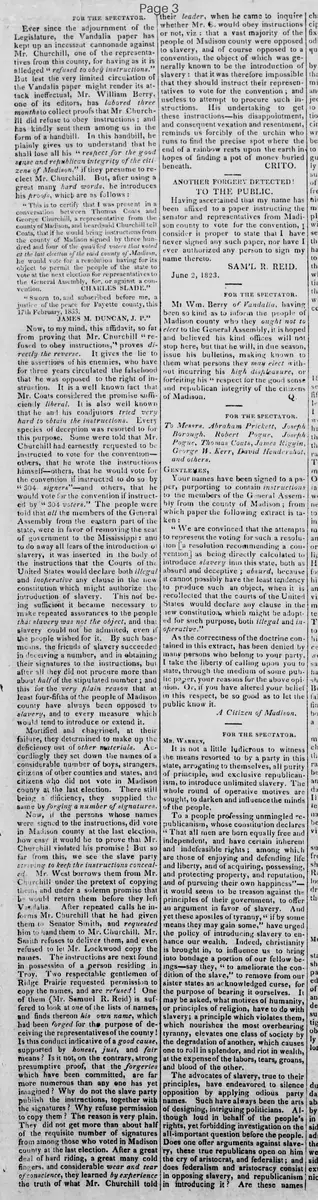
Ever since the adjournment of the Legislature, the Vandalia paper has kept up an incessant cannonade against Mr. Churchill, one of the representatives from this county, for having, as it is alleged, "refused to obey instructions." But lest the very limited circulation of the Vandalia paper might render its attack ineffectual, Mr. William Berry, one of its editors, has labored three months to collect proofs that Mr. Churchill did refuse to obey instructions; and has kindly sent them among us in the form of a handbill. In this handbill, he plainly gives us to understand that he shall lose all his "respect for the good sense and republican integrity of the citizens of Madison," if they presume to re-elect Mr. Churchill. But, after using a great many hard words, he introduces his proofs, which are as follows:
"This is to certify that I was present in a conversation between Thomas Coats and George Churchill, a representative from the county of Madison, and heard said Churchill tell Coats, that if he would bring instructions from the county of Madison signed by three hundred and four of the qualified voters that voted at the last election of the said county of Madison, he would vote for a resolution having for its object to permit the people of the state to vote at the next election for representatives to the General Assembly, for, or against a convention.
CHARLES SLADE."
"Sworn to and subscribed before me, a justice of the peace for Fayette county, this 17th February, 1823.
JAMES M. DUNCAN, J. P."
Now, to my mind, this affidavit, so far from proving that Mr. Churchill "refused to obey instructions," proves directly the reverse. It gives the lie to the assertions of his enemies, who have for three years circulated the falsehood that he was opposed to the right of instruction. It is a well known fact that Mr. Coats considered the promise sufficiently liberal. It is also well known that he and his coadjutors tried very hard to obtain the instructions. Every species of deception was resorted to for this purpose. Some were told that Mr. Churchill had earnestly requested to be instructed to vote for the convention—others, that he wrote the instructions himself—others, that he would vote for the convention if instructed to do so by "304 signers"—and others, that he would vote for the convention if instructed by "304 voters." The people were told that all the members of the General Assembly from the eastern part of the state, were in favor of removing the seat of government to the Mississippi: and to do away all fears of the introduction of slavery, it was inserted in the body of the instructions that the Courts of the United States would declare both illegal and inoperative any clause in the new constitution which might authorize the introduction of slavery. This not being sufficient it became necessary to make repeated assurances to the people that slavery was not the object, and that slavery could not be admitted, even if the people wished for it. By such base means, the friends of slavery succeeded in deceiving a number, and in obtaining their signatures to the instructions, but after all they did not procure more than about half of the stipulated number; and this for the very plain reason that at least four-fifths of the people of Madison county have always been opposed to slavery, and to every measure which would tend to introduce or extend it. Mortified and chagrined, at their failure, they determined to make up the deficiency out of other materials. Accordingly they set down the names of a considerable number of boys, strangers, citizens of other counties and states, and citizens who did not vote in Madison county at the last election. There still being a deficiency, they supplied the same by forging a number of signatures. Now, if the persons whose names were signed to the instructions, did vote in Madison county at the last election, how easy it would be to prove that Mr. Churchill violated his promise! But so far from this, we see the slave party striving to keep the instructions concealed. Mr. West borrows them from Mr. Churchill under the pretext of copying them, and under a solemn promise that he would return them before they left Vandalia. After repeated calls he informs Mr. Churchill that he had given them to Senator Smith, and requested him to hand them to Mr. Churchill. Mr. Smith refuses to deliver them, and even refused to let Mr. Lockwood copy the names. The instructions are next found in possession of a person residing in Troy. Two respectable gentlemen of Ridge Prairie requested permission to copy the names, and are refused! One of them (Mr. Samuel R. Reid) is suffered to look at one of the lists of names, and finds thereon his own name, which had been forged for the purpose of deceiving the representatives of the county! Is this conduct indicative of a good cause, supported by honest, just, and fair means? Is it not, on the contrary, strong presumptive proof, that the forgeries which have been committed, are far more numerous than any one has yet imagined? Why do not the slave party publish the instructions, together with the signatures? Why refuse permission to copy them? The reason is very plain. They did not get more than about half of the requisite number of signatures from among those who voted in Madison county at the last election. After a great deal of hard riding, a great many cold fingers, and considerable wear and tear of conscience, they learned by experience the truth of what Mr. Churchill told their leader, when he came to inquire whether Mr. C. would obey instructions or not, viz: that a vast majority of the people of Madison county were opposed to slavery, and of course opposed to a convention, the object of which was generally known to be the introduction of slavery: that it was therefore impossible that they should instruct their representatives to vote for the convention: and useless to attempt to procure such instructions. His undertaking to get these instructions—his disappointment, and consequent vexation and resentment, reminds us forcibly of the urchin who runs to find the precise spot where the end of a rainbow rests upon the earth in hopes of finding a pot of money buried beneath.
CRITO.
What sub-type of article is it?
What themes does it cover?
What keywords are associated?
What entities or persons were involved?
Letter to Editor Details
Author
Crito.
Recipient
The Spectator
Main Argument
the affidavit proves mr. churchill was willing to obey legitimate instructions from 304 qualified voters, but opponents failed to obtain them through deception, forgery, and invalid signatures, as the majority of madison county opposes slavery and a convention to introduce it.
Notable Details