Thank you for visiting SNEWPapers!
Sign up free
National Gazette
Philadelphia, Philadelphia County, Pennsylvania
What is this article about?
The French National Assembly's decree of September 14 annexing Avignon and Comtat Venaissin to France draws a strong protest from the Pope, who addresses European powers accusing the assembly of unjust usurpation and inconsistency, highlighting historical papal sovereignty over the territories.
Clipping
OCR Quality
Full Text
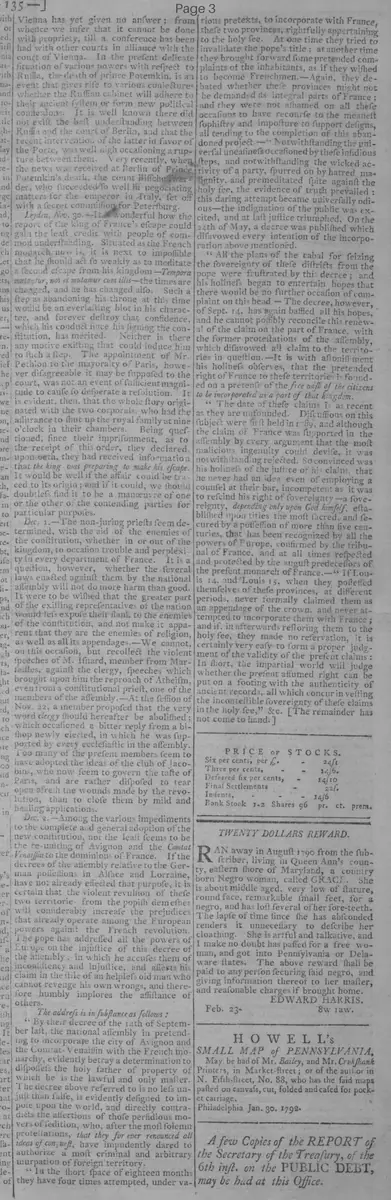
"By their decree of the 14th of September last, the national assembly in pretending to incorporate the city of Avignon and the Comtat-Venaissin with the French monarchy, evidently betray a determination to dispossess the holy father of property of which he is the lawful and only master. The decree above referred to is no less unjust than false, is evidently designed to impose upon the world, and directly contradicts the assertions of those perfidious movers of sedition, who, after the most solemn protestations, that they for ever renounced all ideas of conquest, have impudently dared to authorize a most criminal and arbitrary usurpation of foreign territory.
"In the short space of eighteen months they have four times attempted, under various pretexts, to incorporate with France, these two provinces, rightfully appertaining to the holy see. At one time they tried to invalidate the pope's title; at another time they brought forward some pretended complaints of the inhabitants, as if they wished to become Frenchmen.—Again, they debated whether these provinces might not be demanded as integral parts of France; and they were not ashamed on all these occasions to have recourse to the meanest sophistry and imposture to support designs, all tending to the completion of this abandoned project.—" Notwithstanding the universal uneasiness occasioned by these insidious steps, and notwithstanding the wicked activity of a party, spurred on by hatred malignity, and premeditated spite against the holy see, the evidence of truth prevailed: this daring attempt became universally odious—the indignation of the public was excited, and at last justice triumphed. On the 24th of May, a decree was published which disavowed every intention of the incorporation above mentioned.
" All the plans of the cabal for seizing the sovereignty of these districts from the pope were frustrated by this decree; and his holiness began to entertain hopes that there would be no further occasion of complaint on this head - The decree, however, of Sept. 14, has again baffled all his hopes, and he cannot possibly reconcile this renewal of the claim on the part of France, with the former protestations of the assembly, which disavowed a'l claim to the territories in question. -It is with astonishment his holiness observes, that the pretended right of France to these territories is founded on a pretense of the free wish of the citizens to be incorporated as a part of that kingdom.
" The date of these claims is as recent as they are unfounded. Discussions on this subject were first held in 1789, and although the claim of France was supported in the assembly by every argument that the most malicious ingenuity could devise, it was notwithstanding rejected. So convinced was his holiness of the justice of his claim, that he never had an idea even of employing a counsel at their bar, incompetent as it was to rescind his right of sovereignty -a sovereignty, depending only upon God himself, established upon titles the most sacred, and secured by a possession of more than five centuries, that has been recognized by all the powers of Europe, confirmed by the tribunal of France, and at all times repeated and protested by the august predecessors of the present monarch of France.—" If Louis 14, and Louis 15, when they possessed themselves of these provinces, at different periods, never formally claimed them as an appendage of the crown, and never attempted to incorporate them with France; and if, in afterwards restoring them to the holy see, they made no reservation, it is certainly very easy to form a proper judgment of the validity of the present claims: In short, the impartial world will judge whether the present assumed right can be put on a footing with the authenticity of ancient records, all which concur in vesting the incontestable sovereignty of these claims in the holy see," &c. [The remainder has not come to hand.]
What sub-type of article is it?
What keywords are associated?
What entities or persons were involved?
Where did it happen?
Foreign News Details
Primary Location
Avignon And The Comtat Venaissin
Event Date
Decree Of The 14th Of September Last
Key Persons
Outcome
french national assembly decree incorporating avignon and comtat venaissin into france; papal protest to european powers asserting sovereignty
Event Details
The French National Assembly issued a decree on September 14 to incorporate Avignon and Comtat Venaissin with France, despite previous disavowals including a May 24 decree. The Pope protests this as unjust usurpation, citing historical sovereignty over five centuries, recognized by Europe and past French kings, and appeals to European powers for support.