Thank you for visiting SNEWPapers!
Sign up free
Literary
December 2, 1858
Preble County Democrat
Eaton, Preble County, Ohio
What is this article about?
This essay explains the difference between iron and steel, focusing on Benjamin Huntsman's invention of cast steel around 1769-1770 in Attercliffe near Sheffield. It describes the process, secrecy, and how the secret was stolen by a spy posing as a weary traveler.
Clipping
OCR Quality
95%
Excellent
Full Text
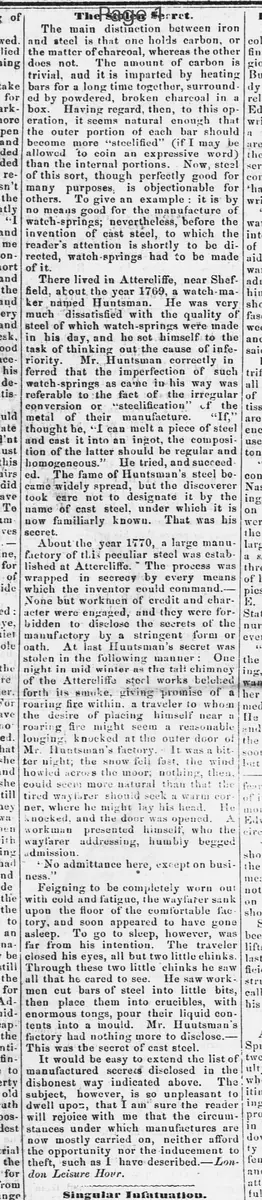
The main distinction between iron and steel is that one holds carbon, or the matter of charcoal, whereas the other does not. The amount of carbon is trivial, and it is imparted by heating bars for a long time together, surrounded by powdered, broken charcoal in a box. Having regard, then, to this operation, it seems natural enough that the outer portion of each bar should become more "steelified" (if I may be allowed to coin an expressive word) than the internal portions. Now, steel of this sort, though perfectly good for many purposes, is objectionable for others. To give an example: it is by no means good for the manufacture of watch-springs; nevertheless, before the invention of cast steel, to which the reader's attention is shortly to be directed, watch-springs had to be made of it.
There lived in Attercliffe, near Sheffield, about the year 1769, a watch-maker named Huntsman. He was very much dissatisfied with the quality of steel of which watch-springs were made in his day, and he set himself to the task of thinking out the cause of inferiority. Mr. Huntsman correctly inferred that the imperfection of such watch-springs as came in his way was referable to the fact of the irregular conversion or "steelification" of the metal of their manufacture.
"If," thought he, "I can melt a piece of steel and cast it into an ingot, the composition of the latter should be regular and homogeneous." He tried, and succeeded. The fame of Huntsman's steel became widely spread, but the discoverer took care not to designate it by the name of cast steel, under which it is now familiarly known. That was his secret.
About the year 1770, a large manufactory of this peculiar steel was established at Attercliffe. The process was wrapped in secrecy by every means which the inventor could command. None but workmen of credit and character were engaged, and they were forbidden to disclose the secrets of the manufactory by a stringent form of oath. At last Huntsman's secret was stolen in the following manner: One night in mid winter as the tall chimney of the Attercliffe steel works belched forth its smoke, giving promise of a roaring fire within, a traveler to whom the desire of placing himself near a roaring fire might seem a reasonable longing, knocked at the outer door of Mr. Huntsman's factory. It was a bitter night: the snow fell fast, the wind howled across the moor; nothing, then, could seem more natural than that the tired wayfarer should seek a warm corner, where he might lay his head. He knocked, and the door was opened. A workman presented himself, who the wayfarer addressing, humbly begged admission.
No admittance here, except on business.
Feigning to be completely worn out with cold and fatigue, the wayfarer sank upon the floor of the comfortable factory, and soon appeared to have gone asleep. To go to sleep, however, was far from his intention. The traveler closed his eyes, all but two little chinks. Through these two little chinks he saw all that he cared to see. He saw workmen cut bars of steel into little bits, then place them into crucibles, with enormous tongs, pour their liquid contents into a mould. Mr. Huntsman's factory had nothing more to disclose. This was the secret of cast steel.
It would be easy to extend the list of manufactured secrets disclosed in the dishonest way indicated above. The subject, however, is so unpleasant to dwell upon, that I am sure the reader will rejoice with me that the circumstances under which manufactures are now mostly carried on, neither afford the opportunity nor the inducement to theft, such as I have described.—London Leisure Hour.
There lived in Attercliffe, near Sheffield, about the year 1769, a watch-maker named Huntsman. He was very much dissatisfied with the quality of steel of which watch-springs were made in his day, and he set himself to the task of thinking out the cause of inferiority. Mr. Huntsman correctly inferred that the imperfection of such watch-springs as came in his way was referable to the fact of the irregular conversion or "steelification" of the metal of their manufacture.
"If," thought he, "I can melt a piece of steel and cast it into an ingot, the composition of the latter should be regular and homogeneous." He tried, and succeeded. The fame of Huntsman's steel became widely spread, but the discoverer took care not to designate it by the name of cast steel, under which it is now familiarly known. That was his secret.
About the year 1770, a large manufactory of this peculiar steel was established at Attercliffe. The process was wrapped in secrecy by every means which the inventor could command. None but workmen of credit and character were engaged, and they were forbidden to disclose the secrets of the manufactory by a stringent form of oath. At last Huntsman's secret was stolen in the following manner: One night in mid winter as the tall chimney of the Attercliffe steel works belched forth its smoke, giving promise of a roaring fire within, a traveler to whom the desire of placing himself near a roaring fire might seem a reasonable longing, knocked at the outer door of Mr. Huntsman's factory. It was a bitter night: the snow fell fast, the wind howled across the moor; nothing, then, could seem more natural than that the tired wayfarer should seek a warm corner, where he might lay his head. He knocked, and the door was opened. A workman presented himself, who the wayfarer addressing, humbly begged admission.
No admittance here, except on business.
Feigning to be completely worn out with cold and fatigue, the wayfarer sank upon the floor of the comfortable factory, and soon appeared to have gone asleep. To go to sleep, however, was far from his intention. The traveler closed his eyes, all but two little chinks. Through these two little chinks he saw all that he cared to see. He saw workmen cut bars of steel into little bits, then place them into crucibles, with enormous tongs, pour their liquid contents into a mould. Mr. Huntsman's factory had nothing more to disclose. This was the secret of cast steel.
It would be easy to extend the list of manufactured secrets disclosed in the dishonest way indicated above. The subject, however, is so unpleasant to dwell upon, that I am sure the reader will rejoice with me that the circumstances under which manufactures are now mostly carried on, neither afford the opportunity nor the inducement to theft, such as I have described.—London Leisure Hour.
What sub-type of article is it?
Essay
What themes does it cover?
Commerce Trade
Moral Virtue
What keywords are associated?
Cast Steel
Huntsman
Invention
Secrecy
Industrial Theft
Sheffield
Watch Springs
What entities or persons were involved?
London Leisure Hour
Literary Details
Author
London Leisure Hour
Subject
Invention Of Cast Steel By Huntsman
Form / Style
Historical Anecdotal Essay
Key Lines
"If," Thought He, "I Can Melt A Piece Of Steel And Cast It Into An Ingot, The Composition Of The Latter Should Be Regular And Homogeneous."
The Traveler Closed His Eyes, All But Two Little Chinks. Through These Two Little Chinks He Saw All That He Cared To See.