Thank you for visiting SNEWPapers!
Sign up free
The National Intelligencer And Washington Advertiser
Washington, District Of Columbia
What is this article about?
A British squadron under Sir John Borlase Warren captured the West Indies islands of St. Bartholomew's (March 20), St. Martins (March 23), and St. Croix and St. Thomas (March 28), as reported by Capt. Newton arriving in New York on April 24.
Clipping
OCR Quality
Full Text
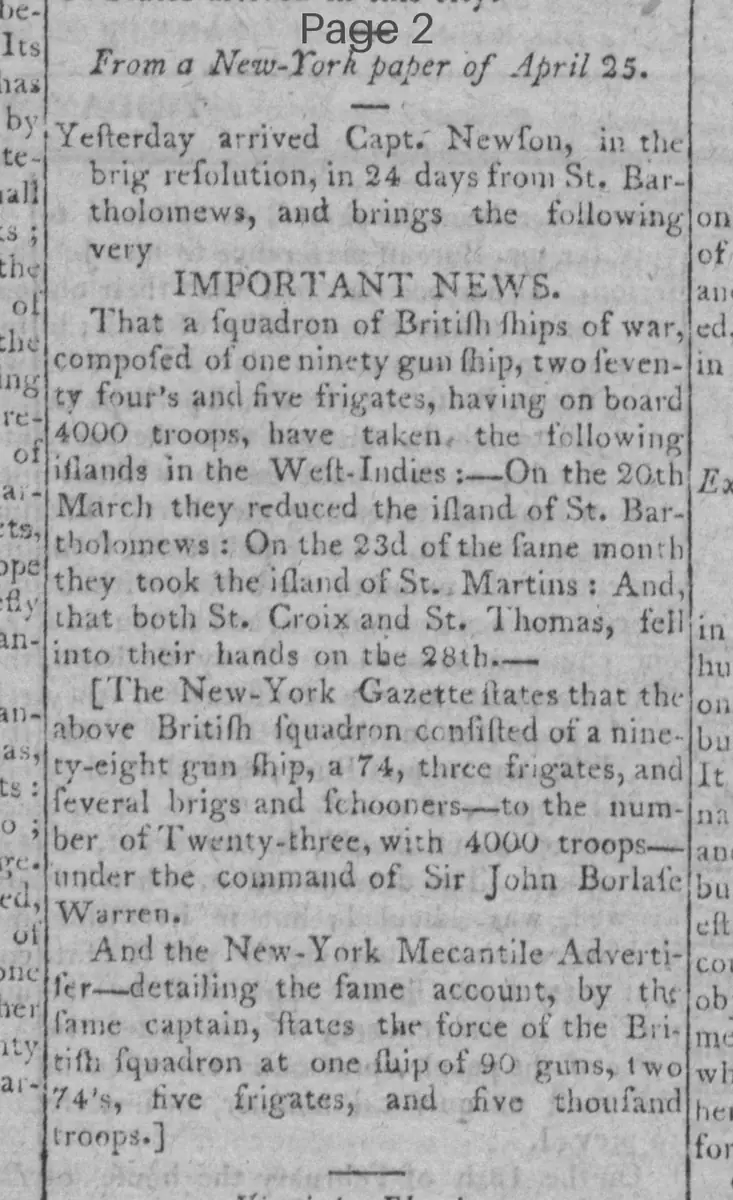
Yesterday arrived Capt. Newton, in the brig Resolution, in 24 days from St. Bartholomew's, and brings the following very IMPORTANT NEWS.
That a squadron of British ships of war, composed of one ninety gun ship, two seventy fours and five frigates, having on board 4000 troops, have taken, the following islands in the West-Indies:—On the 20th March they reduced the island of St. Bartholomew's: On the 23d of the same month they took the island of St. Martins: And, that both St. Croix and St. Thomas, fell into their hands on the 28th.
The New-York Gazette states that the above British squadron consisted of a ninety-eight gun ship, a 74, three frigates, and several brigs and schooners—to the number of Twenty-three, with 4000 troops— under the command of Sir John Borlase Warren.
And the New-York Mercantile Advertiser—detailing the same account, by the same captain, states the force of the British squadron at one ship of 90 guns, two 74's, five frigates, and five thousand troops.
What sub-type of article is it?
What keywords are associated?
What entities or persons were involved?
Where did it happen?
Foreign News Details
Primary Location
West Indies
Event Date
20th March To 28th March
Key Persons
Outcome
islands of st. bartholomew's, st. martins, st. croix, and st. thomas captured by british forces.
Event Details
A British squadron of warships and troops arrived and took the islands: St. Bartholomew's reduced on 20th March, St. Martins taken on 23rd March, St. Croix and St. Thomas fell on 28th March. Squadron composition reported variably as one 90-gun ship, two 74s, five frigates with 4000-5000 troops, or up to 23 vessels under Sir John Borlase Warren.