Thank you for visiting SNEWPapers!
Sign up free
Editorial
April 18, 1933
The Bismarck Tribune
Bismarck, Mandan, Burleigh County, Morton County, North Dakota
What is this article about?
The editorial endorses congressional farm and home finance bills, particularly their refinancing features, which revalue properties and scale down mortgages to aid farmers and homeowners in retaining assets, provide lenders with guaranteed cash, and boost economic confidence amid the Depression. (248 characters)
Clipping
OCR Quality
98%
Excellent
Full Text
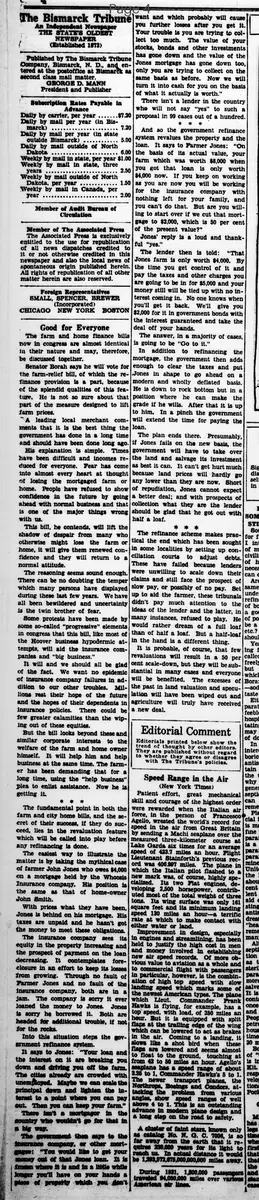
Good for Everyone
The farm and home finance bills now in congress are almost identical in their nature and may, therefore, be discussed together.
Senator Borah says he will vote for the farm-relief bill, of which the refinance provision is a part, because of the splendid qualities of this feature. He is not so sure about that part of the measure designed to lift farm prices.
A leading local merchant comments that it is the best thing the government has done in a long time and should have been done long ago.
His explanation is simple. Times have been difficult and incomes reduced for everyone. Fear has come into almost every heart at thought of losing the mortgaged farm or home. People have refused to show confidence in the future by going ahead with normal business and that is one of the major things wrong with us.
This bill, he contends, will lift the shadow of despair from many who otherwise might lose the farm or home, it will give them renewed confidence and they will return to a normal attitude.
The reasoning seems sound enough. There can be no doubting the temper which many persons have displayed during these last few years. We have all been bewildered and uncertainty is the twin brother of fear.
Some protests have been made by some so-called "progressive" elements in congress that this bill, like most of the Hoover business hypodermic attempts, will aid the insurance companies and "big business."
It will and we should all be glad of the fact. We want no epidemic of insurance company failures in addition to our other troubles. Millions rest their hope of the future and the hopes of their dependents in insurance policies. There could be few greater calamities than the wiping out of these equities.
But the bill looks beyond these and similar corporate interests to the welfare of the farm and home owner himself. It will help him and help business at the same time. The farmer has been demanding that for a long time, using the "help business" plea to enlist assistance. Now he is getting it.
The fundamental point in both the farm and city home bills, and the secret of their success, if they do succeed, lies in the revaluation feature which will be called into play before any refinancing is done.
The easiest way to illustrate the matter is by taking the mythical case of farmer John Jones who owes $4,000 on a mortgage held by the Whoosis Insurance company. His position is the same as that of home-owner John Smith.
With prices what they have been, Jones is behind on his mortgage. His taxes are unpaid and he hasn't got the money to meet these obligations.
The insurance company sees its equity in the property increasing and the prospect of payment on the loan decreasing. It contemplates foreclosure in an effort to keep its losses from growing.
Through no fault of Farmer Jones and no fault of the insurance company, both are in a jam. The company is sorry it ever loaned the money to Jones. Jones is sorry he borrowed it. Both are headed for additional trouble, if not for the rocks.
Into this situation steps the government refinance system.
It says to Jones: "Your loan and the interest on it are breaking you down and driving you off the farm. The cities already are crowded with unemployed. Maybe we can scale the principal down and lighten the interest to a point where you can pay out. Then you can keep your farm."
There isn't a mortgagor in the country who wouldn't go for that in a big way.
The government then says to the insurance company, or other mortgagee: "You would like to get your money out of that Jones loan. It is frozen where it is and in a little while longer you'll have on your hands a piece of property which you don't want and which probably will cause you further losses after you get it.
Your trouble is you are trying to collect too much. The value of your stocks, bonds and other investments has gone down and the value of the Jones mortgage has gone down too, only you are trying to collect on the same basis as before. Now we will turn it into cash for you on the basis of what it actually is worth."
There isn't a lender in the country who will not say "yes" to such a proposal in 99 cases out of a hundred.
And so the government refinance system revalues the property and the loan. It says to Farmer Jones: "On the basis of its actual value, your farm which was worth $8,000 when you got that loan, is only worth $4,000 now. If you keep on working as you are now you will be working for the insurance company with nothing left for your family, and you can't do that. But are you willing to start over if we cut that mortgage to $2,000, which is 50 per cent of the present value?"
Jones' reply is a loud and thankful "yes."
The lender then is told: "That Jones farm is only worth $4,000. By the time you get control of it and pay the taxes and other charges you are going to be in for $5,000 and your money still will be tied up with no interest coming in. No one knows when you'll get it back. We'll give you $2,000 for it in government bonds with the interest guaranteed and take the deal off your hands."
The answer, in a majority of cases, is going to be "Go to it."
In addition to refinancing the mortgage, the government then adds enough to clear the taxes and put Jones in shape to go ahead on a modern and wholly deflated basis.
He is down to rock bottom but in a position where he can make the grade if he wills. After that it is up to him. In a pinch the government will extend the time for paying the loan.
The plan ends there. Presumably, if Jones fails on the new basis, the government will have to take over the land and salvage its investment as best it can. It can't get hurt much because land prices will hardly go any lower than they are now. Short of repudiation, Jones cannot expect a better deal; and with prospects of collection what they are the lender should be glad that he got out with half a loaf.
The refinance scheme makes practical the end which has been sought in some localities by setting up conciliation courts to adjust debts.
These have failed because lenders were unwilling to scale down their claims and still face the prospect of slow pay, or possibly of no pay. Set up to aid the farmer, these tribunals didn't pay much attention to the ideas of the lender and the latter, in many instances, refused to play. He would rather dream of a full loaf than of half a loaf. But a half-loaf in the hand is a different thing.
It is probable, of course, that few revaluations will result in a 50 per cent scale-down, but they will be substantial in many cases and everyone will be benefited. The excesses of the past in land valuation and speculation will have been wiped out and agriculture will truly have received a new deal.
The farm and home finance bills now in congress are almost identical in their nature and may, therefore, be discussed together.
Senator Borah says he will vote for the farm-relief bill, of which the refinance provision is a part, because of the splendid qualities of this feature. He is not so sure about that part of the measure designed to lift farm prices.
A leading local merchant comments that it is the best thing the government has done in a long time and should have been done long ago.
His explanation is simple. Times have been difficult and incomes reduced for everyone. Fear has come into almost every heart at thought of losing the mortgaged farm or home. People have refused to show confidence in the future by going ahead with normal business and that is one of the major things wrong with us.
This bill, he contends, will lift the shadow of despair from many who otherwise might lose the farm or home, it will give them renewed confidence and they will return to a normal attitude.
The reasoning seems sound enough. There can be no doubting the temper which many persons have displayed during these last few years. We have all been bewildered and uncertainty is the twin brother of fear.
Some protests have been made by some so-called "progressive" elements in congress that this bill, like most of the Hoover business hypodermic attempts, will aid the insurance companies and "big business."
It will and we should all be glad of the fact. We want no epidemic of insurance company failures in addition to our other troubles. Millions rest their hope of the future and the hopes of their dependents in insurance policies. There could be few greater calamities than the wiping out of these equities.
But the bill looks beyond these and similar corporate interests to the welfare of the farm and home owner himself. It will help him and help business at the same time. The farmer has been demanding that for a long time, using the "help business" plea to enlist assistance. Now he is getting it.
The fundamental point in both the farm and city home bills, and the secret of their success, if they do succeed, lies in the revaluation feature which will be called into play before any refinancing is done.
The easiest way to illustrate the matter is by taking the mythical case of farmer John Jones who owes $4,000 on a mortgage held by the Whoosis Insurance company. His position is the same as that of home-owner John Smith.
With prices what they have been, Jones is behind on his mortgage. His taxes are unpaid and he hasn't got the money to meet these obligations.
The insurance company sees its equity in the property increasing and the prospect of payment on the loan decreasing. It contemplates foreclosure in an effort to keep its losses from growing.
Through no fault of Farmer Jones and no fault of the insurance company, both are in a jam. The company is sorry it ever loaned the money to Jones. Jones is sorry he borrowed it. Both are headed for additional trouble, if not for the rocks.
Into this situation steps the government refinance system.
It says to Jones: "Your loan and the interest on it are breaking you down and driving you off the farm. The cities already are crowded with unemployed. Maybe we can scale the principal down and lighten the interest to a point where you can pay out. Then you can keep your farm."
There isn't a mortgagor in the country who wouldn't go for that in a big way.
The government then says to the insurance company, or other mortgagee: "You would like to get your money out of that Jones loan. It is frozen where it is and in a little while longer you'll have on your hands a piece of property which you don't want and which probably will cause you further losses after you get it.
Your trouble is you are trying to collect too much. The value of your stocks, bonds and other investments has gone down and the value of the Jones mortgage has gone down too, only you are trying to collect on the same basis as before. Now we will turn it into cash for you on the basis of what it actually is worth."
There isn't a lender in the country who will not say "yes" to such a proposal in 99 cases out of a hundred.
And so the government refinance system revalues the property and the loan. It says to Farmer Jones: "On the basis of its actual value, your farm which was worth $8,000 when you got that loan, is only worth $4,000 now. If you keep on working as you are now you will be working for the insurance company with nothing left for your family, and you can't do that. But are you willing to start over if we cut that mortgage to $2,000, which is 50 per cent of the present value?"
Jones' reply is a loud and thankful "yes."
The lender then is told: "That Jones farm is only worth $4,000. By the time you get control of it and pay the taxes and other charges you are going to be in for $5,000 and your money still will be tied up with no interest coming in. No one knows when you'll get it back. We'll give you $2,000 for it in government bonds with the interest guaranteed and take the deal off your hands."
The answer, in a majority of cases, is going to be "Go to it."
In addition to refinancing the mortgage, the government then adds enough to clear the taxes and put Jones in shape to go ahead on a modern and wholly deflated basis.
He is down to rock bottom but in a position where he can make the grade if he wills. After that it is up to him. In a pinch the government will extend the time for paying the loan.
The plan ends there. Presumably, if Jones fails on the new basis, the government will have to take over the land and salvage its investment as best it can. It can't get hurt much because land prices will hardly go any lower than they are now. Short of repudiation, Jones cannot expect a better deal; and with prospects of collection what they are the lender should be glad that he got out with half a loaf.
The refinance scheme makes practical the end which has been sought in some localities by setting up conciliation courts to adjust debts.
These have failed because lenders were unwilling to scale down their claims and still face the prospect of slow pay, or possibly of no pay. Set up to aid the farmer, these tribunals didn't pay much attention to the ideas of the lender and the latter, in many instances, refused to play. He would rather dream of a full loaf than of half a loaf. But a half-loaf in the hand is a different thing.
It is probable, of course, that few revaluations will result in a 50 per cent scale-down, but they will be substantial in many cases and everyone will be benefited. The excesses of the past in land valuation and speculation will have been wiped out and agriculture will truly have received a new deal.
What sub-type of article is it?
Agriculture
Economic Policy
What keywords are associated?
Farm Relief
Mortgage Refinancing
Economic Recovery
Government Bonds
Debt Revaluation
What entities or persons were involved?
Senator Borah
Congress
Hoover
Insurance Companies
Farmers
Home Owners
Editorial Details
Primary Topic
Support For Farm And Home Refinance Bills
Stance / Tone
Strongly Supportive
Key Figures
Senator Borah
Congress
Hoover
Insurance Companies
Farmers
Home Owners
Key Arguments
Refinancing Provisions Restore Confidence By Preventing Loss Of Farms And Homes
Revaluation Scales Down Mortgages To Current Property Values Benefiting Both Borrowers And Lenders
Government Intervention Avoids Foreclosures And Insurance Company Failures
Plan Addresses Economic Despair And Stimulates Normal Business Activity
Similar To Failed Conciliation Courts But Ensures Lender Participation Through Cash Payment