Thank you for visiting SNEWPapers!
Sign up free
Letter to Editor
October 7, 1844
Alexandria Gazette
Alexandria, Alexandria County, District Of Columbia
What is this article about?
From Washington, Oct. 5, 1844: Writer retracts criticism of Navy Secretary Mason for favoritism in granting officer leaves, praises his intentions, urges firm impartiality, corrects a prior error on Captain Belt, and notes Captain Newton's ongoing court martial. (198 characters)
Clipping
OCR Quality
95%
Excellent
Full Text
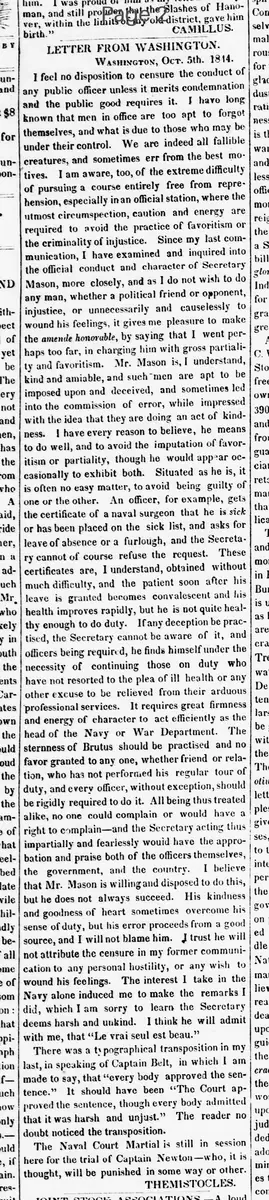
LETTER FROM WASHINGTON.
Washington, Oct. 5th, 1844.
I feel no disposition to censure the conduct of any public officer unless it merits condemnation and the public good requires it. I have long known that men in office are too apt to forget themselves, and what is due to those who may be under their control. We are indeed all fallible creatures, and sometimes err from the best motives. I am aware, too, of the extreme difficulty of pursuing a course entirely free from reprehension, especially in an official station, where the utmost circumspection, caution and energy are required to avoid the practice of favoritism or the criminality of injustice. Since my last communication, I have examined and inquired into the official conduct and character of Secretary Mason, more closely, and as I do not wish to do any man, whether a political friend or opponent injustice, or unnecessarily and causelessly to wound his feelings, it gives me pleasure to make the amende honorable, by saying that I went perhaps too far, in charging him with gross partiality and favoritism. Mr. Mason is, I understand, kind and amiable, and such men are apt to be imposed upon and deceived, and sometimes led into the commission of error, while impressed with the idea that they are doing an act of kindness. I have every reason to believe, he means to do well, and to avoid the imputation of favoritism or partiality, though he would appear occasionally to exhibit both. Situated as he is, it is often no easy matter, to avoid being guilty of one or the other. An officer, for example, gets the certificate of a naval surgeon that he is sick or has been placed on the sick list, and asks for leave of absence or a furlough, and the Secretary cannot of course refuse the request. These certificates are, I understand, obtained without much difficulty, and the patient soon after his leave is granted becomes convalescent and his health improves rapidly, but he is not quite healthy enough to do duty. If any deception be practised, the Secretary cannot be aware of it, and officers being required, he finds himself under the necessity of continuing those on duty who have not resorted to the plea of ill health or any other excuse to be relieved from their arduous professional services. It requires great firmness and energy of character to act efficiently as the head of the Navy or War Department. The sternness of Brutus should be practised and no favor granted to any one, whether friend or relation, who has not performed his regular tour of duty, and every officer, without exception, should be rigidly required to do it. All being thus treated alike, no one could complain or would have a right to complain—and the Secretary acting thus impartially and fearlessly would have the approbation and praise both of the officers themselves, the government, and the country. I believe that Mr. Mason is willing and disposed to do this, but he does not always succeed. His kindness and goodness of heart sometimes overcome his sense of duty, but his error proceeds from a good source, and I will not blame him. I trust he will not attribute the censure in my former communication to any personal hostility, or any wish to wound his feelings. The interest I take in the Navy alone induced me to make the remarks I did, which I am sorry to learn the Secretary deems harsh and unkind. I think he will admit with me, that "Le vrai seul est beau."
There was a typographical transposition in my last, in speaking of Captain Belt, in which I am made to say, that "every body approved the sentence." It should have been "The Court approved the sentence, though every body admitted that it was harsh and unjust." The reader no doubt noticed the transposition.
The Naval Court Martial is still in session here for the trial of Captain Newton—who, it is thought, will be punished in some way or other
THEMISTOCLES.
Washington, Oct. 5th, 1844.
I feel no disposition to censure the conduct of any public officer unless it merits condemnation and the public good requires it. I have long known that men in office are too apt to forget themselves, and what is due to those who may be under their control. We are indeed all fallible creatures, and sometimes err from the best motives. I am aware, too, of the extreme difficulty of pursuing a course entirely free from reprehension, especially in an official station, where the utmost circumspection, caution and energy are required to avoid the practice of favoritism or the criminality of injustice. Since my last communication, I have examined and inquired into the official conduct and character of Secretary Mason, more closely, and as I do not wish to do any man, whether a political friend or opponent injustice, or unnecessarily and causelessly to wound his feelings, it gives me pleasure to make the amende honorable, by saying that I went perhaps too far, in charging him with gross partiality and favoritism. Mr. Mason is, I understand, kind and amiable, and such men are apt to be imposed upon and deceived, and sometimes led into the commission of error, while impressed with the idea that they are doing an act of kindness. I have every reason to believe, he means to do well, and to avoid the imputation of favoritism or partiality, though he would appear occasionally to exhibit both. Situated as he is, it is often no easy matter, to avoid being guilty of one or the other. An officer, for example, gets the certificate of a naval surgeon that he is sick or has been placed on the sick list, and asks for leave of absence or a furlough, and the Secretary cannot of course refuse the request. These certificates are, I understand, obtained without much difficulty, and the patient soon after his leave is granted becomes convalescent and his health improves rapidly, but he is not quite healthy enough to do duty. If any deception be practised, the Secretary cannot be aware of it, and officers being required, he finds himself under the necessity of continuing those on duty who have not resorted to the plea of ill health or any other excuse to be relieved from their arduous professional services. It requires great firmness and energy of character to act efficiently as the head of the Navy or War Department. The sternness of Brutus should be practised and no favor granted to any one, whether friend or relation, who has not performed his regular tour of duty, and every officer, without exception, should be rigidly required to do it. All being thus treated alike, no one could complain or would have a right to complain—and the Secretary acting thus impartially and fearlessly would have the approbation and praise both of the officers themselves, the government, and the country. I believe that Mr. Mason is willing and disposed to do this, but he does not always succeed. His kindness and goodness of heart sometimes overcome his sense of duty, but his error proceeds from a good source, and I will not blame him. I trust he will not attribute the censure in my former communication to any personal hostility, or any wish to wound his feelings. The interest I take in the Navy alone induced me to make the remarks I did, which I am sorry to learn the Secretary deems harsh and unkind. I think he will admit with me, that "Le vrai seul est beau."
There was a typographical transposition in my last, in speaking of Captain Belt, in which I am made to say, that "every body approved the sentence." It should have been "The Court approved the sentence, though every body admitted that it was harsh and unjust." The reader no doubt noticed the transposition.
The Naval Court Martial is still in session here for the trial of Captain Newton—who, it is thought, will be punished in some way or other
THEMISTOCLES.
What sub-type of article is it?
Persuasive
Reflective
Ethical Moral
What themes does it cover?
Military War
Politics
Morality
What keywords are associated?
Navy Department
Secretary Mason
Favoritism
Naval Officers
Leave Of Absence
Impartiality
Court Martial
What entities or persons were involved?
Themistocles
Letter to Editor Details
Author
Themistocles
Main Argument
the author retracts previous charges of gross partiality against secretary mason, attributing his occasional favoritism to kindness and good intentions, while advocating for impartial enforcement of duty among naval officers to ensure fairness.
Notable Details
References The Sternness Of Brutus As A Model For Impartiality
Quotes 'Le Vrai Seul Est Beau'
Corrects Typographical Error Regarding Captain Belt's Sentence
Mentions Ongoing Naval Court Martial Trial Of Captain Newton