Thank you for visiting SNEWPapers!
Sign up free
Delaware Gazette And State Journal
Wilmington, New Castle County, Delaware
What is this article about?
Article describes the upcoming opening of the Jacob Tome Institute in Port Deposit, Md., founded by wealthy philanthropist Jacob Tome to provide practical education for youth. Highlights the school's architecture, curriculum, and Tome's prudent planning, including his unique terraced garden.
Clipping
OCR Quality
Full Text
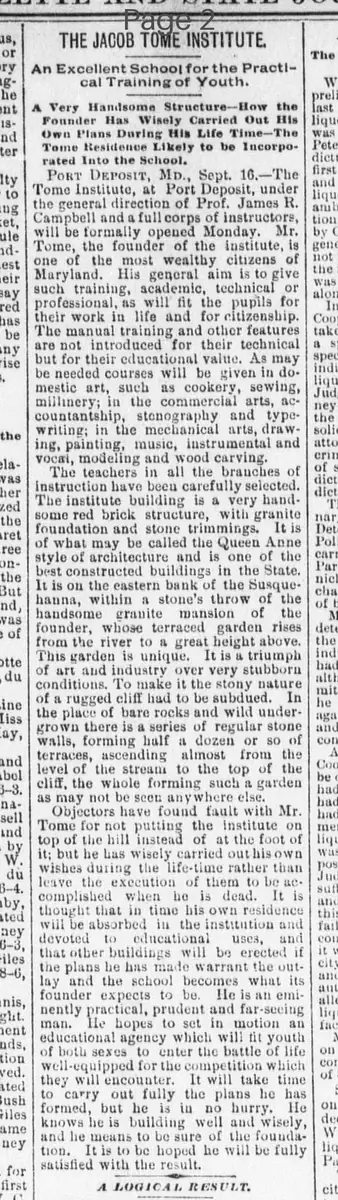
An Excellent School for the Practical Training of Youth.
A Very Handsome Structure—How the Founder Has Wisely Carried Out His Own Plans During His Life Time—The Tome Residence Likely to be Incorporated Into the School.
PORT DEPOSIT, Md., Sept. 16.—The Tome Institute, at Port Deposit, under the general direction of Prof. James R. Campbell and a full corps of instructors, will be formally opened Monday. Mr. Tome, the founder of the institute, is one of the most wealthy citizens of Maryland. His general aim is to give such training, academic, technical or professional, as will fit the pupils for their work in life and for citizenship.
The manual training and other features are not introduced for their technical but for their educational value. As may be needed courses will be given in domestic art, such as cookery, sewing, millinery; in the commercial arts, accountancy, stenography and typewriting; in the mechanical arts, drawing, painting, music, instrumental and vocal, modeling and wood carving.
The teachers in all the branches of instruction have been carefully selected. The institute building is a very handsome red brick structure, with granite foundation and stone trimmings. It is of what may be called the Queen Anne style of architecture and is one of the best constructed buildings in the State.
It is on the eastern bank of the Susquehanna, within a stone's throw of the handsome granite mansion of the founder, whose terraced garden rises from the river to a great height above. This garden is unique. It is a triumph of art and industry over very stubborn conditions. To make it the stony nature of a rugged cliff had to be subdued. In the place of bare rocks and wild undergrowth there is a series of regular stone walls, forming half a dozen or so of terraces, ascending almost from the level of the stream to the top of the cliff, the whole forming such a garden as may not be seen anywhere else.
Objectors have found fault with Mr. Tome for not putting the institute on top of the hill instead of at the foot of it; but he has wisely carried out his own wishes during the life-time rather than leave the execution of them to be accomplished when he is dead. It is thought that in time his own residence will be absorbed in the institution and devoted to educational uses, and that other buildings will be erected if the plans he has made warrant the outlay and the school becomes what its founder expects to be. It is an eminently practical, prudent and far-seeing man. He hopes to set in motion an educational agency which will fit youth of both sexes to enter the battle of life well-equipped for the competition which they will encounter. It will take time to carry out fully the plans he has formed, but he is in no hurry. He knows he is building well and wisely, and he means to be sure of the foundation. It is to be hoped he will be fully satisfied with the result.
What sub-type of article is it?
What themes does it cover?
What keywords are associated?
What entities or persons were involved?
Where did it happen?
Story Details
Key Persons
Location
Port Deposit, Md., Eastern Bank Of The Susquehanna
Event Date
Sept. 16
Story Details
The Jacob Tome Institute in Port Deposit, Md., founded by wealthy citizen Jacob Tome, will open Monday under Prof. James R. Campbell. It provides practical training in academic, technical, and professional skills including manual training, domestic arts, commercial arts, and mechanical arts. The handsome red brick building is near Tome's granite mansion and unique terraced garden. Tome has implemented his plans during his lifetime, with potential future incorporation of his residence into the school.