Thank you for visiting SNEWPapers!
Sign up free
The National Intelligencer And Washington Advertiser
Washington, District Of Columbia
What is this article about?
In the British House of Commons on May 24, Mr. Grenville resumed debate on the address supporting war with France, defending the justice and necessity of hostilities due to French aggressions, breaches of the Treaty of Amiens, and threats to Egypt and Malta.
Merged-components note: Continuation of the transcript of the Imperial Parliament debate on war with France across components.
Clippings
1 of 2
OCR Quality
Full Text
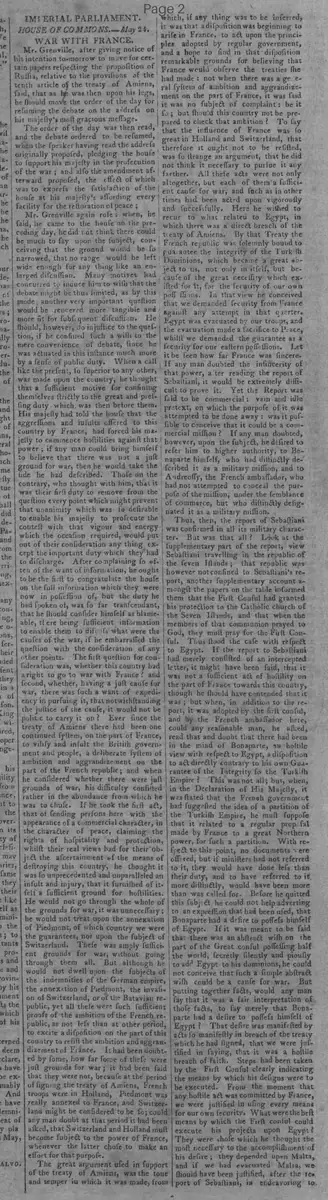
HOUSE OF COMMONS.—May 24.
WAR WITH FRANCE.
Mr. Grenville, after giving notice of his intention to-morrow to move for certain papers respecting the proposition of Russia, relative to the provisions of the tenth article of the treaty of Amiens, said, that as he was then upon his legs, he should move the order of the day for resuming the debate on the address on his majesty's most gracious message.
The order of the day was then read, and the debate ordered to be resumed, when the Speaker having read the address originally proposed, pledging the house to support his majesty in the prosecution of the war; and also the amendment afterward proposed, the effect of which was to express the satisfaction of the house at his majesty's affording every facility for the restoration of peace;
Mr. Grenville again rose: when, he said, he came to the house on the preceding day, he did not think there could be much to say upon the subject, conceiving that the ground would be so narrowed, that no range would be left wide enough for any thing like an enlarged discussion. Many motives had concurred to induce him to wish that the debate might be thus limited, as by this mode another very important question would be rendered more tangible and more fit for subsequent discussion. He should, however, do injustice to the question, if he confined such a wish to the mere convenience of debate, since he was actuated in this instance much more by a sense of public duty. When a call like the present, so superior to any other, was made upon the country, he thought that a sufficient motive for confining themselves strictly to the great and pressing duty which was then before them. His majesty had told the house that the aggressions and insults offered to this Country by France, had forced his majesty to commence hostilities against that power; if any man could bring himself to believe that there was not a just ground for war, then he would take the side he had described. Those on the contrary, who thought with him, that it was their first duty to remove from the question every point which might prevent that unanimity which was so desirable to enable his majesty to prosecute the contest with that vigour and energy which the occasion required, would put out of their consideration any thing except the important duty which they had to discharge. After complaining so often of the want of information, he ought to be the first to congratulate the house on the full information which they were now in possession of, but the duty he had spoken of, was so far transcendent, that he should consider himself as blameable, there being sufficient information to enable them to discern what were the causes of the war, if he embarrassed the question with the consideration of any other points. The first question for consideration was, whether this country had a right to go to war with France? and second, whether, having a just cause for war, there was such a want of expediency in pursuing it, that notwithstanding the justice of the cause, it would not be politic to carry it on? Ever since the treaty of Amiens there had been one continued system, on the part of France, to vilify and insult the British government and people, a deliberate system of ambition and aggrandizement on the part of the French republic; and when he considered whether there were just grounds of war, his difficulty consisted rather in the abundance from which he was to choose. If he took the first act, that of sending persons here with the appearance of a Commercial character, in the character of peace, claiming the rights of hospitality and protection, whilst their real views had for their object the ascertainment of the means of destroying this country, he thought it was so unprecedented and unparalleled an insult and injury, that it furnished of itself a sufficient ground for hostilities. He would not go through the whole of the grounds for war, it was unnecessary; he would not treat upon the annexation of Piedmont, of which country we were the guarantees, nor upon the subject of Switzerland. These was amply sufficient grounds for war, without going through them all. But although he would not dwell upon the subjects of the indemnities of the German empire, the annexation of Piedmont, the invasion of Switzerland, or of the Batavian republic, yet all these were such sufficient such proofs of the ambition of the French republic, as not less than at other period, to excite a disposition on the part of this country to resist the ambition and aggrandizement of France. It had been doubted by some, how far some of these were just grounds for war; it had been said that they were not, because at the period of signing the treaty of Amiens, French troops were in Holland, Piedmont was really annexed to France, and Switzerland might be considered to be so; could of any man doubt at that period it had been a asked, that Switzerland and Holland must y, become subject to the power of France, whenever the latter chose to make an effort for that purpose.
The great argument used in support of the treaty of Amiens, was the tone and temper in which it was made, from which, if any thing was to be inferred, it was that a disposition was beginning to arise in France, to act upon the principles adopted by regular government, and a hope to find in that disposition remarkable grounds for believing that France would observe the treaties they had made : not when there was a general system of ambition and aggrandizement on the part of France, it was said it was no subject of complaint: be it so ; but should this country not be prepared to check that ambition ? To say that the influence of France was so great in Holland and Switzerland, that therefore it ought not to be resisted, was so strange an argument, that he did not think it necessary to pursue it any farther. All these acts were not only altogether, but each of them a sufficient cause for war, and such as in other times had been acted upon vigorously and successfully. Here he wished to recur to what related to Egypt, in which there was a direct breach of the treaty of Amiens. By that Treaty the French republic was solemnly bound to guarantee the integrity of the Turkish Dominions, which became a great object to us, not only in itself, but because of the great necessity which existed for it, for the security of, our own possessions. In that view he conceived that we demanded security from France against any attempt in that quarter. Egypt was evacuated by our troops, and the evacuation made a sacrifice to Peace, whilst we demanded the guarantee as a security for our eastern possessions. Let it be seen how far France was sincere. If any man doubted the insincerity of that power, after reading the report of Sebastiani, it would be extremely difficult to prove it. Yet the Report was said to be commercial: vain and idle pretext, on which the purpose of it was attempted to be done away : was it possible to conceive that it could be a commercial mission ? If any man doubted, however, upon the subject, he desired to refer him to higher authority, to Bonaparte himself, who had distinctly described it as a military mission, and to Andreossi, the French ambassador, who had not attempted to conceal the purpose of the mission, under the semblance of commerce, but who distinctly designated it as a military mission.
Thus, then, the report of Sebastiani was confirmed in all its military character. But was that all? Look at the supplementary part of the report, view Sebastiani travelling in the republic of the seven Islands ; that republic was however not confined to Sebastiani's report, another supplementary account among the papers on the table informed them that the First Consul had granted his protection to the Catholic church of the Seven Islands, and that when the members of that communion prayed to God, they must pray for the First Consul. Thus stood the case with respect to Egypt. If the report to Sebastiani had merely consisted of an intercepted letter, it might have been said, that it was not a sufficient act of hostility on the part of France towards this country, though he should have contended that it was ; but when, in addition to the report, it was adopted by the first consul, and by the French ambassador here, could any reasonable man, he asked, read that and doubt that there had been in the mind of Bonaparte, an hostile view with respect to Egypt, a disposition to act directly contrary to his own Guarantee of the Integrity of the Turkish Empire? This was not all; but, when, in the Declaration of His Majesty, it was stated that the French government had suggested the idea of a partition of the Turkish Empire, he must suppose that it related to a regular proposal made by France to a great Northern power, for such a partition. With respect to this point, no documents were offered, but if ministers had not referred to it, they would have done less than their duty, and to have referred to it more distinctly, would have been more than was called for. Before he quitted this subject, he could not help adverting to an expression that had been used, that Bonaparte had a desire to possess himself of Egypt. If it was meant to be said that there was an abstract wish on the part of the Great consul possessing half the world, secretly silently and piously to add Egypt to his dominions, he could not conceive that such a simple abstract wish could be a cause for war. But putting together facts, would any man say that it was a fair interpretation of those facts, to say merely that Bonaparte had a desire to possess himself of Egypt ? That desire was manifested by acts so manifestly in breach of the treaty which he had signed, that we were justified in saying, that it was a hostile breach of faith. Steps had been taken by the First Consul clearly indicating the means by which his designs were to be executed. From the moment that any hostile act was committed by France, we were justified in using every means for our own security. What were the best means by which the First consul could execute his projects upon Egypt? They were those which he thought the most necessary to the accomplishment of his desire; they depended upon Malta, and if we had evacuated Malta, we should have been justified, after the report of Sebastiani, in endeavoring to
retake it. Would any man, ay, that if it was just to retake it, it was not also just to retain it when it was already in our possession? He could not see the least difference between our retaining Malta, if France committed a breach of faith, and our right of possessing ourselves of it again after a breach of the treaty of Amiens, and having previously given it up.
In this view of the subject, he was not one of those who would go into a minute discussion respecting the 10th Article of the Treaty of Amiens. He would grant, that if the stipulation of the Treaty had been fulfilled, and we had then refused to deliver up Malta, that a breach of that Treaty might have been fairly alleged against us; but it appeared to him that no case had ever been made out by France which gave her a right to demand the evacuation of Malta by us. He really thought that there never was a period of War in which so many and such invincible grounds of War, on the part of this country, were so clearly and distinctly made out, as in the moment when he was addressing the House.
Before he sat down he wished to say a word or two with respect to the question of expediency. It might be said that any sufficient grounds of War might exist, and yet considerations of expediency might render it doubtful whether Parliament should recommend the prosecution of the War; but were there or not any such grounds of expediency at the present moment? If they were to say that such a War at the present moment would not be a dangerous experiment, and that it would not press heavily, in point of expense, upon every man in the Country, they would be deceiving themselves and disguising the truth. But what had they to consider: he lamented that their voice upon this occasion would only be a choice of great evils. Before, however, they agreed to a change for War, they were to consider what they would lose. Was it Peace that they would lose? Would any man say, that it was a change from a state of unequal Truce to a state of equal War.
They must look danger courageously in the face, and hope with confidence for a glorious result. Did they sacrifice by such a change, that which was valuable or even tolerable?
Without entering into the consideration of the conduct of his Majesty's Ministers, he would ask, whether if the wisest men in the country, who was at the head of affairs, if it were possible that they would have suffered the last two months of protracted negotiation, during which we experienced not a peace but a truce, in which we disarmed while the enemy armed, in which we were called upon to give up our conquest, whilst the enemy was pursuing a system of aggrandizement, and completing their military preparations, to be afterwards carried into effect against this country? Was it to be said, that we were to wait till they had completed all their arrangements and were we to be taught to believe, that we were to wait patiently the event of the attack, and not to take those means which we were called upon by God and man to take for our own security? It might be said, that even at the moment of the present discussion, we had gained an advantage of great moment, since the great and mighty Republic of France, had thought it to abandon a great acquisition, namely, that of Louisiana. It might be asked, was not that a fresh indication of a pacific spirit? but he could not conceive that any one would be so childish as to ask such a question, What was the cause of it, the War? However paradoxical it might seem, he considered that cession as a fresh indication of a hostile mind on the part of France. It was evident, in his opinion, that it was the object of France, in this cession, to do away one enemy more, and to endeavour to prevent an alliance between the United States and this country. It had been said that we were without allies: he did not see any occasion for treating our former Continental Alliances so lightly as they had been treated. But however we might be without allies, to those countries with whom we might wish to ally ourselves, it would not be unimportant to show our readiness to repel a danger which was common to all, to show our disposition courageously to meet the difficulties which presented themselves, and bravely to overcome them. He would say a few words with respect to the amendment: it appeared to him that there was no duty more incumbent upon them, when representing the spirit and sense of the country upon the present occasion, than that they should speak with an unanimous voice. There was no sacrifice which he would not make, consistent with conscience and honour, to obtain that unanimity. If then he saw in the amendment no material difference, must he not complain, that without any essential difference, it should have the effect of weakening that unanimity? Though there was not one word in that amendment that he would not willingly subscribe to, yet he could not but lament that it would have the effect of preventing Parliament from speaking with an unanimous voice. The country was placed in a very arduous situation, but he was confident that the spirit of Englishmen were amply sufficient to encounter successfully
that there would be found means, and mind, and spirit to meet the contest in which we were engaged. If the country was true to itself, and Parliament was true to the country, there need be no fear for the issue of that contest.
[Debate to be continued.]
What sub-type of article is it?
What keywords are associated?
What entities or persons were involved?
Where did it happen?
Foreign News Details
Primary Location
France
Event Date
May 24
Key Persons
Event Details
Mr. Grenville defends the British decision to go to war with France, citing French aggressions including breaches of the Treaty of Amiens, the military mission of Sebastiani to Egypt, threats to Turkish dominions, retention of Malta, annexations in Europe, and French cession of Louisiana as hostile intent.