Thank you for visiting SNEWPapers!
Sign up free
Richmond Daily Times
Richmond, Virginia
What is this article about?
President Millard Fillmore delivers an emotional homecoming speech in his native city, thanking citizens for their warm welcome, reflecting on his rise from humble beginnings, expressing hope to retire there, and defending his administration's efforts to preserve the Union and enforce laws against foreign aggression like the Cuba invasion.
Clipping
OCR Quality
Full Text
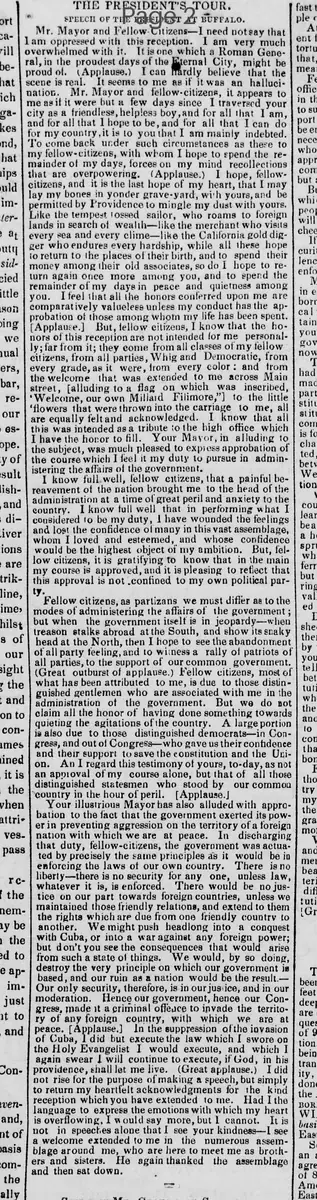
I know full well, fellow citizens, that a painful bereavement of the nation brought me to the head of the administration at a time of great peril and anxiety to the country. I know full well that in performing what I considered to be my duty, I have wounded the feelings and lost the confidence of many in this vast assemblage, whom I loved and esteemed, and whose confidence would be the highest object of my ambition. But, fellow citizens, it is gratifying to know that in the main my course is approved, and it is pleasing to reflect that this approval is not confined to my own political party
Fellow citizens, as partizans we must differ as to the modes of administering the affairs of the government; but when the government itself is in jeopardy—when treason stalks abroad at the South, and show its snaky head at the North, then I hope to see the abandonment of all party feeling, and to witness a rally of patriots of all parties, to the support of our common government. (Great outburst of applause.) Fellow citizens, most of what has been attributed to me, is due to those distinguished gentlemen who are associated with me in the administration of the government. But we do not claim all the honor of having done something towards quieting the agitations of the country. A large portion is also due to those distinguished democrats—in Congress, and out of Congress—who gave us their confidence and their support to save the constitution and the Union. And I regard this testimony of yours, to-day, as not an approval of my course alone, but that of all those distinguished statesmen who stood by our common country in the hour of peril. [Applause.]
Your illustrious Mayor has also alluded with approbation to the fact that the government exerted its power in preventing aggression on the territory of a foreign nation with which we are at peace. In discharging that duty, fellow-citizens, the government was actuated by precisely the same principles as it would be in enforcing the laws of our own country. There is no liberty—there is no security for any one, unless law, whatever it is, is enforced. There would be no justice on our part towards foreign countries, unless we maintained those friendly relations, and extend to them the rights which are due from one friendly country to another. We might push headlong into a conquest with Cuba, or into a war against any foreign power; but don't you see the consequences that would arise from such a state of things. We would, by so doing, destroy the very principle on which our government is based, and our ruin as a nation would be the result.— Our only security, therefore, is in our justice, and in our moderation. Hence our government, hence our Congress, made it a criminal offence to invade the territory of any foreign country, with which we are at peace. [Applause.] In the suppression of the invasion of Cuba, I did but execute the law which I swore on the Holy Evangelist I would execute, and which I again swear I will continue to execute, if God, in his providence, shall let me live. (Great applause.) I did not rise for the purpose of making a speech, but simply to return my heartfelt acknowledgments for the kind reception which you have extended to me. Had I the language to express the emotions with which my heart is overflowing, I would say more, but I cannot. It is not in speeches alone that I see your kindness—I see a welcome extended to me in the numerous assemblage around me, who are here to meet me as brothers and sisters. He again thanked the assemblage and then sat down.
What sub-type of article is it?
What themes does it cover?
What keywords are associated?
What entities or persons were involved?
Where did it happen?
Story Details
Key Persons
Location
Buffalo, New York
Story Details
In a heartfelt speech, President Fillmore thanks his hometown citizens for their bipartisan welcome, reflects on his journey from a poor boy to the presidency following national bereavement, expresses desire to retire among them under Providence, credits associates and Democrats for preserving the Union against treason, and affirms commitment to enforcing laws against foreign invasions like Cuba to maintain justice and national security.