Thank you for visiting SNEWPapers!
Sign up free
Jenks's Portland Gazette
Portland, Cumberland County, Maine
What is this article about?
A French report details efforts in February 1802 to reconcile Toussaint Louverture with colonial authorities in St. Domingo using his sons as intermediaries. Toussaint receives a praising letter from Bonaparte but faces threats and eventual betrayal, leading to his arrest and chains, as criticized in an American newspaper.
Clipping
OCR Quality
Full Text
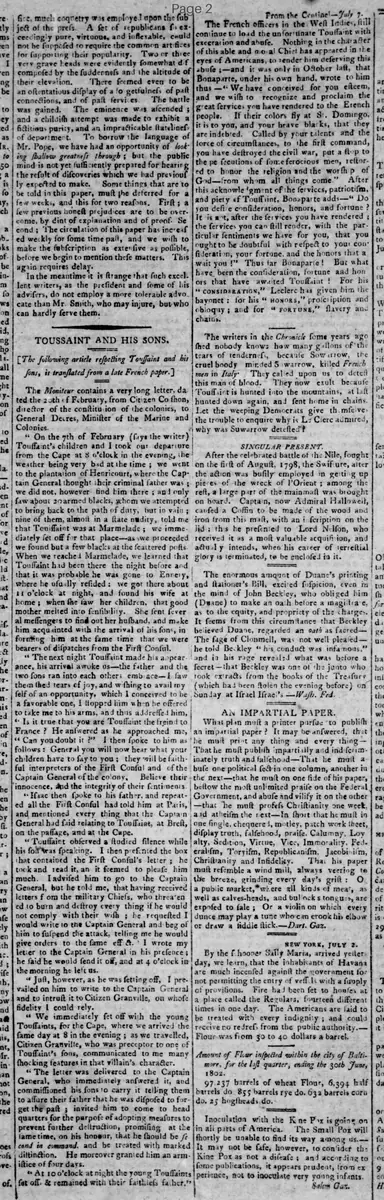
[The following article respecting Toussaint and his sons, is translated from a late French paper.]
The Moniteur contains a very long letter, dated the 20th of February, from Citizen Rochon, director of the constitution of the colonies, to General Decres, Minister of the Marine and Colonies.
"On the 7th of February (says the writer) Toussaint's children and I took our departure from the Cape at 8 o'clock in the evening, the weather being very bad at the time; we went to the plantation of Henricourt, where the Captain General thought their criminal father was; we did not, however find him there; and only saw about 20 armed blacks, whom we attempted to bring back to the path of duty, but in vain; nine of them, almost in a state nudity, told me that Toussaint was at Marmelade; we immediately set off for that place—as we proceeded we found but a few blacks at the scattered posts. When we reached Marmelade, we learned that Toussaint had been there the night before and that it was probable he was gone to Ennery, where he usually resided: we got there about 11 o'clock at night, and found his wife at home; when she saw her children, that good mother melted into sensibility. She sent several messengers to find out her husband, and make him acquainted with the arrival of his sons, informing him at the same time that we were bearers of dispatches from the First Consul.
"The next night Toussaint made his appearance, his arrival awoke us—the father and the two sons ran into each other; embrace—I saw them shed tears of joy, and wishing to avail myself of an opportunity, which I conceived to be a favorable one, I stopped him when he offered to take me to his arms, and thus addressed him,
"Is it true that you are Toussaint the friend to France? He answered as he approached me, "Can you doubt it?" I then spoke to him as follows: General you will now hear what your children have to say to you; they will be faithful interpreters of the First Consul and of the Captain General of the colony, Believe their innocence, and the integrity of their sentiments.
"Isaac then spoke to his father, and repeated all the First Consul had told him at Paris, and mentioned every thing that the Captain General had said relating to Toussaint, at Brest, on the passage, and at the Cape.
"Toussaint observed a studied silence while his son was speaking. I then presented the box that contained the First Consul's letter: he took and read it, and it seemed to please him much. I advised him to go to the Captain General, but he told me, that having received letters from the military Chiefs, who threatened to burn and destroy every thing if he would not comply with their wish; he requested I would write to the Captain General and beg of him to suspend the attack, telling me he would give orders to the same effect. I wrote my letter to the Captain General in his presence; he said he would send it off, and at 4 o'clock in the morning he left us.
"Just, however, as he was setting off, I prevailed on him to write to the Captain General and to intrust it to Citizen Granville, on whose fidelity I could rely.
"We immediately set off with the young Toussaints, for the Cape, where we arrived the same day at 8 in the evening; as we travelled, Citizen Granville, who was preceptor to one of Toussaint's sons, communicated to me many shocking features in that villain's character.
"The letter was delivered to the Captain General, who immediately answered it, and commissioned his sons to carry it telling them to assure their father that he was disposed to forget the past; invited him to come to head quarters for the purpose of adopting measures to prevent further destruction, promising at the same time, on his honour, that he should be second in command, and be treated with marked distinction. He moreover granted him an armistice of four days.
"At 10 o'clock at night the young Toussaints set off, & remained with their faithless father."
From the Centinel—July 7.
The French officers in the West Indies, still continue to load the unfortunate Toussaint with execration and abuse. Nothing in the character of this able and moral Chief has appeared in the eyes of Americans, to render him deserving this abuse;—and it was only in October last, that Bonaparte, under his own hand, wrote to him thus—"We have conceived for you esteem, and we wish to recognize and proclaim the great services you have rendered to the French people. If their colors fly at St. Domingo, it is to you, and your brave blacks, that they are indebted. Called by your talents and the force of circumstances, to the first command, you have destroyed the civil war, put a stop to the persecutions of one ferocious men, restored to honor the religion and the worship of God—from whom all things come." After this acknowledgment of the services, patriotism, and piety of Toussaint, Bonaparte adds—"Do you desire consideration, honors, and fortune? It is right, after the services you have rendered; the services you can still render, with the particular sentiments we have for you, that you ought to be doubtful with respect to your consideration, your fortune, and the honors that await you!" Thus far Bonaparte! But what have been the consideration, fortune and honors that have awaited Toussaint! For his "consideration," Leclerc has given him the bayonet: for his "Honors," proscription and obloquy: and for "fortune," slavery and chains.
What sub-type of article is it?
What keywords are associated?
What entities or persons were involved?
Where did it happen?
Foreign News Details
Primary Location
St. Domingo
Event Date
7th 8th Of February 1802
Key Persons
Outcome
armistice of four days granted; toussaint invited to headquarters with promise of second in command and distinction; ultimately betrayed, arrested, and imprisoned in chains.
Event Details
Citizen Rochon and Toussaint's sons travel to find Toussaint in St. Domingo, deliver dispatches and a letter from the First Consul praising his services. Toussaint reunites with sons, requests suspension of attacks due to threats from military chiefs. Captain General offers reconciliation and armistice, but Toussaint is later captured and treated harshly despite Bonaparte's earlier esteem.